
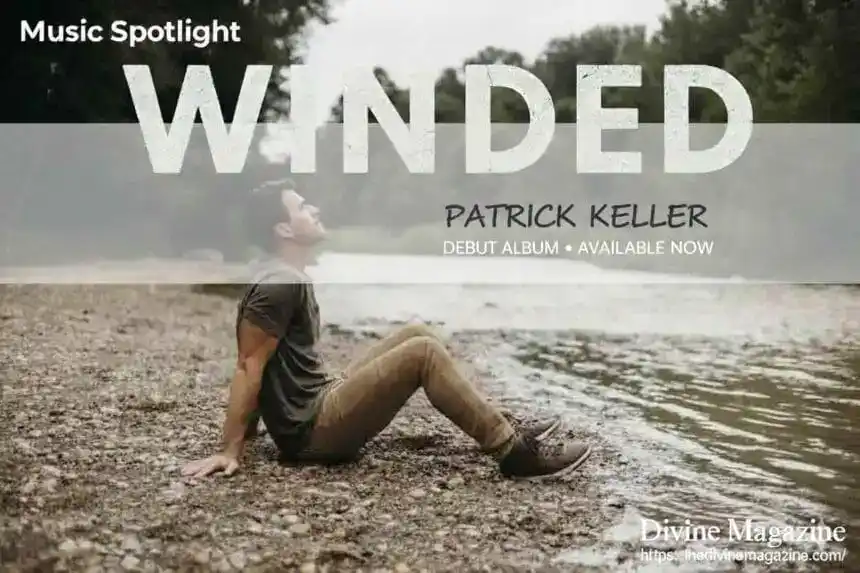
Life often oscillates between chaos and calm without warning, leaving us breathless in its wake. It is within this delicate tension between beauty and brokenness that US singer-songwriter Patrick Keller finds his voice in his soul-stirring debut album, Winded. Released on November 7th, this 11-track collection is an intimate exploration of resilience and rediscovery, marking Keller’s powerful return to music after years away from the recording studio.
Blending alternative and folk influences with raw acoustic textures and cinematic layering, Winded is a deeply personal project entirely performed and produced by Keller himself. Drawing inspiration from the likes of Ruston Kelly and Counting Crows, Keller turns quiet reflection into cathartic release, offering a sanctuary for listeners navigating their own seasons of grief and hope. As Keller notes, the album serves as a reminder that “strength doesn’t always look like standing tall; sometimes, it’s simply choosing to stand at all.”

Winded is such an intimate and introspective debut. When did the first spark for this album appear, and at what point did you realize it was becoming a full 11-track project rather than just a few songs?
Thanks, that really wasn’t the intention, but it really naturally formed that way. Life was really quite strange and challenging but also a really big teacher in the last year. So my story kind of came out in the songs. I knew I wanted to do a full album after I had written “Always in the Room”. It started with just getting back to music again, and then I wrote AITR, and then it became clear I had a bigger story to tell.
You’ve described Winded as exploring “the tension between beauty and brokenness.” Can you share a specific moment or season in your life that shaped that theme most clearly?
I think I would be comfortable talking about it as a season. There were some moments in my life where I was truly taken aback in 2024 in 2025. When I didn’t know what was next each day. When I did feel broken and lost. Lots of those moments, actually. Months and months of feeling that way. And although not out of the woods, I found that there was some beauty in the past, and beauty in learning and growing through it all.
More Read

After years away from recording, what pulled you back to music—and what felt different about returning this time?
Those moments. Really, just that. I felt the need to share and also help people that were in similar positions relate.
Almost every instrument and layer on Winded is performed and produced by you. What made you decide to take such a hands-on, solitary approach to the record?
It just felt like something I needed to do. I needed to “do the work.” It was almost like all the different parts of me were able to express themselves in the album playing most of the instruments. It challenged me and helped me grow in a season that I needed to, and still need to grow in.
The album moves between raw acoustic textures, ambient rock tones, and cinematic layering. How did you find the right sonic balance to match the emotional weight of these songs?
That’s a crazy good question. I think again; it just felt right. I wanted it to feel like a story, like something someone could sit and hear from start to finish, and ride the waves with me. And that sonic balance had to hold true throughout the record.
“Where Silence Feels Safer” and “Mountains” are standout tracks that hold both grief and hope. Can you walk us through the stories or images behind those songs?
Well, again, for now I think I would just paint a picture that there were points in my life over the last few years that I would feel hope for something, only to fall off the mountain. But I chose to keep climbing because I knew I could hit the summit again. And with “Where Silence Feels Safer,” that song probably meant the most to me. It truly was me making a statement that I won’t stay in a place any longer where silence feels safer than being me. Or where you can’t trust the ground you’re standing on not to break beneath you. And I think others could relate to that.

You’ve cited Ruston Kelly, Augustana, Counting Crows, and Dave Matthews as influences. Where do you hear their fingerprints on Winded, and where do you feel you’ve carved out something distinctly your own?
I think Augustana’s music probably sounds the most similar. Strong ballads, patterns you can rely on, and lyrics that carry you like climbing up and down a mountain. Ruston is probably my favorite artist, and the tension in his music with his life journey means so much to me, and I felt there were some similarities there. And Dave, well, I’m nowhere near him in talent, but he is probably the artist I would say has influenced me the longest, although I don’t listen much but still won’t miss his shows.
You’ve said that music helps you process things and brings you purpose and peace. What does your writing process look like when you’re working through something heavy—do you start with lyrics, melody, or just sitting with a feeling?
Something heavy—most always I start with the lyrics, then bring the melody to match.
The album lives in that space between being “winded” by life and finding the breath to begin again. Was there a particular song that was the hardest to write emotionally—and one that felt the most healing?
Where Silence Feels Safer was the hardest to write, for sure. But the most necessary. I think the most healing song might have been I Believe in You or Mountains. Messages of hope that you will climb out of whatever hard thing you are in.
Strength in Winded doesn’t always look like standing tall; sometimes it’s simply choosing to stand at all. How has your personal definition of strength changed over the years?
I think things people often perceive as strong are actually REALLY weak. Being vulnerable, admitting your mistakes, and sharing that you are conflicted is actual strength.
Whether you’re playing solo or with a full band, your music invites listeners into a very honest space. How do you create that sense of safety and authenticity in a live setting?
I think again, just being vulnerable and sharing your story. Allowing your emotion to come through. Everyone can really relate to that. Also, giving each song the space to do its “work” without rushing through it or pushing a message.
You’ve said, “I want people to feel heard… we’re all going through something.” What do you hope someone sitting alone with headphones on, listening to Winded front to back, walks away feeling?
That they aren’t alone in struggles. That they should be who they want to be and share what they need to share. Oftentimes we have these external pressures to be something we aren’t—and all that does is create internal wounds because we are literally destroying the fabric of ourselves.
Looking ahead, has making Winded changed how you see your future as an artist? Are there new sounds, collaborations, or stories you’re excited to explore next There are so many things I want to do next. I want to lean more into the acoustic and ambient textures. I want to tell more of this story. I am working on new music as we speak. More to come!