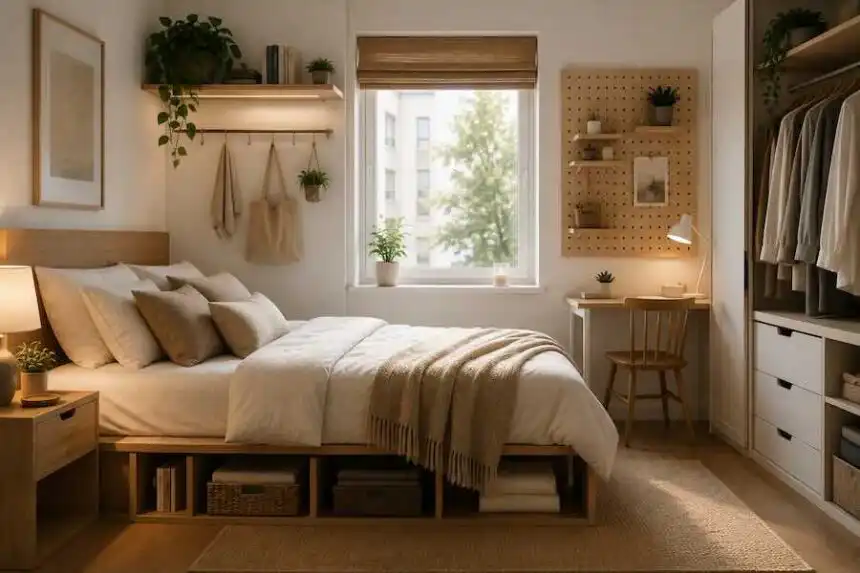
A tidy bedroom changes the way a space feels before you have moved a single decorative object. Clear floor space, an uncluttered bedside surface, softly folded bedding and somewhere sensible for everyday belongings can make even a compact room feel calmer.
- Start With Less, Not More
- Design Around the Person Who Sleeps There
- Let the Bedside Table Work Harder
- Look Up When the Floor Is Full
- A Pegboard Can Change With the Room
- There Is Useful Space Beneath the Bed
- Leave a Little Empty Space
- The Fifteen-Minute Reset
- A Bedroom That Feels Quiet
- FAQ: Keeping a Small Bedroom Tidy
The good news is that square footage is not everything. In a small bedroom, thoughtful furniture placement and storage often matter more than size. Instead of trying to squeeze another cabinet into the room, look closely at the spaces already available: beneath the bed, beside it, behind a door and across an empty section of wall.
The aim is not a bedroom that looks permanently staged. It is a room that can return to order quickly after an ordinary day.
Start With Less, Not More
Minimalism works particularly well in a small bedroom, but that does not mean stripping the room of personality. It means giving each piece of furniture a reason to occupy valuable floor space.
Begin with the essentials: the bed, clothing storage and whatever you genuinely use every day. A desk might be indispensable if the bedroom doubles as a workspace. For somebody else, removing that same desk could immediately make the room more comfortable.
Before buying anything new, ask a simple question: does this object solve a problem the room actually has?
Design Around the Person Who Sleeps There
Bedrooms should respond to routines rather than decorating formulas. If you read at night, accessible lighting and a surface beside the bed matter. If clothes regularly accumulate on a chair, the room probably needs a more convenient hanging solution rather than another lecture about tidiness.
The same principle applies to the bed itself. Mattress dimensions should suit the sleeper while leaving enough circulation space around the room. Comfort requirements are personal, so compare construction, firmness, dimensions and trial policies carefully rather than choosing by appearance alone. The original article references iSense as one option for researching adjustable sleep systems.
Once the essentials reflect the way you actually live, keeping the room organized becomes considerably easier.

Let the Bedside Table Work Harder
A conventional bedside table gives you somewhere for a lamp and a glass of water. A compact chest of drawers does the same job while quietly hiding considerably more.
That small change illustrates one of the most useful rules for compact bedrooms: whenever possible, choose furniture capable of performing two functions. A storage bench can provide seating. An ottoman can conceal spare bedding. A desk with drawers can replace a separate cabinet.
Fewer individual pieces also create cleaner sightlines, which can make the room feel less crowded.
Look Up When the Floor Is Full
Walls are often the largest unused storage surface in a small bedroom.
A shallow shelf can hold books, accessories or neatly arranged storage boxes without consuming floor space. Add a rail or hooks beneath it and the same section of wall can accommodate tomorrow’s clothes, bags or frequently worn pieces.
Keep the arrangement restrained. Vertical storage is useful precisely because it removes visual noise from the floor; covering every wall with belongings simply moves the clutter upward.
A Pegboard Can Change With the Room
For belongings that change frequently, a pegboard offers more flexibility than fixed shelving. Hooks, miniature shelves and containers can be rearranged as your needs change.
Use one above a desk for stationery and headphones, near a wardrobe for accessories, or as a compact display for objects you actually enjoy seeing. Keeping its palette close to the wall color creates a quieter architectural effect, while natural plywood introduces warmth and texture.
There Is Useful Space Beneath the Bed
The area beneath a bed can hold a surprising amount without changing the visual character of the room. Low storage boxes, purpose-built drawers or a bed frame with integrated compartments work particularly well for spare linens, seasonal clothing and items that are not needed every morning.
The important distinction is between storage and hiding clutter. Use containers that can be pulled out easily and group similar belongings together. If retrieving one sweater requires emptying half the room, the system is unlikely to survive everyday life.
When updating the bed itself, simple bedding can reinforce the sense of order. Neutral or tonal sheets reduce visual interruption, while texture from linen, cotton or a woven throw keeps the room from feeling sterile.
Leave a Little Empty Space
This is the part that storage advice sometimes misses. Not every shelf needs filling.
A clear section of wall, an almost-empty bedside surface or visible floor around the bed gives the eye somewhere to rest. In a compact room, that negative space can be as important as the furniture itself.
It also leaves room for life. A book placed beside the bed or yesterday’s sweater does not immediately make the entire bedroom appear chaotic.
The Fifteen-Minute Reset
No storage system can keep a bedroom tidy without a small amount of maintenance. Fortunately, the routine does not need to become another project.
Spend a few minutes returning clothes to the wardrobe, clearing the bedside surface, making the bed and putting stray objects back where they belong. Doing this regularly is usually easier than allowing a week’s worth of clutter to accumulate and sacrificing an afternoon to fixing it.
A useful test of the room’s organization is whether this reset feels easy. If it repeatedly takes too long, the problem may not be your cleaning habits. You may own too much for the available storage, or the storage may simply be in the wrong place.
A Bedroom That Feels Quiet
The most successful small bedrooms are not necessarily immaculate. They simply have rhythm: somewhere for clothes, somewhere for books, clear paths around the furniture and enough breathing room that the eye is not constantly searching for order.
Start by removing what the room does not need. Then make the furniture work harder, use vertical and under-bed space intelligently, and finish with a short daily reset. The result is less about perfection than ease — opening the bedroom door at the end of the day and finding a space that feels settled.
FAQ: Keeping a Small Bedroom Tidy
How can I make a small bedroom look less cluttered?
Reduce the number of freestanding objects, keep frequently used belongings within easy reach and use concealed storage for visually busy items. Leaving some surfaces deliberately empty also makes a noticeable difference.
What furniture works best in a small bedroom?
Prioritize appropriately scaled pieces with more than one function. Beds with storage, compact drawer units used as bedside tables, storage benches and desks with integrated drawers can reduce the total amount of furniture required.
How should I organize a bedroom without much closet space?
Combine wall-mounted shelves, hooks or rails with under-bed storage. Keep everyday clothing easiest to reach and move seasonal pieces into less accessible storage until they are needed.
How often should I tidy my bedroom?
A short daily reset can prevent clutter from becoming a larger job. Clothes, bedside items and visible surfaces usually provide the highest-impact places to start.