

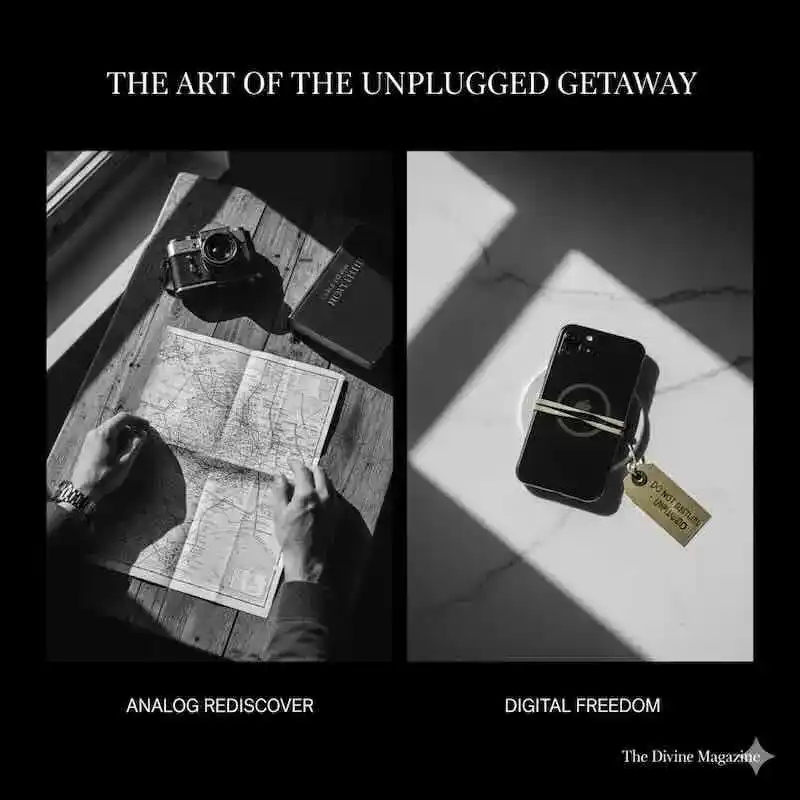
In 2026, the ultimate luxury isn’t a faster connection—it’s the freedom to disconnect entirely. As our lives become increasingly entwined with the digital world, the “Phone-Free Vacation” has evolved from a niche challenge into a necessary ritual for mental restoration.
Stepping away from the “glow” allows your nervous system to reset, your attention span to heal, and your memories to be recorded in your heart rather than just your cloud storage. Here is your architectural blueprint for a successful digital detox.
1. The Pre-Trip “Protocol”
A phone-free trip fails when you aren’t prepared for the logistical void. You must build an analog safety net before you depart.
- Inform Your Circle: Send a final message to family and close friends with your itinerary and the landline number of your accommodation.
- Set the “Prestige” OOO: Your out-of-office reply shouldn’t just say you’re away; it should state you are offline. This manages expectations and prevents the “ping” anxiety.
- The Paper Trail: Print your boarding passes, hotel confirmations, and a few physical maps of your destination. There is a tactile joy in unfolding a map that GPS simply cannot replicate.
2. Transitioning to Analog Tools
To replace the Swiss Army Knife in your pocket, you’ll need to rediscover the beauty of single-use objects.
- Navigation: Use physical guidebooks like Lonely Planet or download offline maps on a dedicated GPS device or a tablet that you keep tucked away for emergencies only.
- Photography: Carry a standalone digital camera or, for a truly nostalgic experience, a 35mm film camera. This forces you to be intentional with every shot; rather than mindlessly snapping hundreds of photos you’ll never look at.
- Timekeeping: Wear a classic wristwatch. Checking your phone “just for the time” is the primary gateway to a 20-minute social media scroll.
3. Navigating the “Withdrawal” Phase
On day one or two, you will likely experience “phantom vibration syndrome”—the sensation that your phone is buzzing in your empty pocket.
- Lean into the Boredom: Boredom is the precursor to creativity. Use those “in-between” moments at cafes or train stations to people-watch, sketch, or simply breathe.
- The Morning Ritual: Without a morning scroll, your day starts with the environment, not the internet. Listen to the local sounds; notice the light in your room.
“A VACATION WITHOUT A SCREEN IS NOT A VACATION FROM THE WORLD; IT IS A RE-ENTRY INTO IT.”
| Feature | Digital Vacation | Phone-Free Vacation |
| Navigation | Google Maps (Passive) | Paper Maps/Intuition (Active) |
| Memories | 500+ Digital Files | 24 Intentional Film Frames |
| Presence | Splintered Attention | Deep Immersion |
| Social | “Posting” the Experience | “Living” the Experience |
| Sleep | Blue Light Disruption | Natural Circadian Rhythm |
FAQ: The Offline Experience
Q: What if there is an emergency? A: If you aren’t comfortable leaving the phone at home, place it in “Airplane Mode,” wrap it in a rubber band, and put it at the bottom of your suitcase. It is there if you truly need it, but not accessible for casual use.

Q: How do I get around without Uber or Grab? A: Relearn the art of the taxi hail or the public transit kiosk. If you’re in a city, hotel concierges are an invaluable (and human) resource for local transport.
Q: Won’t I get bored on long flights or train rides? A: This is the perfect time for a “must read” physical book. You’ll find that without the option of a screen, you can finish an entire novel in a single trip.
Conclusion
Taking a phone-free vacation in 2026 is a radical act of self-care. It challenges the modern myth that we must be “available” at all times. By choosing to be unreachable, you become fully reachable to yourself and the people physically standing next to you. The world doesn’t stop when you turn off your phone; in fact, that’s usually when it truly begins to appear.
Are you brave enough to leave the charger behind on your next trip? Tell us your “unplugged” plan in the comments.