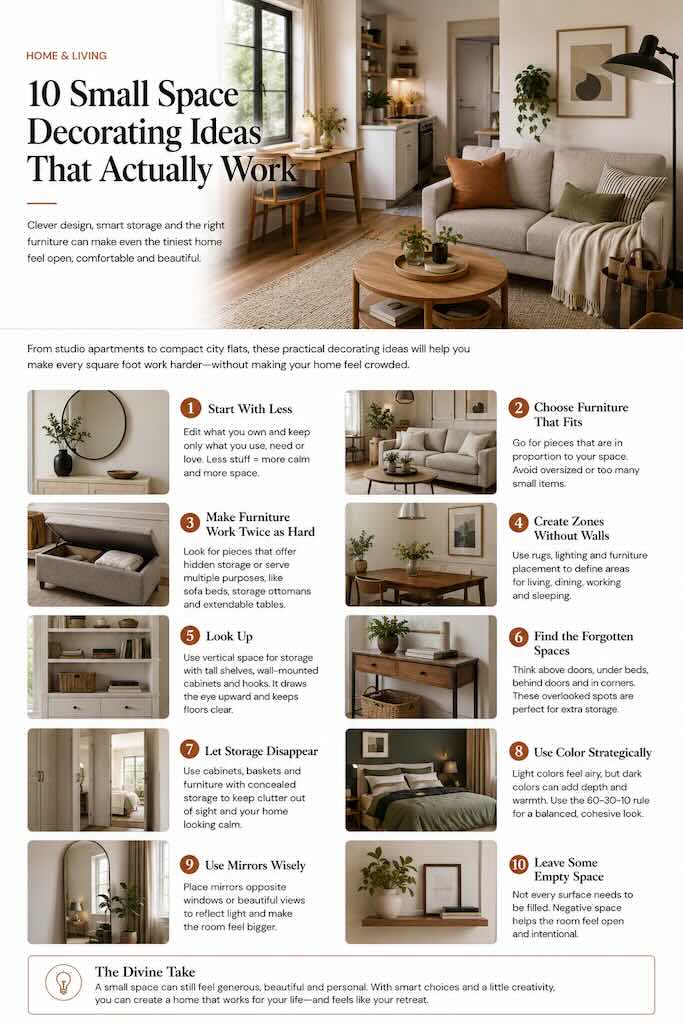
Small-space living does not have to mean sacrificing comfort, personality, or good design. In fact, a compact home can feel more intentional than a much larger one when every piece of furniture, every surface, and every corner has a purpose.
- Start With Less, Not More
- Choose Furniture That Fits the Room
- Make Furniture Work Twice as Hard
- Use the Two-Thirds Rule for Better Proportions
- Look Up: Your Walls Are Valuable Space
- Create Zones Without Building Walls
- Find the Forgotten Spaces
- Let Storage Disappear Into the Room
- Use Color Strategically
- Use Mirrors Where They Can Reflect Something Beautiful
- Leave Some Empty Space
- A Small Home Can Still Feel Generous
- Frequently Asked Questions
The secret is not simply finding ways to squeeze more things into less space. It is creating a home that feels visually calm, functions well, and still reflects how you actually want to live.
Whether you live in a studio apartment, a small city flat, or simply have one room that feels tighter than you would like, these small-space decorating ideas can help you make every square foot work harder without making your home feel crowded.
Start With Less, Not More
Before buying storage baskets, shelving units, or space-saving furniture, look carefully at what is already in the room.
Small spaces amplify clutter. A side table covered in objects or an oversized chair that might disappear into a large living room can suddenly dominate a compact apartment.
Rather than trying to organize everything you own, decide what genuinely deserves space in the room. Keep the objects you use, need, or love and give them somewhere intentional to live.
The result is not necessarily minimalism. It is simply a more edited home.
Choose Furniture That Fits the Room
One of the easiest small-space mistakes is assuming that every piece of furniture needs to be tiny. Filling a room with lots of undersized furniture can actually make it feel busier.
Instead, focus on proportion. A comfortable sofa paired with one occasional chair may look calmer than several small chairs squeezed around the room.
Pay particular attention to visual weight. Furniture with exposed legs, slim profiles, and some visible floor underneath tends to feel lighter than bulky pieces that extend all the way to the ground.
Make Furniture Work Twice as Hard
Multifunctional furniture earns its place in a compact home.
An ottoman can provide seating, storage, and a place to set a tray. A bench can work at the dining table and provide hidden storage underneath. A console can become a temporary desk, while a sleeper sofa can turn a living room into an occasional guest room.
The important distinction is to choose pieces you would still want in your home even without the clever feature. Space-saving furniture should make a room look better, not turn it into a collection of gadgets.
Use the Two-Thirds Rule for Better Proportions
Small rooms are particularly sensitive to scale. Furniture that is too large overwhelms the room, while furniture that is too small can make everything feel disconnected.
A useful starting point is the two-thirds rule for furniture. For example, a coffee table often looks most balanced when it is roughly two-thirds the length of the sofa, while artwork can follow a similar relationship to the furniture beneath it.
These proportions are not strict mathematical requirements, but they can help create visual balance when space is limited.
Look Up: Your Walls Are Valuable Space
When floor space disappears, vertical space becomes one of your biggest assets.
Tall bookcases, wall-mounted cabinets, floating shelves, and hooks can provide useful storage without consuming more of the floor. Extending shelving higher up a wall can also draw the eye upward and make the room feel taller.
The same principle works with curtains. Hanging the curtain rod closer to the ceiling rather than immediately above the window can create the impression of greater height.
Create Zones Without Building Walls
A studio or open-plan apartment can quickly feel like one large room containing everything you own. Creating visual zones makes the space feel more organized.
A rug can define the living area. A pendant light can visually anchor a dining table. A narrow console can mark the transition between an entrance and living space. Even turning a sofa so that its back faces another area can create a subtle boundary.
You do not necessarily need screens or room dividers. Often, furniture placement alone is enough.
Find the Forgotten Spaces
Some of the best storage opportunities in a small home are hiding in places that are easy to overlook.
- The wall above a doorway
- The space underneath a bed
- The back of a door
- An empty corner beside a wardrobe
- The wall above a desk or sofa
- The space underneath a bench
Before adding another piece of furniture, look for unused vertical or hidden space that could solve the problem instead.
Let Storage Disappear Into the Room
Storage does not always need to announce itself.
Cabinetry painted the same color as the wall can visually recede. Matching storage boxes create less visual noise than an assortment of containers. Closed cabinets can hide everyday clutter, while open shelves can be reserved for books and objects you actually want to see.
This balance between open and concealed storage is particularly useful in small homes. Too much open shelving can quickly make a compact room feel busy.
Use Color Strategically
White and pale neutrals are popular in small rooms because they reflect light and can create an airy feeling, but that does not mean a compact home has to be completely beige.
Deep greens, warm browns, muted blues, rust, and even near-black shades can work beautifully in smaller rooms when used intentionally.
If you are unsure how to distribute color, the 60-30-10 decorating rule offers a simple starting point: roughly 60% dominant color, 30% secondary color, and 10% accent.
Keeping the overall palette relatively restrained also helps different areas of a small home flow together instead of feeling fragmented.
Use Mirrors Where They Can Reflect Something Beautiful
Mirrors are a classic small-space trick, but placement matters more than simply hanging the largest mirror you can find.
Positioning one opposite or adjacent to a window can bounce daylight deeper into a room. A mirror that reflects artwork, greenery, or an attractive part of the room can also create a stronger sense of depth.
A mirror reflecting a cluttered kitchen counter, on the other hand, simply gives you twice as much visual clutter.
Leave Some Empty Space
Perhaps the most overlooked small-space decorating trick is knowing when to stop.
Not every wall needs artwork. Not every corner needs furniture. Not every shelf needs to be filled.
Negative space gives the eye somewhere to rest and makes the pieces you have chosen feel more deliberate. In a compact room, a little emptiness can be one of the most luxurious design decisions you make.
A Small Home Can Still Feel Generous
The best small spaces do not necessarily look bigger than they really are. They simply feel comfortable, balanced, and easy to live in.
Choose furniture at the right scale, make use of vertical space, hide everyday clutter, and resist the temptation to fill every available surface. When every object has a reason for being there, even a tiny apartment can feel surprisingly generous.
Frequently Asked Questions
How do you make a small room look bigger?
Reduce visual clutter, choose appropriately scaled furniture, expose more of the floor where possible, use vertical storage, and maximize natural light. Mirrors can also create additional depth when positioned thoughtfully.
Should small rooms always be painted white?
No. Light colors can create an airy effect, but darker colors can make a compact room feel intimate and sophisticated. A cohesive palette and good lighting usually matter more than choosing white simply because the room is small.
What furniture works best in a small apartment?
Look for furniture that is correctly proportioned and, where useful, multifunctional. Storage ottomans, benches, extendable tables, sleeper sofas, wall-mounted desks, and furniture with visible legs can all work particularly well.
How can I add storage without making a room feel cluttered?
Use vertical and concealed storage first. Tall cabinets, under-bed drawers, built-ins, floating shelves, and furniture with hidden compartments provide storage without filling the room with additional freestanding pieces.