

A
Witness emotion beyond Earth.
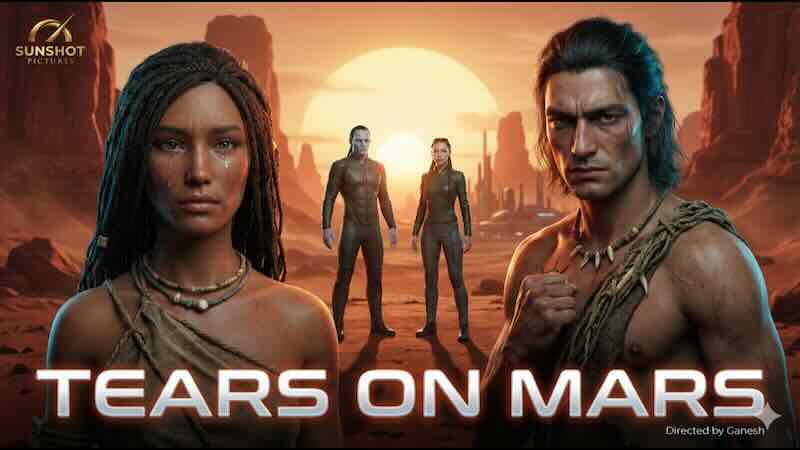
Tears on Mars is an AI-generated sci-fi feature film that explores grief, survival, and war on the red planet—crafted entirely using next-generation generative video technology.
🚀 War begins on Mars — March 2026
In a moment that’s already drawing attention from both the film community and the AI world, Tears on Mars marks another bold step in the evolution of AI-driven cinema. Following the historic breakthrough of The Mission of Death, this new project expands the creative scope of AI filmmaking—moving beyond proof of concept into emotionally rich, large-scale storytelling.
Directed by Ganesh, a CAIS Certified AI Scientist and the creator of the world’s first AI feature film, Tears on Mars shifts the focus from spectacle to human (and non-human) emotion. Set against the harsh landscape of Mars, the story uses loss and conflict as the spark that ignites a full-scale war—one that forever changes those who survive it.

From Technology to Tragedy
While The Mission of Death proved that AI could sustain a full feature film, Tears on Mars asks a deeper question:
Can AI tell stories that truly feel?
Using advanced generative video systems inspired by Veo-class models, the film delivers consistent characters, controlled camera language, and cinematic lighting across long narrative sequences. But its defining trait is emotional weight—quiet moments of grief, restrained dialogue, and visual storytelling that relies on silence as much as action.
The newly released official trailer gives a first glimpse into this world of tension and emotion:
▶️ Watch now: https://youtu.be/cYxlD-zjUDA
A New Kind of Sci-Fi Film
Unlike traditional space epics driven purely by technology or conquest, Tears on Mars blends science fiction with intimate drama. War is not the starting point—it is the consequence.
The project demonstrates how far AI filmmaking has progressed in areas such as:
- Long-form narrative consistency
- Cinematic camera movement and shot grammar
- Emotional facial performance
- High-detail environments and large-scale worldbuilding
- Trailer-grade visuals suitable for 4K presentation
The AI-First Workflow
As with its predecessor, Tears on Mars is created without physical cameras, sets, or actors. Every frame is generated through an AI-first “concept-to-screen” workflow, where storytelling decisions guide technology—not the other way around.
This approach dramatically reduces production barriers, allowing complex sci-fi worlds to be built without traditional constraints of budget, location, or logistics.
What It Means for the Future
Industry observers see Tears on Mars as part of a growing shift in cinema—one where AI is no longer just a tool for effects or automation, but a collaborator in storytelling.
AI-generated filmmaking opens new possibilities:
- Faster creative iteration
- Independent creators competing at cinematic scale
- Stories that would otherwise be impossible to produce
Rather than replacing traditional filmmaking, projects like Tears on Mars suggest a hybrid future—where human imagination leads, and AI expands what is possible.
Looking Ahead
With Tears on Mars, the conversation moves beyond “Can AI make a movie?” to “What kinds of stories can only be told this way?”
As the official trailer sets the stage for its March 2026 release, one thing is clear:
the future of cinema is no longer theoretical.
It is emotional.
It is experimental.
And you can see it unfolding now — on Mars.