Poland rewards travelers who like to move through a city rather than simply observe it. Medieval squares open into café-lined streets, royal architecture sits beside contemporary galleries, and rivers cut through some of the country’s most compelling urban landscapes. For a first visit, Kraków, Warsaw and Wrocław remain three of the strongest places to begin.
Each offers a different version of Poland. Kraków carries the atmosphere of the former royal capital. Warsaw tells a remarkable story of destruction, reconstruction and modern reinvention. Wrocław feels lighter and more playful, shaped by islands, bridges, colorful façades and its famous bronze dwarfs.
Kraków: Poland’s Historic Royal City
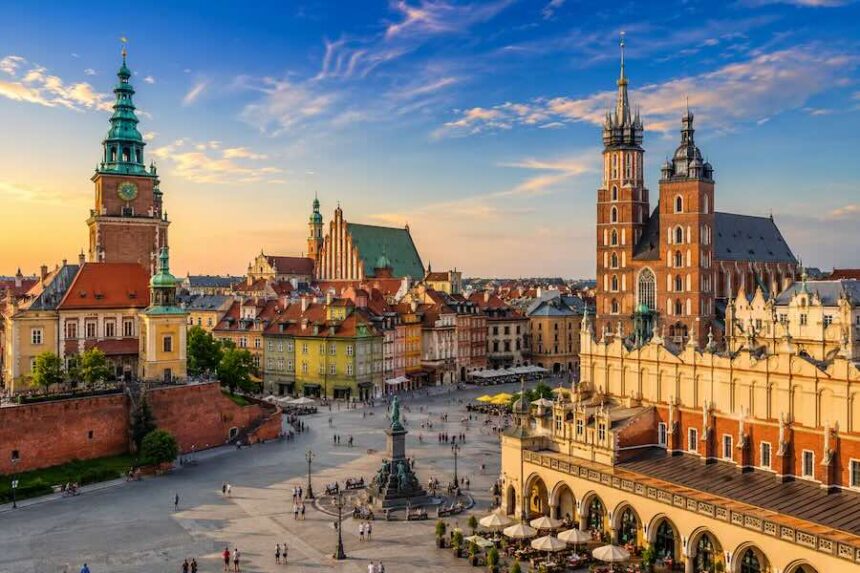
Kraków is one of Poland’s essential city breaks. Once the country’s royal capital, its historic centre was among the first places inscribed on the UNESCO World Heritage List, and the city remains remarkably easy to explore on foot. The official Polish tourism guide to Kraków highlights its combination of history, culture, food and distinct neighborhoods.
Begin at the Main Market Square, Rynek Główny. Its vast open space has retained its medieval layout since the 13th century, surrounded by historic façades and anchored by the Cloth Hall. Nearby, the towers of St. Mary’s Basilica rise above the square, while streets leading away from the centre reveal restaurants, small shops and layers of architecture accumulated across centuries.
From there, walk toward Wawel Hill and Wawel Royal Castle, historically associated with Poland’s kings. The route between the market square and Wawel is compact enough to make wandering part of the experience rather than simply transportation between landmarks.
Kraków also works well as a base for exploring southern Poland. The UNESCO-listed Wieliczka Salt Mine is nearby, while travelers with more time can continue toward the Tatra Mountains and Zakopane.
Warsaw: A Capital Rebuilt and Reinvented
Warsaw offers a completely different visual rhythm. Large sections of the Polish capital were devastated during World War II, including its historic centre. The Old Town was subsequently reconstructed with extraordinary attention to its historic form and is now a UNESCO World Heritage Site.
The Old Town Market Square is a natural starting point, with colorful façades surrounding one of the city’s most atmospheric public spaces. From here, travelers can follow the Royal Route toward grand historic buildings, Łazienki Królewskie and eventually Wilanów. The official Warsaw travel overview provides a useful introduction to the route and the city’s major cultural sites.
Warsaw’s appeal, however, comes from more than reconstructed history. The city places museums, modern towers, postwar architecture, green parks and lively neighborhoods within the same urban frame. The Warsaw Rising Museum provides important context for the events of 1944, while the Museum of Modern Art adds a distinctly contemporary presence to the centre.
After a day inside museums and historic buildings, head toward the Vistula. Warsaw’s riverbanks and boulevards offer walking and cycling routes, places to sit near the water and a calmer perspective on the capital.
Wrocław: Bridges, Islands and Dwarfs
Wrocław sits in Lower Silesia in southwestern Poland, and its position has given the city a layered Czech, German and Polish history. Today those influences meet in an energetic university city built around the Oder River.
Its Market Square is surrounded by colorful townhouses and dominated by the historic Town Hall. From there, wandering toward Ostrów Tumski reveals an older and quieter side of Wrocław, including the Gothic Cathedral of St. John the Baptist.
Water is part of the city’s character. More than 100 road bridges and footbridges connect its riverbanks, according to Poland’s official tourism portal, creating constantly changing views as you move between neighborhoods and islands.
Then there are the dwarfs. Small bronze figures appear across Wrocław in doorways, squares and unexpected corners. Their story is connected to the Orange Alternative anti-communist movement of the 1980s, but they have since become one of the city’s most recognizable attractions. Searching for them turns an ordinary walk into an informal treasure hunt.
How to Travel Between Polish Cities
A car can be useful when exploring rural areas, mountains or destinations away from major transport routes, but it is not essential for a city-focused trip. Poland’s rail network connects its major urban centres, while trams, buses and other public transport make getting around cities relatively straightforward.
For example, official Polish tourism information lists typical Intercity journey times of approximately 2 hours 20 minutes between Warsaw and Kraków and 3 hours 50 minutes between Warsaw and Wrocław. Checking schedules and booking longer journeys ahead can make a multi-city itinerary considerably easier.
Within the cities themselves, walking is often the most rewarding option for central districts. Public transport can then cover longer distances. Warsaw is currently the only Polish city with a metro system.
What to Know Before Visiting Poland
Poland is part of the European Union but does not use the euro. The national currency is the Polish złoty, abbreviated PLN. Cards and contactless payments are widely useful in cities, but carrying some złoty remains practical for smaller purchases and situations where electronic payment is unavailable.
English is commonly encountered around major tourist attractions, hotels and restaurants, particularly in destinations such as Kraków, Warsaw and Wrocław. It is still worth checking language options when booking specialist tours or guided visits.
Which Polish City Should You Visit First?
Choose Kraków if medieval streets, royal history and atmospheric old architecture are the priority. Choose Warsaw for museums, modern city life and one of Europe’s most striking stories of urban reconstruction. Choose Wrocław for a more compact city break filled with bridges, riverside walks, colorful architecture and a playful cultural identity.
If time allows, don’t choose at all. Linking the three cities by train creates a varied introduction to Poland: Kraków’s stone courtyards and church towers, Warsaw’s broad avenues and reconstructed Old Town, then Wrocław’s islands and bridges. Three cities, each telling a distinctly different part of the country’s story.
Frequently Asked Questions About Visiting Poland
Is Kraków or Warsaw better for a first visit?
Kraków is particularly appealing for travelers seeking a compact historic centre and traditional European city-break atmosphere. Warsaw offers a larger, more contemporary capital-city experience with major museums, modern architecture and extensive green spaces.
Can you travel around Poland without renting a car?
Yes. Major cities are connected by rail, and Kraków, Warsaw and Wrocław have extensive local public transport. A rental car becomes more useful when an itinerary includes smaller towns, countryside or remote attractions.
Does Poland use the euro?
No. Poland uses the Polish złoty (PLN), so travelers should not assume that euro cash will be accepted for everyday purchases.
How many days should you spend in Poland?
A week gives travelers enough time for a useful introduction to two or three major cities. A longer trip makes it easier to add destinations such as Wieliczka, the Tatra Mountains, Gdańsk, Toruń or other regions beyond the main city-break circuit.