
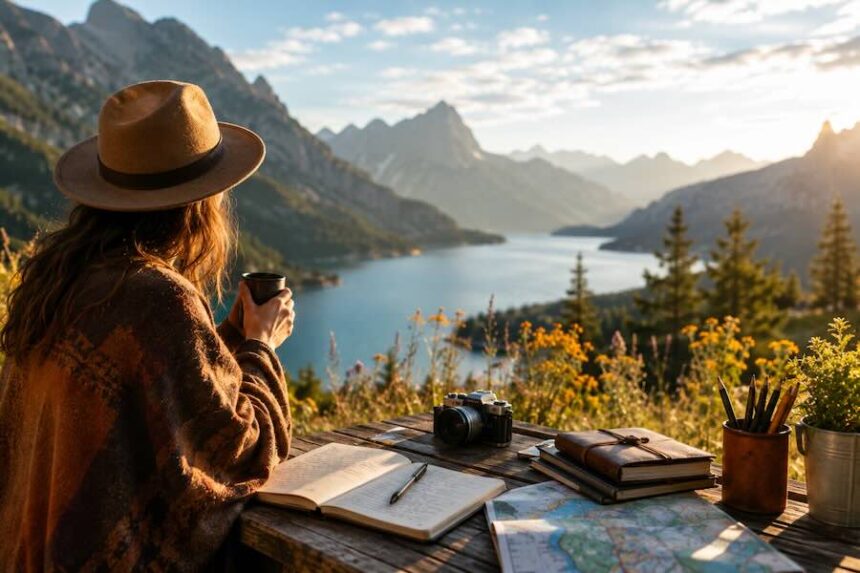
Creative blocks rarely arrive with drama. More often, they appear quietly: the sketchbook stays closed, the instrument gathers dust, or the document remains blank after another long day. Adult routines can leave little space for curiosity, and without fresh input, creative work can begin to feel repetitive.
Travel can interrupt that pattern. A different street, unfamiliar food, another language drifting across a café, or simply waking to a landscape you have never seen before can make you pay attention again. For artists, writers, musicians, photographers, and other creative people, that renewed attention can be more valuable than forcing another hour of work.
Research has also explored connections between international experience and creativity. One influential study published by the American Psychological Association found associations between living abroad and creative performance, particularly when people engaged deeply with another culture rather than simply passing through it.
A break from the day-to-day grind
Routine can be useful, but too much repetition gives the mind fewer unexpected details to work with. The same commute, rooms, conversations, and screens become familiar enough that we barely notice them.
Travel disrupts that familiarity. Even a short trip asks you to navigate different streets, make small decisions, observe unfamiliar architecture, and adjust to another rhythm. You begin looking closely again. For someone experiencing a creative block, that change of context can provide new material without requiring creativity itself to become another task.
The restorative power of nature
Travel does not need to mean crowded airports or packed city itineraries. Sometimes the useful part is simply getting outside. Forests, coastlines, mountains, lakes, and open countryside create a different sensory environment from the constant notifications and visual noise of everyday life.
Research has linked contact with nature to benefits including reduced stress and improvements in aspects of attention and wellbeing. The American Psychological Association has reviewed research examining these effects. For creative work, the practical value may be surprisingly simple: a quieter mind has more room to notice things.
Interacting with new people
Places become more interesting when you listen to the people who live there. Conversations can reveal local traditions, family histories, humor, music, food, and perspectives that no itinerary can fully capture.
For a writer, that might mean hearing a story that changes the direction of a character. A musician might discover an unfamiliar rhythm. A photographer may begin looking at a neighborhood differently after learning its history. The point is not to collect other people’s cultures as creative material, but to listen, engage respectfully, and allow unfamiliar perspectives to challenge your own assumptions.
Having brand-new experiences
Novelty gives the senses something to do. Swim in the sea for the first time. Walk through snow. Taste a regional dish you cannot find at home. Take an unfamiliar train and watch the landscape change through the window.
These experiences provide texture: sounds, colors, smells, gestures, weather, light. They become details you can later draw, photograph, write about, compose around, or simply remember. Inspiration does not always arrive as a finished idea. Sometimes it begins as one vivid detail that refuses to leave.
Learning new art forms
Local creative traditions can be another reason to travel slowly. Visit independent galleries, workshops, music venues, markets, studios, and cultural institutions. Watch craftspeople work when visitors are welcome, and take a class when one is offered appropriately.
You do not need to become skilled in another discipline for the experience to matter. Working with unfamiliar materials or techniques can alter the way you think about your own practice. A ceramicist’s approach to texture might influence a photographer. Traditional textile patterns could shift a designer’s sense of color. A live performance might send a songwriter home hearing rhythm differently.
Rediscovering why you create
Creative work becomes particularly difficult when the thing you once loved starts feeling like an obligation. Deadlines, algorithms, clients, analytics, and expectations can gradually replace experimentation.
Travel creates distance from that machinery. Bring a notebook without planning to publish what you write. Take photographs without thinking about engagement. Draw badly. Hum melodies into your phone. Give yourself permission to make things that have no commercial purpose at all.
That freedom can reconnect you with the original pleasure of making something simply because you wanted to see what happened.
The creative energy of adventure
For some people, inspiration comes from stillness. Others need movement. Hiking an unfamiliar trail, kayaking, cycling through a new landscape, or trying another appropriately supervised outdoor activity can pull attention firmly into the present.
The goal does not need to be an adrenaline rush. What matters is stepping beyond the predictable and becoming alert to your surroundings again. That heightened attention can follow you back to the page, studio, rehearsal room, or camera.
You don’t have to travel far
Creative travel does not require an expensive international trip. A train ride to a nearby town, a weekend in the countryside, a museum in a neighboring city, or a day spent walking somewhere unfamiliar can create the same essential shift: new surroundings and closer observation.
Instead of traveling with a checklist, leave some empty space in the itinerary. Wander. Sit somewhere for longer than necessary. Notice the afternoon light on a building, the sound of a market closing, or the changing landscape outside a train window. Creativity often returns when you stop demanding that it perform on schedule.
Conclusion
Travel cannot guarantee inspiration, and a plane ticket is not a cure for every creative block. What travel can offer is interruption: a temporary break from familiar patterns and a reason to observe the world more carefully.
For a tired creative mind, that may be enough. Change the scenery, meet people, experience something unfamiliar, and give yourself time without demanding an immediate result. The next idea may arrive somewhere between the destination and the journey home.
FAQ
Can travel really make you more creative?
Research has found associations between certain forms of travel and international experience and creative thinking. The effect is not automatic, however. Meaningful engagement with unfamiliar environments and cultures appears more important than simply visiting another destination.
Do I need to travel abroad to find creative inspiration?
No. Exploring an unfamiliar town, landscape, museum, neighborhood, or cultural event close to home can introduce novelty and break established routines.
What should creatives do while traveling?
Keep the itinerary flexible. Carry a notebook or camera, visit cultural spaces, spend time outdoors, talk with local people respectfully, and record observations without pressuring yourself to turn everything into finished work.
Is solo travel better for creativity?
Not necessarily. Solo travel can provide quiet and independence, while traveling with other people can create conversations and shared experiences. The better choice depends on the environment in which you personally become most observant and curious.