




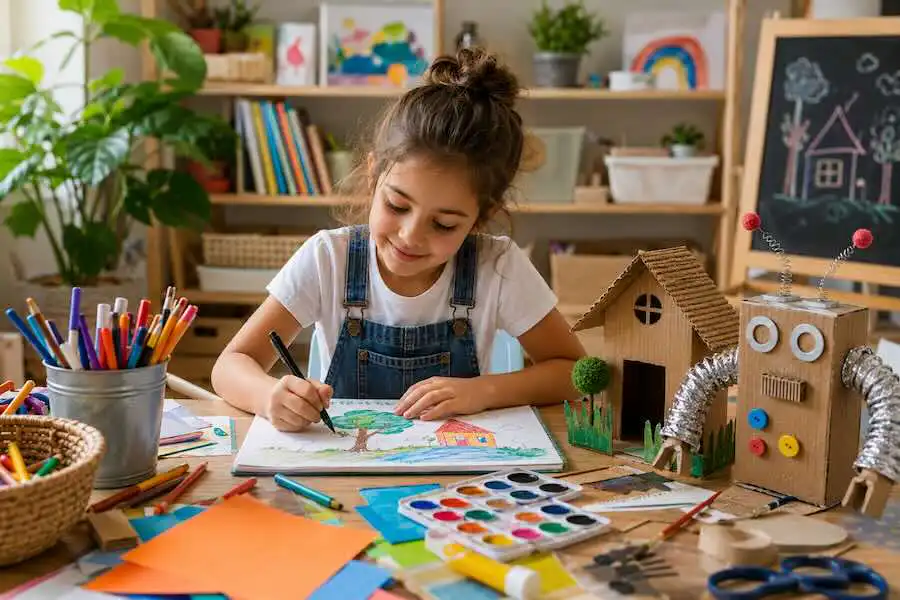
A cardboard box can become a spaceship before lunch and a puppet theatre by late afternoon. A spoon becomes a microphone. A crooked line on paper turns into an animal nobody has seen before. Children rarely need sophisticated materials to be creative; they need time, permission and enough space for an idea to change direction.
Creative activities can give children opportunities to communicate ideas, experiment, solve problems and explore feelings through writing, art, storytelling, movement, music and play. The useful part is often not the polished object at the end. It is everything that happens while they are making it.
Why creativity matters for children
Creativity is much broader than being talented at drawing or music. A child inventing an unusual solution to a building problem is being creative. So is one changing the rules of a game, constructing an imaginary world or finding three different endings for the same story.
Creative experiences can involve language, fine motor skills, decision-making, experimentation and social interaction. The Center on the Developing Child at Harvard University explains how children’s developing executive-function skills support processes including planning, attention and managing information. Open-ended play can create natural opportunities to exercise many of these abilities.
The important word is open-ended. If an adult decides exactly what the child must make, what colors to use and what the finished object should look like, the activity becomes closer to following instructions than exploring an idea.
Create the conditions, then give them room
Parents do not need to orchestrate creativity from beginning to end. Sometimes the better role is simply to put interesting materials within reach.
Paper, cardboard, washable paint, pencils, fabric scraps, building materials and recycled packaging can be enough. Ask questions when your child wants engagement, but resist correcting every unexpected decision. The purple fox, upside-down house or impossible machine may be precisely where the interesting thinking begins.
Creative writing without making it feel like homework
Writing becomes more inviting when children are allowed to start somewhere other than a blank page and a formal assignment. A ridiculous character, unfinished sentence or invented song can provide the first spark.
- Invent song lyrics: Take a familiar melody and create completely new words for it.
- Build a joke book: Let children invent riddles, jokes and funny observations, then illustrate their favorites.
- Create a picture story: A child can invent the plot and illustrate each scene. Simple drawing references, such as this guide to drawing a fox, can help when they want a starting point.
- Design a comic: Fold paper into panels and let dialogue, drawings and characters develop together.
- Invent a board game: Create the story, objective, playing pieces, board and rules, then test whether the game actually works.
Spelling and grammar can be addressed separately when appropriate. During imaginative writing, interrupting every sentence for correction can pull attention away from the idea the child is trying to capture.
Turn cardboard into architecture
Large cardboard boxes are unusually good creative material because they begin with almost no prescribed identity. Cut a doorway and the box becomes a house. Add circular windows and suddenly it is a submarine.
Give children tape, washable markers and safe age-appropriate craft materials, then allow them to decide what they are building. Smaller boxes can become furniture, robots, vehicles or parts of a miniature city.
For more structured inspiration, these quick craft ideas for children can provide starting points without requiring complicated equipment.
Experiment with texture and paint
Painting does not have to mean a brush moving across flat white paper. Texture changes the experience immediately.
Try age-appropriate painting tools such as sponges, cardboard edges, leaves or textured rollers. Children can compare marks, layer colors and discover what happens when one material moves across another.
Keep materials washable and appropriate for the child’s age, supervise younger children closely and avoid small objects or substances that could create choking, inhalation or other safety risks.
Build something from recycled materials
A clean recycling box can function like an inexpensive construction kit. Cardboard tubes, cartons, paper, foil and boxes can become machines, creatures, buildings or objects without names.
Try giving the activity a loose challenge rather than a fixed result: build something that moves, invent a creature that could live underwater, or design a machine that solves an imaginary problem.
The constraint gives the child somewhere to begin while leaving the solution open.
Combine physical art with digital storytelling
Screens do not have to sit opposite traditional creative play. They can become another tool inside it.
A child might sculpt characters from clay, build scenery from cardboard and then photograph each scene to create a stop-motion story. PBS LearningMedia offers an introduction to stop-motion animation that can help turn physical objects into a simple filmmaking project.
This kind of activity crosses several creative forms at once: model-making, photography, storytelling, sequencing, sound and editing.
Explore photography and filmmaking
Photography can teach children to notice details they normally walk past. Give them a simple visual assignment: photograph five interesting shadows, find circles around the house, document one color or tell a story using six images.
Older children can expand the idea into a short film. They might write a script, choose locations, create costumes, act, direct or edit. The finished movie can be wonderfully rough. Planning how separate shots become one coherent story is part of the creative work.
For younger children, digital projects should remain age-appropriate and supervised. Parents should also consider privacy carefully before allowing children to publish photographs, videos or personal writing online.
Make music without needing formal lessons
Musical creativity can begin before a child knows a single note. Clap a rhythm and ask them to answer it. Tap different household objects and compare their sounds. Hum a melody and let the other person guess it.
If you play an instrument, let your child encounter it through curiosity before turning the experience into instruction. Demonstrate fast and slow playing, quiet and loud sounds, or simple repeating patterns they can imitate.
When a child becomes interested in learning more formally, start with manageable sounds and patterns. Our guide to teaching a child acoustic guitar offers additional ideas for introducing an instrument.
Turn everyday life into theatre
Drama requires remarkably little equipment. A blanket becomes a costume. Two chairs become a stage. A wooden spoon can play almost any supporting role.
- Act out an ordinary event: Turn breakfast, a trip to the supermarket or a family joke into a miniature play.
- Make puppets: Paper bags, socks or simple craft materials can become characters with their own voices and personalities.
- Tell a story in turns: One person begins with a situation, then each participant adds the next piece.
- Play charades or drawing games: Children can create their own cards instead of relying on a commercial set.
Taking turns with a story is particularly useful because nobody controls the direction for long. Each new contribution forces everyone else to adapt.
Give boredom a little space
Not every empty afternoon needs to be filled immediately. When adults supply entertainment at the first sign of boredom, children have fewer reasons to invent something themselves.
A small collection of accessible creative materials can help. Keep paper, pencils, reusable craft supplies, building materials and appropriate recycled objects somewhere children can reach them. The invitation is quietly present without dictating what happens next.
Focus on the process rather than the finished product
Creative confidence can shrink when every activity is judged by how attractive the result looks. Instead of automatically saying that a drawing is beautiful, ask about it. What is happening here? How did you make that texture? What would happen if you built another version?
Questions like these show interest in decisions and ideas rather than measuring the child against an adult standard of what the finished work should resemble.
Conclusion
Encouraging creativity in children does not require an elaborate craft room or a calendar packed with organized activities. Often, simpler is better: useful materials, an intriguing starting point and enough freedom for the original plan to become something else.
Writing, music, cardboard construction, photography, storytelling and digital media can all become creative territory. Adults can supply tools, safety and occasional guidance. The child supplies the unexpected part.
Frequently asked questions
How can parents encourage creativity in children?
Provide accessible materials, time for open-ended play and opportunities to make choices. Ask curious questions rather than controlling the result, and allow children to change direction when an activity develops differently than expected.
What are easy creative activities for kids at home?
Drawing comics, building with cardboard, inventing stories, making puppets, taking themed photographs, creating rhythms and constructing objects from clean recycled materials can all be started with relatively simple supplies.
Does creativity only mean art and music?
No. Creativity can appear through problem-solving, storytelling, humor, construction, imaginative play, game design, photography, movement and many other activities that involve producing or exploring ideas.
Should parents correct children’s creative work?
It depends on the activity. When the purpose is open-ended creative exploration, constant correction can redirect attention toward getting things “right.” Safety boundaries and specific skill instruction still matter, but children can benefit from having room to make their own creative decisions.
Can technology be used creatively by children?
Yes. Photography, animation, filmmaking, digital drawing and music-making can turn technology into a creative tool rather than passive entertainment. Activities should be appropriate for the child’s age, with adult supervision and sensible privacy protections when online services are involved.