



Every piece in a capsule wardrobe earns its place twice. That’s the whole rule. Before anything enters your closet, it has to work with at least two other things you already own — a blazer that pairs with both denim and tailored trousers, a silk shirt that moves from desk to dinner without a second thought. One outfit isn’t enough. Two is the minimum for a piece to be worth keeping.
It sounds almost too simple to be useful. But most overstuffed closets aren’t full of bad clothes — they’re full of clothes that only ever worked one way. The statement skirt bought for a single wedding. The blouse that only makes sense with the trousers it was photographed with in a lookbook. Each item earns its shelf space through novelty rather than versatility, and novelty fades fast.
Why the number two matters
Stylists have talked about capsule wardrobes for decades, usually in terms of a total count — twenty pieces, thirty-three pieces, some tidy number meant to signal restraint. But a fixed number doesn’t actually tell you what to keep. It just tells you when to stop. The 2-piece rule works differently: it’s a filter you apply to every single item, one at a time, regardless of how large or small the closet ends up being.
Ask it of a jacket. Ask it of a pair of boots. If you can picture two distinct outfits — different occasions, different moods, ideally different seasons — the piece has range. If you can only picture the one it was bought for, it’s a costume, not a wardrobe staple.
Putting it into practice
Start with what’s already hanging up, not what’s on a wishlist. Pull ten pieces at random and ask the question honestly. A neutral trench coat will pass instantly — over a slip dress, over jeans, over a suit. A sequined top bought for one New Year’s Eve will not, and that’s fine. Not everything needs to pass. The rule isn’t about eliminating personality from your closet; it’s about being honest with yourself about which pieces are doing quiet, repeated work and which ones are waiting for a single occasion to come around again.
The same logic applies before you buy, which is where it saves the most money and closet space. Standing in a fitting room, the question isn’t “do I love this,” it’s “where else does this go.” A camel coat answers instantly. A bright printed jumpsuit usually doesn’t — and that’s useful information before it leaves the store, not six months later when it’s still unworn.
Where it breaks down — and where that’s fine
No rule survives contact with real life perfectly intact. A truly special-occasion piece — a wedding dress, a formal gown — will never pass the two-outfit test, and it isn’t supposed to. The rule is for the everyday core of a wardrobe, not for the handful of pieces that exist for singular, memorable moments. Apply it too rigidly and you lose the pieces that make getting dressed feel personal rather than efficient.
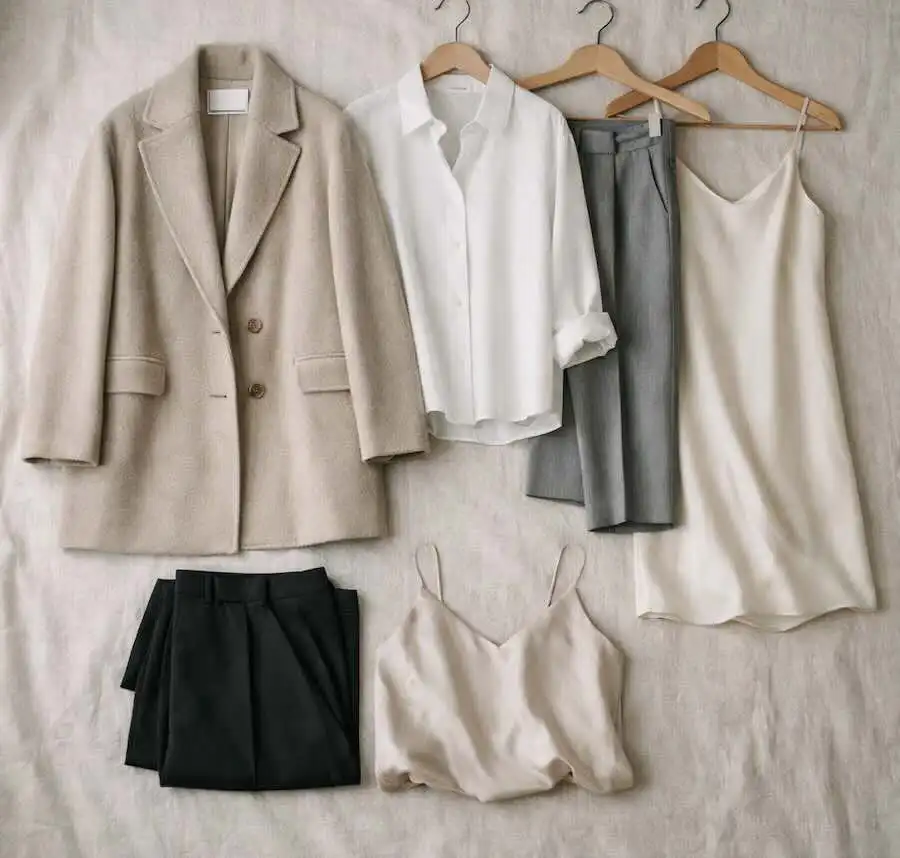
It also helps to lean on a neutral foundation first. Most stylists point to the same starting point: a base of versatile neutrals — white, navy, black, beige, grey — that almost anything else can be layered over, as Stitch Fix’s styling guide lays out well. From there, colour and pattern become additions rather than obligations. One stylist quoted by a recent piece on building a versatile capsule wardrobe put the whole philosophy simply: versatility, not uniformity, is the real goal. And if two pieces feels too strict a threshold to start with, easing in with a 3-3-3 method — three tops, three bottoms, three pairs of shoes, all interchangeable — can be a gentler on-ramp to the same habit.
Conclusion
The 2-piece rule isn’t about owning less for its own sake. It’s a quiet filter that changes how you shop and how you get dressed — favouring pieces with range over pieces with a single, memorable moment attached to them. Applied consistently, it turns a closet into something closer to a toolkit: smaller, but far more useful, with almost nothing in it that goes unworn.
FAQ
What exactly counts as a “different outfit”?
A genuine change in occasion, season, or mood — not just a different accessory. A blazer worn over a dress and then over jeans counts as two outfits. A blazer worn open versus buttoned does not.
Does this work for a full wardrobe or just travel packing?
Both. It’s often used to build lean travel capsules, but the same logic scales up to a full closet — it’s simply applied to more pieces at once.
What if a piece only has one use but I still love it?
Keep it. The rule is a filter for the everyday core of a wardrobe, not a ban on sentimental or occasion-only pieces. It’s meant to sharpen decisions, not eliminate personality.
Is there an easier version of this rule to start with?
Yes — the 3-3-3 method (three tops, three bottoms, three pairs of shoes, all mix-and-matchable) is a softer starting point before narrowing down to the stricter 2-piece standard.