


Scoliosis changes the spine’s natural alignment, usually creating a sideways curve that may also involve rotation. It is often first identified during childhood or adolescence, although adults can live with scoliosis too. Exercise cannot simply straighten an established spinal curve, but the right movement program may improve strength, mobility, posture, balance, and everyday comfort.
The important word is right. Scoliosis varies considerably from person to person, so an exercise that feels comfortable for one individual may not suit another. According to the Scoliosis Research Society, treatment decisions depend on factors including the type and magnitude of the curve, skeletal maturity, and whether the curve is progressing. Exercise is therefore best approached as one part of an individualized care plan.
Can Exercise Help With Scoliosis?
Exercise can play a useful role in scoliosis management, particularly when the goal is maintaining mobility and strengthening muscles that support the trunk and spine. Some people may also be prescribed scoliosis-specific exercises by a physical therapist rather than relying on a generic workout.
Exercise should not, however, be presented as a substitute for bracing or surgery when either treatment is clinically indicated. Bracing may be recommended for certain growing adolescents whose curves are at risk of progressing, while more severe cases can require surgical assessment. The American Academy of Orthopaedic Surgeons provides additional guidance on how scoliosis is evaluated and treated.
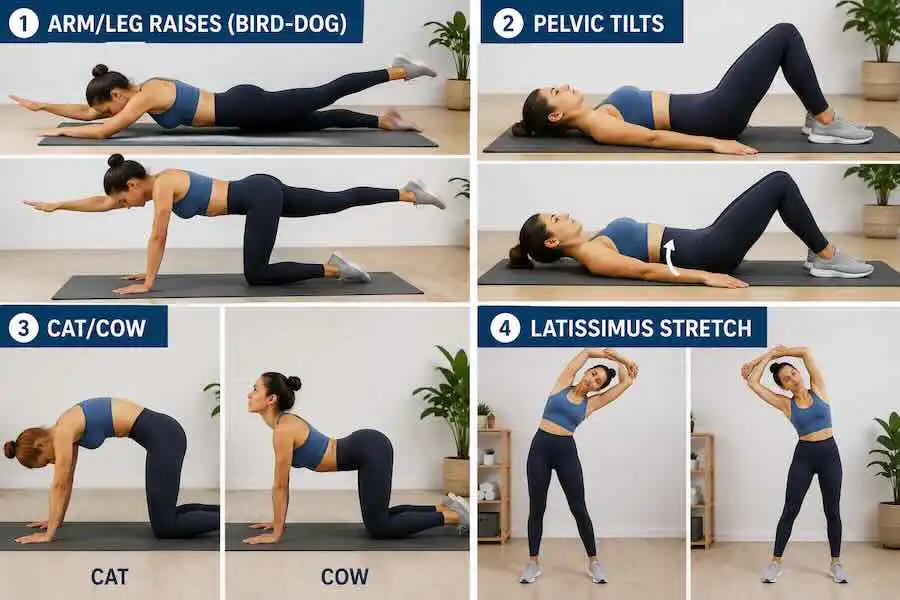
1. Bird-Dog Arm and Leg Raises
The bird-dog is a controlled core exercise that challenges balance while engaging muscles around the abdomen, back, shoulders, and hips. Rather than attempting to force the spine into a particular position, concentrate on keeping your trunk stable throughout the movement.
- Begin on your hands and knees.
- Position your hands beneath your shoulders and knees beneath your hips.
- Keep your neck comfortable and your trunk controlled.
- Slowly extend one arm forward while extending the opposite leg behind you.
- Pause briefly without twisting your torso or forcing your back to arch.
- Return to the starting position and repeat on the opposite side.
Quality matters more than chasing a specific repetition count. If maintaining balance becomes difficult, a physical therapist can modify the movement to suit your strength and spinal curve.
2. Pelvic Tilts
Pelvic tilts are a small, controlled movement that can help you become more aware of the relationship between your pelvis, abdominal muscles, and lower back. A padded surface or yoga mat can make the exercise more comfortable.
- Lie on your back with your knees bent and feet comfortably on the floor.
- Keep your shoulders relaxed.
- Gently engage your abdominal muscles and tilt your pelvis so the lower back moves slightly toward the floor.
- Hold briefly while continuing to breathe normally.
- Release slowly and repeat without forcing the movement.
A pelvic tilt should feel controlled rather than aggressive. Stop if the exercise produces sharp pain, numbness, or other new symptoms.
3. Cat-Cow
Cat-cow is familiar from yoga, but it can also function as a gentle spinal mobility exercise. The movement alternates between rounding and extending the back while encouraging you to move slowly with your breathing.
- Begin on your hands and knees with your hands under your shoulders and knees under your hips.
- Start with your spine in a comfortable neutral position.
- Slowly round your back upward while allowing your head to follow naturally.
- Reverse the movement gently, allowing your chest to open and your abdomen to move toward the floor.
- Continue alternating between the two positions at a comfortable pace.
Avoid pushing toward an extreme range simply because the pose appears deeper. With scoliosis, controlled movement is more useful than trying to reproduce someone else’s posture exactly.
4. Latissimus Dorsi Stretch
The latissimus dorsi is a broad muscle extending across much of the back and connecting with the upper arm. Gentle stretching may feel useful when the muscles around the trunk and shoulders are tight, although scoliosis can create asymmetrical movement patterns that make individualized guidance particularly valuable.
- Stand comfortably with your feet approximately shoulder-width apart.
- Raise your arms overhead without forcing your shoulders.
- Hold one wrist gently with the opposite hand.
- Lean gradually to one side until you feel a comfortable stretch through the opposite side of your trunk.
- Return slowly to the center before changing sides.
Do not assume both sides need exactly the same stretch or intensity. A clinician familiar with your curve pattern can advise whether symmetrical stretching is appropriate.
What About Scoliosis-Specific Exercises?
Generic strengthening and mobility exercises are different from physiotherapeutic scoliosis-specific exercises. One recognized approach is the Schroth Method, which uses individualized exercises, postural awareness, and breathing techniques based on a person’s particular spinal curve.
That distinction matters. A scoliosis-specific program is not simply a collection of stretches found online. It is typically taught and adjusted by a trained practitioner who can see how your spine, rib cage, pelvis, and posture respond during movement.
Exercise Safety With Scoliosis
Before beginning a new scoliosis exercise routine, particularly if you have significant curvature, persistent pain, osteoporosis, previous spinal surgery, or neurological symptoms, speak with an appropriate healthcare professional. A physical therapist can assess movement patterns and teach modifications that fit your condition.
Stop exercising and seek medical advice if movement causes significant or worsening pain, new weakness, numbness, tingling, problems with balance, or other concerning symptoms. Exercise should support your care rather than encourage you to work through unexplained warning signs.
Conclusion: Make Movement Personal
Bird-dogs, pelvic tilts, cat-cow movements, and gentle lat stretches can form part of an active routine for some people with scoliosis. Their value lies in controlled movement, mobility, body awareness, and muscular support rather than promising to correct a spinal curve on their own.
That is why personalization matters. Know your curve, understand your treatment plan, and work with a qualified professional when necessary. A few carefully chosen movements performed well are more useful than an ambitious routine that ignores what your individual spine needs.
FAQ: Exercises for Scoliosis
Can exercise straighten scoliosis?
General exercise should not be expected to straighten an established structural scoliosis curve. Exercise may support strength, mobility, posture, and function, while scoliosis-specific exercise programs may be incorporated into professional treatment plans.
Is yoga safe for scoliosis?
Some yoga movements may be comfortable and useful for people with scoliosis, but suitability depends on the individual and the type of movement. Certain positions may require modification, particularly when they involve substantial twisting, bending, or spinal loading.
Should someone with scoliosis exercise every day?
There is no single exercise schedule appropriate for everyone with scoliosis. Frequency should reflect your age, fitness, symptoms, treatment plan, and the exercises being performed. A physical therapist can provide a more individualized schedule.
What is the Schroth Method?
The Schroth Method is a scoliosis-specific physical therapy approach that uses individualized exercises, postural correction, and breathing techniques. It is generally taught by a practitioner trained in the method rather than attempted from written instructions alone.
When should I see a doctor about scoliosis?
Seek professional assessment if you notice signs of spinal curvature or asymmetry, if an existing curve appears to be changing, or if you develop persistent pain or neurological symptoms. Children and adolescents with scoliosis may require monitoring during growth because some curves can progress.