




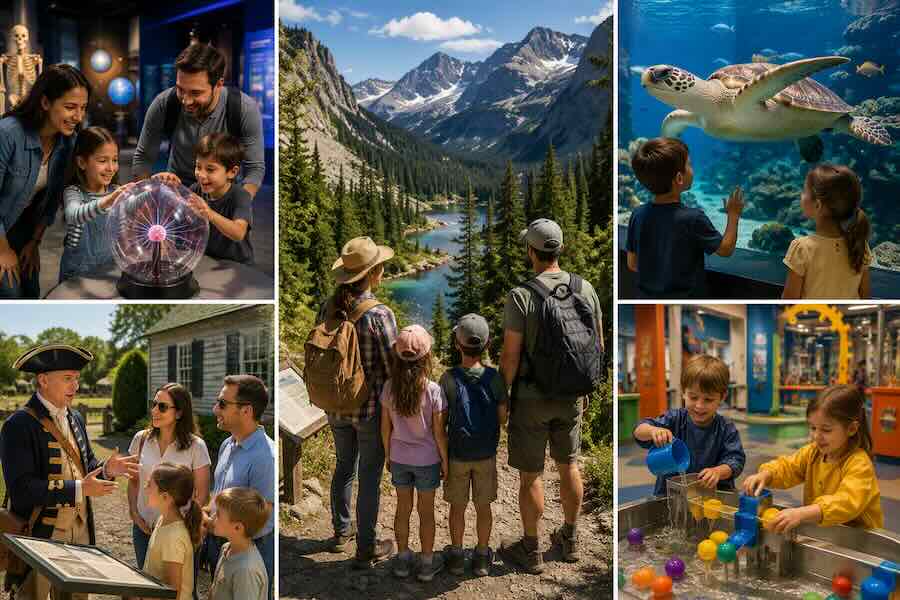
The best family outings leave everyone with something to talk about on the journey home. Children may remember touching a fossil, watching a shark glide overhead, or spotting an animal between the trees. Adults often come away having learned something unexpected too. Education works differently when it happens beyond a classroom.
That makes educational family outings particularly useful when you want a day that feels worthwhile without turning leisure time into another lesson. The key is choosing places where information is embedded in exploration, movement, play, and discovery. From science museums to national parks, these five ideas offer plenty of room for both curiosity and fun.
1. Science museums turn curiosity into something tangible
A good science museum rarely asks children to stand quietly and simply look. Buttons invite pressing. Levers move. Lights flash across darkened galleries. Experiments make invisible ideas suddenly visible.
That hands-on quality makes science museums particularly effective for mixed-age families. Exhibitions can move between biology, physics, space, engineering, climate, medicine, and technology, giving each person a chance to find a subject that catches their attention.
Look for museums offering demonstrations, laboratories, planetarium shows, workshops, or interactive galleries rather than relying entirely on static displays. Organizations such as the Association of Science and Technology Centers can also be useful when searching for science centers in different destinations.
2. National parks make nature the classroom
Few educational outings offer the scale of a national park. Instead of reading about geology, forests, wildlife, or ecosystems, children can stand inside them. A trail becomes a route through local ecology. Rock formations reveal geological history. Animal tracks introduce questions before anyone has opened a guidebook.
The experience can be as gentle or adventurous as your family needs. Younger children might enjoy a short nature trail and visitor center, while older children can tackle longer hikes, wildlife observation, cycling, kayaking, or guided ranger activities.
Before visiting, check the park’s official information for seasonal conditions, accessibility, trail difficulty, wildlife guidance, and educational programs. In the United States, the National Park Service provides individual park guides and family-oriented resources. Similar national park authorities can help when traveling elsewhere.
3. Historical sites put families inside the story
History becomes easier to grasp when there is a physical place attached to it. Standing inside a centuries-old building, following an ancient street, or seeing an object used in everyday life can make the past feel considerably less abstract.
Castles, archaeological sites, monuments, preserved homes, industrial heritage sites, and living-history museums can all work well. The strongest family experiences often combine original surroundings with storytelling, reconstructed objects, costumes, demonstrations, or interactive interpretation.
Rather than trying to absorb every date and detail, give children something specific to investigate. Ask them to find the strangest object, imagine how a room was used, or choose one historical figure they want to know more about. A small mission can transform a long museum visit into a story they actively participate in.
4. Aquariums reveal a world normally hidden from view
An aquarium offers an immediate sense of scale and movement that photographs struggle to reproduce. A ray passes silently overhead. A jellyfish catches blue light. Tiny reef fish disappear between coral structures while larger species move slowly through deep tanks.
Behind the spectacle is an opportunity to introduce marine ecosystems, animal behavior, food webs, biodiversity, pollution, and ocean conservation. Interactive exhibits and educator talks can give children context for what they are seeing without interrupting the excitement of the visit.
When choosing an aquarium or marine attraction, look beyond the size of its tanks. Consider its conservation work, animal-welfare practices, educational programs, and participation in credible professional organizations. The Association of Zoos and Aquariums provides information about accredited institutions and conservation programs.
5. Children’s museums make learning feel like play
For younger children, few destinations understand active learning as naturally as a children’s museum. These spaces are generally designed around doing rather than observing: building structures, making art, experimenting with water, role-playing everyday environments, producing sounds, or testing simple scientific ideas.
The apparent simplicity is part of their strength. Play can encourage problem-solving, communication, creativity, experimentation, and independence without children necessarily thinking of the experience as educational.
The Association of Children’s Museums is a useful starting point for finding institutions and understanding the role these spaces play in learning through play.
How to make an educational family outing more enjoyable
Resist the temptation to see everything. A relaxed two-hour visit where children remain curious can be more valuable than an exhausting day spent moving through every gallery or attraction. Check opening times and age recommendations beforehand, pack around the weather, and leave enough space for food and breaks.
It also helps to involve children before leaving home. Let them choose between two destinations, find something they want to see, or take responsibility for a small part of the itinerary. That sense of ownership can change an outing from something planned for them into an experience they helped create.
Conclusion
Family learning doesn’t need desks, worksheets, or a carefully structured lesson. Sometimes it begins beneath a planetarium dome, beside a tide pool, on a forest trail, or in front of an object made hundreds of years ago.
Science museums, national parks, historical sites, aquariums, and children’s museums all create different versions of the same experience: curiosity shared between generations. Choose the one that fits your family’s interests, leave some room for spontaneity, and let the questions lead the day.
FAQ: educational family outings
What makes a good educational family outing?
The strongest outings combine opportunities to explore with information children can understand at their own level. Interactive exhibits, demonstrations, trails, guided activities, and hands-on experiences can make learning feel natural rather than forced.
Which educational outings are best for younger children?
Children’s museums, interactive science centers, aquariums, short nature trails, and living-history attractions can work particularly well because they combine movement and sensory experiences with relatively short periods of concentration.
How can parents keep children interested at museums?
Focus on a few exhibits rather than attempting to cover the entire museum. Give children choices, ask open-ended questions, use interactive areas, and schedule breaks before attention starts to fade.
Can outdoor activities be educational?
Yes. Hiking, wildlife watching, rock pooling, stargazing, and exploring national parks can introduce subjects including biology, geology, geography, weather, conservation, and environmental science through direct observation.
How should we choose an outing for children of different ages?
Look for destinations with several levels of participation. A science museum with children’s exhibits and more advanced galleries, or a national park with both short trails and longer routes, gives family members different ways to engage with the same destination.