




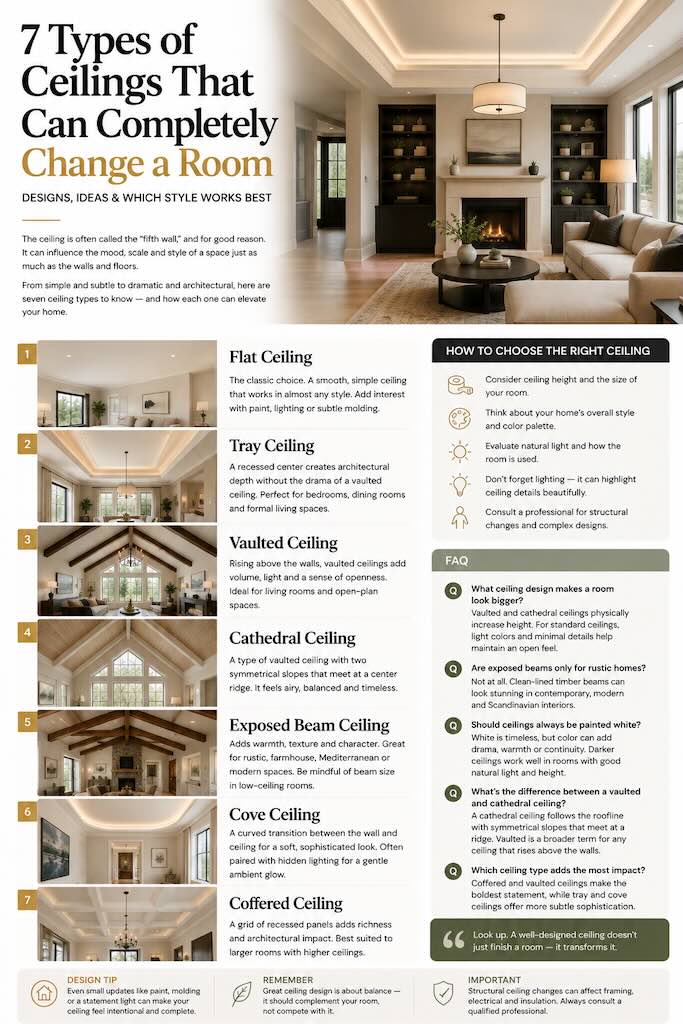
We spend a lot of time thinking about what goes on our walls and surprisingly little time looking up. Yet the ceiling can quietly change how an entire room feels — making it appear taller, more architectural, warmer or considerably more dramatic.
And a ceiling doesn’t need elaborate detailing to make an impact. Sometimes a simple change in paint, molding or exposed beams is enough to give a previously forgettable surface a much bigger role in the room.
From clean flat ceilings to dramatic vaults, these are seven ceiling styles worth knowing — and where each one works best.
Editor’s note: This article from Divine Magazine’s earlier archive has been substantially rewritten and updated.
1. Flat Ceiling: Simple Doesn’t Have to Mean Boring
The standard flat ceiling is what most of us live with: a smooth horizontal surface without major architectural detailing.
Its simplicity is actually its greatest advantage.
A flat ceiling gives you freedom to create interest through lighting, paint and subtle decorative details without competing with the architecture of the room. It also works particularly well in contemporary and Scandinavian-inspired interiors where restraint is part of the aesthetic.
If yours feels uninspiring, don’t immediately assume it needs structural work. Painting the ceiling a deliberate color, adding an oversized pendant or introducing understated molding can completely change the effect.
2. Tray Ceiling: Architecture Without Overwhelming the Room
A tray ceiling uses different ceiling levels to create a recessed central area, producing an effect similar to an upside-down tray.
It’s a useful way to introduce architectural depth without the dramatic height of a vaulted ceiling.
Tray ceilings are particularly effective in bedrooms, dining rooms and larger living spaces where the ceiling can help visually define the room.
The mistake is assuming every layer needs decoration. Keeping the detailing restrained often creates a more contemporary result.
For something subtle, keep the entire ceiling close to the wall color. For more contrast, paint the recessed section a slightly deeper shade or use carefully positioned lighting to emphasize its shape.
3. Vaulted Ceiling: When Height Becomes the Feature
Few architectural features change the feeling of a room as immediately as a vaulted ceiling.
Rather than remaining flat, the ceiling rises above the standard wall height, creating additional volume overhead. The result can make a room feel expansive, bright and dramatic.
Vaulted ceilings work particularly well in living rooms and open-plan spaces, especially when paired with generous windows that emphasize the additional height.
There are practical considerations, however. Greater ceiling volume can affect heating, cooling, acoustics and even something as mundane as changing a lightbulb.
This is one ceiling where beauty and practicality need to be considered together.
4. Cathedral Ceiling: Similar to Vaulted, but Not Quite the Same
“Vaulted” and “cathedral” are often used interchangeably, but they aren’t necessarily identical.
A cathedral ceiling typically has two symmetrical sloping sides that follow the shape of the roof and meet at a higher central ridge. A vaulted ceiling is a broader category and doesn’t have to follow that symmetrical form.
The strong central line of a cathedral ceiling can make a room feel beautifully balanced, particularly when the architecture is allowed to remain relatively uncluttered.
Rather than filling the upper walls with decoration, let the proportions do some of the visual work.
5. Exposed Beam Ceiling: Instant Warmth and Character
Exposed beams can make even a relatively minimal room feel warmer and more grounded.
Natural timber works beautifully against white, cream and other quiet neutral ceilings, creating the kind of contrast often seen in rustic, Mediterranean and modern Scandinavian interiors.
And beams don’t necessarily need to be part of the home’s original structure to achieve the look. Decorative beams can sometimes create a similar visual effect without functioning as structural supports.
Scale matters, though. Heavy dark beams in a small room with a low ceiling can make the space feel compressed rather than cozy.
In rooms without generous ceiling height, lighter timber or more restrained beam proportions can produce a softer result.
6. Cove Ceiling: The Soft Alternative
Most rooms meet at a sharp 90-degree angle where the walls reach the ceiling. A cove ceiling softens that transition with a curved or rounded profile.
The result feels more fluid and architectural, particularly in rooms where you want elegance without heavy decorative molding.
Cove details can also work beautifully with concealed lighting. Rather than seeing the light source directly, illumination can wash gently across the ceiling and create a softer evening atmosphere.
It’s a detail that can feel surprisingly modern when kept clean and minimal.
7. Coffered Ceiling: Maximum Architectural Impact
If a tray ceiling adds subtle depth, a coffered ceiling makes architecture impossible to ignore.
Coffered ceilings use a grid of recessed panels, usually created by intersecting beams or molding. They’re traditionally associated with grand interiors, but simplified versions can work surprisingly well in contemporary homes.
The key is proportion.
Because coffering visually lowers portions of the ceiling, it generally feels most comfortable when there’s enough height to support the additional detail. In a low-ceilinged room, the same treatment can feel heavy.
If your architecture can handle it, though, a coffered ceiling can transform an otherwise plain room before you’ve added a single piece of furniture.
Don’t Forget Crown Molding
Crown molding isn’t technically a type of ceiling. It’s trim installed where the walls and ceiling meet — but it can dramatically change how the ceiling is perceived.
Traditional rooms can support more elaborate profiles, while contemporary interiors generally benefit from cleaner, simpler molding.
One particularly effective trick is painting the molding the same color as the walls or ceiling rather than automatically choosing contrasting white. The architectural detail remains, but the overall effect becomes quieter.
The Ceiling Color Trick
White isn’t your only option.
Painting the ceiling can alter the visual balance of a room without changing its architecture at all.
A ceiling painted in the same color as the walls can create a cocooning, continuous effect. A slightly lighter version of the wall color can maintain cohesion while keeping the ceiling feeling open.
Darker ceilings can create intimacy and drama, particularly in dining rooms, bedrooms and spaces designed primarily for evenings.
Before committing, consider natural light and ceiling height. The same deep shade that feels sophisticated in a tall, sunny room can feel much heavier in a small, dark space.
Which Ceiling Works Best for Your Room?
| Ceiling Style | Best For | Overall Effect |
|---|---|---|
| Flat | Almost any room | Clean and versatile |
| Tray | Bedrooms and dining rooms | Subtle architectural depth |
| Vaulted | Living and open-plan spaces | Airy and dramatic |
| Cathedral | Rooms beneath pitched roofs | Tall and symmetrical |
| Exposed beams | Living rooms and kitchens | Warm and characterful |
| Cove | Bedrooms, hallways and living spaces | Soft and elegant |
| Coffered | Larger rooms with good ceiling height | Architectural and sophisticated |
Look Up Before You Redecorate
Before choosing another cushion, rug or piece of wall art, stand in the middle of the room and look upward.
Does the ceiling disappear completely? Does its height suit the furniture below it? Could a pendant, molding, beam, color change or architectural detail give the room something it’s currently missing?
You don’t necessarily need the most elaborate ceiling on this list. In many homes, the most successful approach is also the simplest.
The goal isn’t to make everyone notice your ceiling.
It’s to make the entire room feel better because you finally remembered it was there.
FAQ: Ceiling Design
What type of ceiling makes a room look bigger?
Vaulted and cathedral ceilings physically increase the volume above a room and can create a more spacious feeling. In rooms with standard ceilings, lighter colors, restrained detailing and well-planned lighting can help maintain a sense of openness.
Are exposed beams suitable for modern homes?
Yes. Exposed beams aren’t limited to rustic interiors. Simple timber beams paired with clean furniture and neutral colors can work particularly well in contemporary and Scandinavian-inspired rooms.
Should ceilings always be painted white?
No. White can make a ceiling feel bright and neutral, but using color can create continuity, warmth or drama. Consider the room’s ceiling height and available natural light when choosing a darker shade.
What’s the difference between a vaulted and cathedral ceiling?
A cathedral ceiling typically follows two symmetrical slopes that meet at a central ridge. “Vaulted ceiling” is a broader term covering elevated ceiling designs that don’t necessarily follow the roofline or have symmetrical sides.
Renovation note: Structural ceiling alterations can affect framing, electrical systems, insulation, ventilation and other parts of a building. Consult appropriately qualified professionals before making structural changes.