




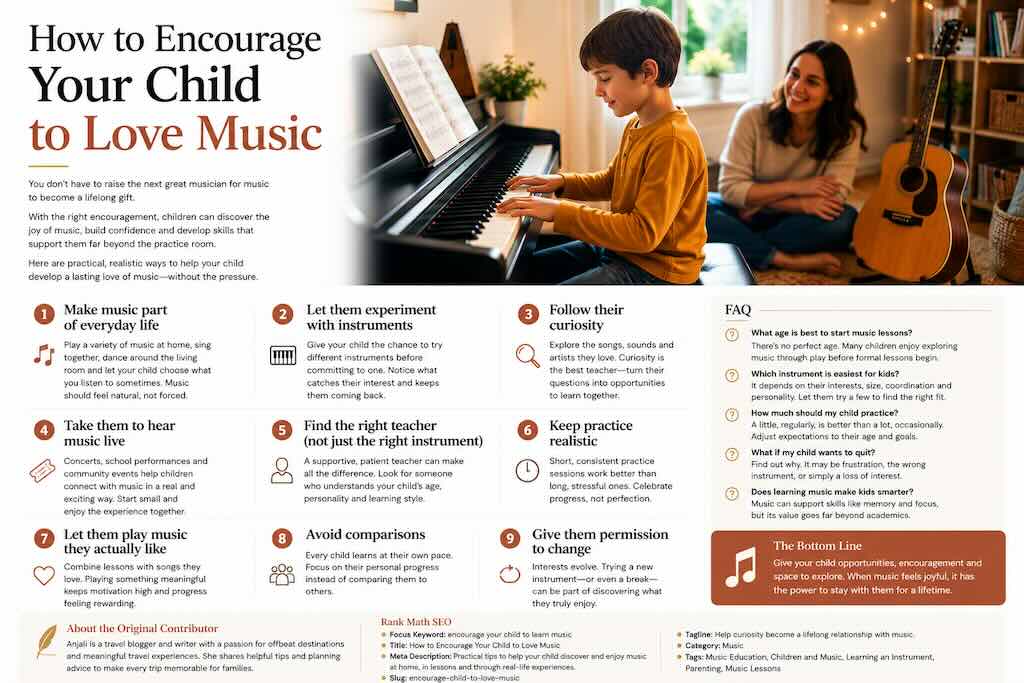
A child doesn’t need to become a musician for music to become an important part of their life.
They might spend years learning piano, pick up a guitar for six months, sing constantly around the house or eventually decide that playing an instrument isn’t for them at all. None of those outcomes makes their early experience with music a failure.
The goal isn’t necessarily to raise the next great performer. It’s to give children opportunities to listen, experiment, create and discover what music means to them.
And if you want that interest to last, enthusiasm usually works better than pressure.
Editor’s note: This article from Divine Magazine’s earlier archive has been substantially rewritten and updated.
1. Make Music Part of Everyday Life
Before thinking about lessons, instruments or practice schedules, start with something much simpler: let music exist naturally at home.
Play different kinds of music while you’re cooking. Sing badly in the car. Dance around the living room. Let children choose what everyone listens to occasionally, even when their selection isn’t exactly what you would have picked.
The important part is showing them that music isn’t simply another subject adults expect them to master. It’s something people use to celebrate, relax, move, concentrate, remember and have fun.
You can also introduce variety. Classical music one morning, jazz another evening, pop in the car and music from different cultures over dinner. You don’t need to explain everything you’re playing. Sometimes curiosity starts simply because something sounds different.
2. Let Them Experiment With Instruments
You don’t need to buy a piano because your four-year-old tapped three notes on one at somebody else’s house.
Instead, give children opportunities to experiment before committing to an instrument.
They might encounter instruments through school, community programs, music classes, friends or family members. Some music stores and teachers may also offer introductory sessions where children can experience different instruments.
Pay attention to what repeatedly draws them back.
One child may be fascinated by the piano. Another might immediately gravitate toward drums. Someone else may want to sing rather than play anything at all.
The instrument you’re most excited about isn’t necessarily the one they’ll love.
3. Follow Their Curiosity
Adults sometimes become so focused on developing a child’s talent that they accidentally remove the thing that created the interest in the first place: curiosity.
If your child wants to know how a guitar makes different notes, explore that. If they’re fascinated by movie soundtracks, listen to them together. If they’re obsessed with one singer, ask what they like about the songs.
These conversations don’t have to become formal music lessons.
Questions as simple as “Can you hear the drums?” or “Does this song sound happy or sad to you?” encourage active listening without turning the experience into homework.
4. Take Them to Hear Music Live
Recorded music is one thing. Seeing somebody create it a few feet away is something else entirely.
And your child’s first live-music experience doesn’t need to involve expensive arena tickets.
Look for outdoor concerts, school performances, community festivals, family-friendly shows, orchestral programs for children or local musicians performing during daytime events.
Seeing musicians perform can help children connect the sounds they’ve heard with actual instruments and people. They can watch a drummer keep time, see how musicians communicate onstage or notice how an audience reacts when a favorite song begins.
For younger children, choose events where moving around, talking occasionally or leaving early won’t become stressful for everyone involved.
5. Choose the Right Teacher — Not Just the Right Instrument
Once a child shows sustained interest, formal lessons may be worth exploring.
But finding the right teacher can matter just as much as choosing the instrument.
A technically brilliant musician isn’t automatically the ideal teacher for a beginner. Look for somebody who understands the child’s age, communicates clearly and can balance learning fundamentals with keeping lessons engaging.
Ask how lessons are structured, what practice expectations look like and how the teacher handles children who become frustrated or temporarily lose motivation.
A trial lesson can also reveal something a biography can’t: whether your child actually connects with the person teaching them.
6. Keep Practice Realistic
“Go practice your instrument” can turn something exciting into a chore remarkably quickly.
Learning an instrument does require repetition, but the amount and structure should make sense for the child’s age, ability and goals.
Short, consistent sessions may be much more manageable for younger beginners than expecting them to sit with an instrument for a long stretch.
It also helps to distinguish between encouraging consistency and demanding perfection.
Missing a note isn’t a disaster. Struggling with a new technique isn’t evidence that someone lacks talent. Those moments are simply part of learning something difficult.
7. Let Them Play Music They Actually Like
Scales and exercises have their place, but imagine being ten years old and discovering that learning guitar apparently means never playing any of the songs that made you want a guitar.
Where appropriate, let children work toward music they recognize and enjoy alongside the technical material they need to learn.
That might mean a simplified version of a favorite pop song, something from a movie soundtrack or a piece they’ve heard another musician perform.
Being able to play even a small part of something they love can provide a powerful sense of progress.
8. Don’t Compare Them With Other Children
One child can hear a melody and reproduce it almost immediately. Another may need considerably longer to understand the same idea.
That’s normal.
Comparing siblings, classmates or children in the same music group can quickly make learning feel like a competition they didn’t agree to enter.
Instead, notice individual progress.
The chord that was impossible last month is suddenly easier. They can keep rhythm for longer. They’re confident enough to play in front of somebody else. They remembered a piece without being reminded.
Those small changes are worth recognizing.
9. Give Them Permission to Change Instruments
Choosing an instrument at eight years old doesn’t have to become a lifetime contract.
A child may begin with piano and eventually become fascinated by guitar. A young drummer might discover music production. Someone taking instrumental lessons may realize that singing is what they really enjoy.
Changing direction doesn’t necessarily mean the earlier lessons were wasted. Rhythm, listening, coordination and basic musical concepts can carry from one musical experience into another.
Sometimes exploring several things is how children eventually discover the one that sticks.
10. Know When to Let Them Stop
This may be the most difficult part for parents, especially after paying for an instrument and months of lessons.
There’s a difference between temporary frustration and genuinely losing interest.
If a child wants to quit after one difficult lesson, helping them work through the frustration can teach persistence. If they’ve consistently disliked lessons for months, dread every practice session and show no interest in continuing, forcing the issue indefinitely may achieve the opposite of what you wanted.
Talk to them. Talk to their teacher. Find out what’s actually wrong.
Maybe they need another teacher. Maybe they chose the wrong instrument. Maybe they need a break.
Or maybe music will remain something they love listening to rather than something they want to perform.
That’s perfectly valid too.
What Can Children Gain From Learning Music?
Music education can involve far more than learning how to play the correct notes.
Depending on the child and the way music is taught, learning an instrument can provide opportunities to practice concentration, listening, coordination, patience and working toward longer-term goals. Group music-making can also introduce collaboration: listening to other people, keeping time together and understanding that your part belongs within something larger.
But parents should be cautious about treating music lessons as a guaranteed shortcut to higher intelligence or better academic performance. Children don’t need a promise that piano lessons will turn them into mathematical geniuses for music education to have value.
Creating something, developing a skill and experiencing music more deeply are worthwhile outcomes in themselves.
You Don’t Have to Raise a Musician
Perhaps your child will eventually perform onstage.
Perhaps they’ll play guitar occasionally with friends. Maybe they’ll spend years learning an instrument and then barely touch it as an adult.
Or perhaps they’ll never want lessons at all but grow into someone who absolutely loves music.
None of those possibilities needs to be considered a failure.
Introduce them to music. Give them opportunities to explore it. Encourage effort when things become difficult.
Then give them enough space to decide what role they want music to play in their own life.
FAQ: Encouraging Children to Learn Music
What is the best age for a child to start music lessons?
There isn’t one ideal age for every child or instrument. Readiness depends on factors such as attention span, physical development, interest and the type of instruction. Younger children can still explore rhythm, singing and musical play before beginning formal instrumental lessons.
Which instrument is easiest for a child to learn?
No single instrument is easiest for every child. Size, coordination, musical interests and access to a good teacher all matter. Letting children experience several instruments before committing can help identify what genuinely interests them.
Should parents make children practice music?
Children often need structure and reminders when developing a new skill, but practice expectations should be realistic for their age. Encouraging consistency is different from creating constant conflict around the instrument.
What if my child wants to quit music lessons?
Find out why before deciding what to do. Temporary frustration, problems with a teacher, dislike of a particular instrument and genuinely losing interest are different situations and may require different responses.
Does learning music make children smarter?
Music learning can involve skills such as attention, listening, coordination and memory, but parents should be wary of claims that instrumental lessons automatically increase intelligence or guarantee stronger academic performance. Music has plenty of value without reducing it to an academic advantage.