




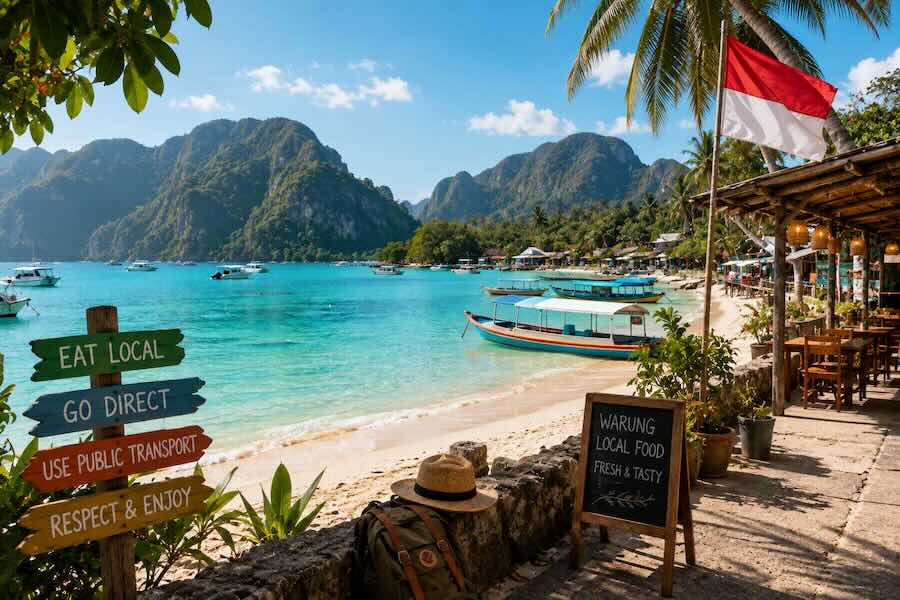
Indonesia rewards travelers who slow down. Beyond Bali’s polished resorts, the archipelago stretches across thousands of islands, where ferries cross volcanic horizons, neighborhood warungs serve deeply regional food, and accommodation can shift from simple guesthouses to design-led stays within a few streets.
Traveling Indonesia on a budget is less about stripping the experience back and more about spending carefully. Local transport, flexible itineraries, regional food, and direct bookings can leave more room in your budget for the experiences that brought you here in the first place.
Haggle where it is appropriate
Bargaining remains part of the shopping experience in some Indonesian markets and independent stalls, but context matters. Fixed-price shops, restaurants, supermarkets, ticket offices, and businesses displaying set prices are generally not places to negotiate.
Where bargaining is expected, keep it light and respectful. Ask the price, make a reasonable counteroffer, and decide what the item is actually worth to you. If you cannot agree, walking away politely is better than turning a small purchase into an argument over a negligible amount of money.
Compare direct bookings before paying
Booking directly can sometimes produce a better room rate, a more flexible cancellation policy, breakfast, an upgrade, or another small perk. It is not automatically cheaper, though, so compare the hotel’s direct offer with reputable booking platforms before committing.
The same principle applies to activities. A hotel can make arranging a driver or excursion effortless, while a reputable local operator may provide greater flexibility. Compare what is actually included rather than choosing on price alone. Transport, entrance fees, meals, insurance, equipment, and guide credentials can materially change the value of a tour.
Use local transport strategically
Indonesia is enormous, so there is no single transport strategy that works everywhere. Java has extensive rail connections alongside buses and local transit, while moving between islands may involve ferries or domestic flights. Within major cities, public transportation can be considerably cheaper than arranging private transport for every journey.
Check routes, fares, payment methods, and schedules before leaving your accommodation rather than assuming the system works the same way from one island to another. For longer journeys, compare the complete cost and travel time. An apparently cheap connection can lose its advantage once transfers, port transportation, luggage charges, and an extra night’s accommodation are added.
Talk to people
Some of the most useful travel information never appears on a booking page. Guesthouse owners, guides, café staff, other travelers, and local residents can point you toward inexpensive transport, quieter beaches, neighborhood restaurants, or destinations you might otherwise miss.
These conversations can also give you a better sense of local prices. Just verify practical information when money or safety is involved, particularly for transportation, tours, boat trips, and remote excursions.
A local guide can be worth the expense
Hiring a guide sounds counterintuitive when you are trying to save money, but the right guide can make a complicated day considerably easier. Local knowledge is particularly useful around archaeological sites, national parks, volcanic landscapes, diving areas, and destinations where transportation is difficult to coordinate independently.
Before booking, establish the total price and exactly what it covers. Ask about transportation, permits, entrance fees, meals, equipment, group size, and additional charges. For outdoor activities, prioritize properly qualified operators and safety standards over the lowest quote.
Eat where the neighborhood eats
Indonesia’s food is one of the easiest places to make a travel budget work beautifully. Warungs and casual local restaurants can serve dishes with remarkable depth for considerably less than restaurants concentrated around major tourist districts.
Look beyond the familiar nasi goreng. Regional cooking changes dramatically across the country, from the rich dishes associated with Padang cuisine to Javanese specialties and the seafood traditions found across the islands. A busy establishment with a steady flow of local customers can also be a useful signal when choosing somewhere to eat.
Look beyond Bali
Bali remains one of Indonesia’s defining destinations, but it represents only a fragment of the country. Java brings together rail journeys, cities, temples, volcanoes, and coffee-growing landscapes. Lombok offers beaches and mountain country, while destinations farther east can feel dramatically different again.
Venturing beyond the busiest resort areas can sometimes reduce accommodation and dining costs, although remote destinations are not automatically cheaper. Limited flights, boats, guides, and infrastructure can make less-visited islands surprisingly expensive to reach. Build the itinerary around total journey cost rather than room prices alone.
Build flexibility into your Indonesia budget
Leave some financial breathing room for ferry changes, weather disruptions, baggage fees, entrance charges, transfers, and the inevitable place you decide deserves another night. Indonesia’s geography makes rigid island-hopping schedules particularly vulnerable to disruption.
For current entry requirements and official travel information, check the official Indonesia tourism website and relevant Indonesian government sources before departure. Prices, visa requirements, transportation schedules, and local regulations can change.
Conclusion
A budget trip through Indonesia does not have to feel restrictive. Spend locally where it makes sense, compare bookings, understand transportation before moving between islands, and leave enough time to experience each destination rather than racing through a checklist.
The reward is a journey with more texture: breakfast at a neighborhood warung, a ferry cutting across bright water, an unexpected conversation, and perhaps an island that was never part of the original plan.
FAQ
Is Indonesia suitable for budget travel?
Yes. Accommodation, local food, and transportation can be relatively affordable in many parts of Indonesia, although costs vary considerably by destination and travel style.
Is it cheaper to book hotels directly in Indonesia?
Sometimes, but not always. Compare the property’s direct rate with reputable booking platforms and consider extras such as breakfast, cancellation terms, taxes, and airport transfers.
Should you haggle in Indonesia?
Bargaining can be appropriate at certain markets and independent stalls. It generally is not appropriate where prices are clearly fixed. Keep negotiations friendly and respectful.
Is Bali the cheapest Indonesian island to visit?
Not necessarily. Bali has options across many budgets, but popular areas can be expensive. Other islands may offer lower daily costs, although transportation to remote destinations can increase the total price.
What is the best way to save money while traveling around Indonesia?
Eat locally, compare accommodation prices, use appropriate public transportation, avoid unnecessary transfers, and spend longer in fewer destinations. Constant island hopping can quickly increase a trip’s cost.
Originally contributed by Keith Harrison.