



Curly hair can look completely different from one wash day to the next. One day your curls are soft, defined and full of bounce; the next, they seem determined to frizz in every direction. While there is no single routine that works for every curl pattern, leave-in conditioner can make a noticeable difference when dryness, tangles and frizz are getting in the way.
Curly and coily hair can be more prone to dryness because natural oils from the scalp have a harder time travelling along the bends and curves of the hair shaft. That makes moisture an important part of a good hair-care routine.
A leave-in conditioner won’t magically create perfect curls, but the right formula can add softness and slip, make detangling easier and help protect hair from some of the everyday friction that contributes to frizz and breakage.
What Does Leave-In Conditioner Actually Do?
Unlike a traditional rinse-out conditioner, a leave-in is designed to remain on the hair after washing.
Depending on the formula, it can help soften the hair, reduce tangles, improve manageability and give curls a smoother foundation before you apply gels, mousses or creams.
Some leave-ins also provide heat protection, although you shouldn’t assume every conditioner does. If you’re going to diffuse or use other heated styling tools, check the product instructions to see whether it is specifically designed to protect against heat.
How to Choose a Leave-In Conditioner for Curly Hair
The biggest mistake may be choosing a leave-in simply because the bottle says it’s made for curls. Curl pattern is only one part of the equation.
Think about how your hair actually behaves. Is it fine and easily weighed down? Thick and consistently dry? Color-treated? Prone to tangling? Does it absorb rich creams happily, or does product seem to sit on the surface?
Fine curls and waves may respond better to lightweight lotions, milks or sprays, while thicker, coarser or particularly dry curls may benefit from richer creams. There are exceptions, so treat these as starting points rather than strict rules.
The best leave-in is ultimately the one that leaves your hair feeling conditioned without making it sticky, greasy or limp.
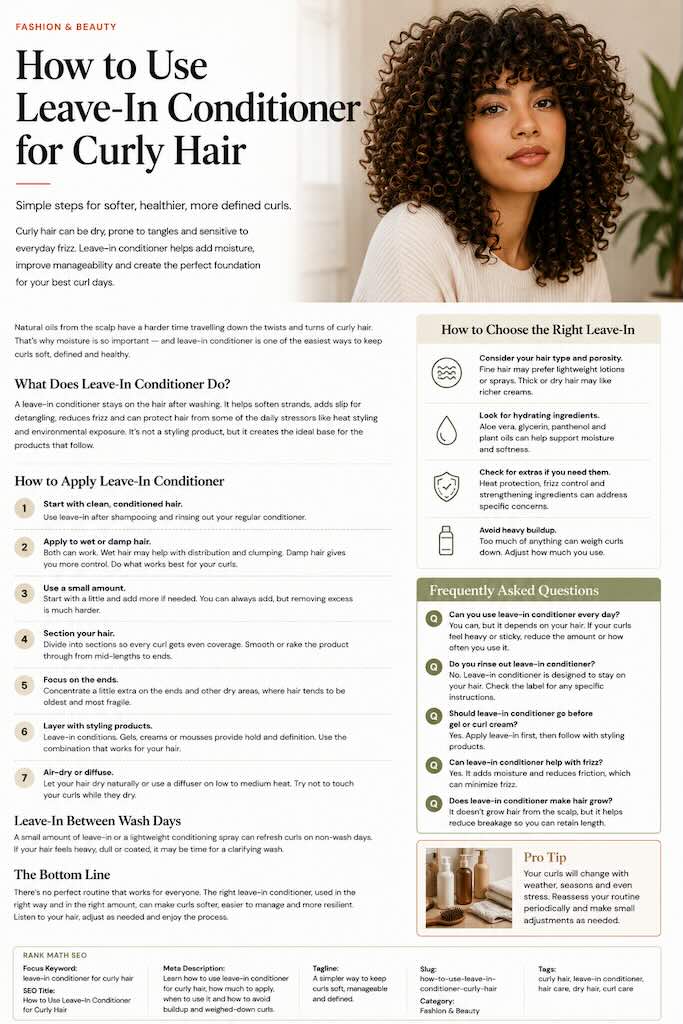
How to Apply Leave-In Conditioner
1. Start With Clean, Conditioned Hair
Unless the instructions for your particular products say otherwise, use leave-in conditioner after shampooing and rinsing out your regular conditioner.
You don’t necessarily need a complicated routine. Shampoo, conditioner, leave-in and one styling product may be all your curls need.
2. Experiment With Wet and Damp Hair
You’ll often hear that leave-in conditioner must be applied to either soaking-wet or damp hair. In reality, both methods can work.
Applying product to wetter hair can make distribution easier and may encourage curl clumping. Applying it after gently removing some excess water can give you more control and may work better with certain formulas.
Try both and pay attention to the result. Your curls are a better guide than an arbitrary rule.
If you remove excess water first, gently squeeze rather than aggressively rubbing your hair. A soft T-shirt or microfiber towel can be useful for reducing friction.
3. Start With Less Than You Think You Need
It’s tempting to assume that dry curls need lots of conditioner, but more product doesn’t necessarily mean more moisture.
Start with a small amount and distribute it thoroughly before deciding whether you need more. The right quantity depends on your hair’s length, density and texture as well as the concentration of the product.
If your curls feel coated, greasy or unusually heavy after drying, try using less next time rather than immediately switching products.
4. Section Your Hair
If you have thick or dense curls, dividing your hair into sections can make a surprisingly big difference.
Instead of smoothing conditioner over the visible surface and hoping it reaches everything underneath, work through a few sections so the product is distributed more evenly.
You can rake the product gently through with your fingers, smooth it over the hair with your palms or use a detangling brush if that works well for your curl pattern.
5. Give the Ends Extra Attention
The ends are the oldest part of your hair and often the first area to show dryness and damage. Concentrating a little extra leave-in through the mid-lengths and ends can therefore make sense, particularly if your roots become oily or weighed down easily.
Pay attention to other consistently dry areas too. The outer layer of the hair can experience more environmental exposure and everyday friction than sections protected underneath.
Leave-In Conditioner Isn’t the Same as a Styling Product
This is where curly-hair routines can become confusing.
A leave-in conditioner primarily helps condition and improve manageability. A curl cream may add moisture as well as definition, while a gel or mousse is generally used to provide hold and help curls maintain their shape as they dry.
You don’t necessarily need all of them.
If your hair is fine, layering leave-in, cream, mousse, gel and oil could leave your curls flatter than when you started. Begin with the products your hair actually needs and add another step only when it solves a specific problem.
Watch for Product Buildup
Leave-in conditioner stays on the hair, which means repeated applications can eventually contribute to buildup — particularly when you’re also using styling creams, gels, oils or dry shampoo.
If your curls suddenly look dull, feel coated, become difficult to style or don’t respond to products the way they normally do, adding even more conditioner may not be the answer.
A thorough wash may be all that’s needed to give you a cleaner starting point. How frequently you need that reset depends on your hair, scalp and the products you use.
Can You Use Leave-In Conditioner Between Wash Days?
Yes, but you may not need a full application.
For curls that have become slightly dry or frizzy overnight, try wetting your hands and smoothing a very small amount of leave-in over the areas that need attention. A lightweight conditioning spray can also work well for refreshing hair without completely restyling it.
If your hair already feels heavily coated with product, however, another layer is unlikely to improve matters. That may be your signal that wash day has arrived.
Air-Dry or Diffuse?
Both are options, and neither is automatically better for every head of curls.
Air-drying is simple and requires no heat, while diffusing can speed up drying and help create volume and definition. If you use heat, keep the temperature reasonable and make sure you’re using appropriate heat protection.
Once you’ve applied your products and your curls have started forming, try not to continually touch them while they dry. Less manipulation can mean less disruption to the curl pattern and less visible frizz.
If dryness remains a recurring problem despite changing your styling routine, it may be worth looking at your entire wash-day routine rather than expecting one product to fix everything. Our guide to caring for dry hair is a useful place to start.
The Bottom Line
Leave-in conditioner can be one of the most useful products in a curly-hair routine, but the secret isn’t using as much as possible or following a complicated set of curl rules.
Choose a texture that suits your hair, start with a small amount, distribute it evenly and adjust according to how your curls look and feel once they’re completely dry.
Your ideal routine may change with the weather, your haircut, chemical treatments and even the styling products you’re using alongside your conditioner. Curly hair rarely follows a perfect formula — and learning what your own curls respond to is often more useful than following somebody else’s routine step for step.
Frequently Asked Questions
Can you use leave-in conditioner every day?
You can use leave-in conditioner as often as your hair needs it, but daily application isn’t necessary for everyone. If your curls start feeling heavy, coated or greasy, reduce the amount or frequency and consider whether product buildup could be the problem.
Do you rinse out leave-in conditioner?
No. Products specifically labelled as leave-in conditioners are formulated to remain on the hair. Follow the directions on your particular product, as formulas can vary.
Should leave-in conditioner go before curl cream or gel?
Leave-in conditioner is generally applied before styling products. If you’re layering several products, check their individual instructions and experiment with smaller amounts to avoid weighing down your curls.
Can leave-in conditioner help with frizz?
It can help. Conditioning the hair and reducing friction can make curls look smoother and more manageable, although humidity, hair condition, styling technique and the products layered over your leave-in can all affect frizz.
Does leave-in conditioner make hair grow faster?
Leave-in conditioner doesn’t make hair grow faster from the scalp. Keeping hair conditioned and reducing tangles and breakage can, however, help protect the length you already have.