




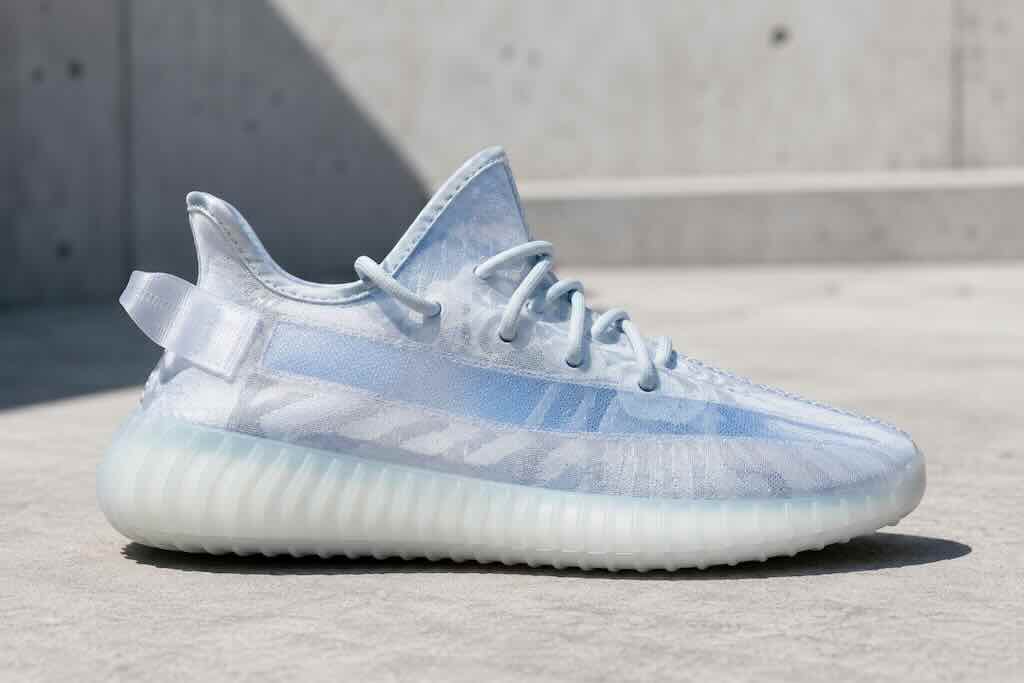
The Yeezy Boost 350 V2 “Mono Ice” belongs to a very specific moment in sneaker history. Released in 2021, its pale blue palette and translucent upper pushed the familiar 350 V2 silhouette into lighter, more technical territory, replacing the dense Primeknit appearance associated with many earlier editions.
It is also important to view the shoe differently today. The Adidas-Yeezy partnership no longer exists: Adidas terminated its partnership with Ye in October 2022, ending production of Yeezy-branded products. Adidas subsequently sold its remaining inventory and reported that, by December 31, 2024, it no longer held any Yeezy products. That makes the Mono Ice a discontinued sneaker encountered primarily through existing collections and the resale market.

The Yeezy Boost 350 V2 Mono Ice at a Glance
The Mono Ice, style code GW2869, was part of 2021’s Mono series. Contemporary Yeezy release calendars list its U.S. launch on June 18, 2021, at a retail price of $220. Mono Mist and Mono Clay appeared alongside it, carrying the same experimental direction into different palettes.
What made Mono Ice immediately recognizable was not simply the icy color. Its construction exposed more of the sneaker’s architecture. Through the semi-translucent upper, internal structural elements become part of the visual language rather than remaining hidden beneath an opaque knit.
1. The Translucent Upper Changed the 350 V2
Many earlier Yeezy Boost 350 V2 releases were closely associated with knitted uppers. Mono Ice changed the texture significantly, using a translucent monofilament-style mesh that gives the shoe a lighter, almost skeletal appearance.
The effect is particularly clear in daylight. Internal reinforcement can be seen beneath the pale surface, while socks subtly influence the finished look. White or similarly light socks preserve the monochromatic effect; darker colors create deliberate contrast through the upper.
2. Its Color Is Quiet but Distinctive
Mono Ice sits somewhere between powder blue, icy grey, and translucent white depending on the light. That restraint is part of its appeal. Rather than relying on high-contrast patterning, the sneaker uses small shifts in opacity and tone to define its shape.
It also makes the pair relatively easy to style. Neutral trousers, washed denim, shorts, tonal sportswear, and simple oversized pieces all leave enough visual space for the unusual upper to register. Readers building a broader footwear rotation can also explore Divine’s guide to essential men’s shoe styles.
3. The Familiar Side Stripe Remains
The long lateral stripe remains one of the defining elements of the 350 V2 silhouette. On Mono Ice, however, it integrates with the translucent construction rather than sitting against a heavily patterned knit.
That combination gives the sneaker an interesting tension: the proportions are unmistakably 350 V2, but the material treatment makes the shoe feel markedly different from many releases that preceded it.
4. The Internal Structure Becomes Part of the Design
Look closely through the upper and a web-like internal framework becomes visible. Function and appearance overlap here. Instead of disguising the sneaker’s supporting construction, Mono Ice allows it to create depth beneath the mesh.
This is arguably the detail that has aged best. Years after its original release, the layered construction still gives Mono Ice a technical character without requiring complicated graphics or excessive color.
5. Boost Cushioning Sits Underneath
Beneath the experimental upper sits the familiar Boost-based cushioning associated with the 350 V2 family. Adidas describes Boost technology as a cushioning system built from expanded thermoplastic polyurethane particles designed around energy return and comfort.
On Mono Ice, the light-toned sole unit complements the upper rather than interrupting it, keeping the profile soft and nearly monochromatic from collar to outsole.
Buying Yeezy Mono Ice Today Is a Resale-Market Decision
The original advice to reserve Mono Ice through an Adidas app is now obsolete. Adidas formally ended the Yeezy partnership in 2022 and later worked through the remaining inventory. Its 2024 annual reporting states that sales of remaining Yeezy products generated approximately €650 million that year and that no Yeezy inventory remained at year-end.
For collectors, that changes the buying equation. Condition, provenance, seller reputation, original packaging, size labels, and return policies now matter at least as much as finding the right size.
How to Approach Yeezy Authentication
Older authentication guides often reduce the process to a handful of supposedly definitive clues: a particular font, stitching detail, insole print, or box label. That is too simplistic for a mature resale market. Counterfeits change, production details can vary, and normal wear can alter precisely the features buyers are told to inspect.
Instead, examine the pair as a complete object. Compare the style code, size information and labels with the box where available. Look closely at proportions, material quality, internal construction, outsole and Boost appearance, stitching consistency, branding and the geometry of the upper. Be cautious when a seller relies on one detail as absolute proof of authenticity.
Purchase history can be useful too. An original receipt or documented transaction adds context, although documentation itself should never be treated as infallible. For expensive pairs, an established sneaker authentication service or resale platform with buyer protection can provide another layer of scrutiny.
What About the Box and Labels?
Mono Ice is associated with style code GW2869, a useful reference when assessing a listing. Packaging information should be internally consistent with the shoe, its stated size and the specific release.
Still, authenticating the box without examining the sneaker is risky. Boxes, labels and receipts can be reproduced or separated from their original shoes. Treat packaging as supporting evidence rather than the entire authentication process.
Why Mono Ice Still Matters
The Mono series arrived late enough in the Adidas-Yeezy story to benefit from an already recognizable silhouette, yet it altered one of that silhouette’s most visible characteristics. The translucent construction made the internal framework visible and gave a familiar sneaker an unexpectedly airy surface.
There is also a historical dimension now. Adidas reported that the two sales drops of remaining Yeezy inventory during 2023 generated around €750 million, followed by approximately €650 million from remaining-product sales in 2024. By the end of that year, the company’s Yeezy inventory was gone. The sneakers remain; the business that produced them does not.
Conclusion
The Yeezy Boost 350 V2 Mono Ice is best understood today as an archived piece of a discontinued collaboration rather than an upcoming sneaker release. Its cool translucent mesh, visible internal framework and restrained palette distinguish it within an enormous 350 V2 catalog.
For anyone buying a pair now, patience matters. Study the specific release, compare the entire shoe rather than hunting for one supposed tell, and choose sellers that provide clear photographs, provenance and meaningful buyer protection.
Frequently Asked Questions
When did the Yeezy Boost 350 V2 Mono Ice release?
The Mono Ice, style code GW2869, was released in the U.S. on June 18, 2021, with an original retail price of $220.
Does Adidas still make Yeezys?
No. Adidas terminated its partnership with Ye in October 2022 and ended production of Yeezy-branded products. The company subsequently sold remaining inventory and reported that it held no Yeezy products as of December 31, 2024.
What is the style code for Yeezy Mono Ice?
The Yeezy Boost 350 V2 Mono Ice is associated with style code GW2869.
Can one detail prove that a Yeezy is authentic?
No single detail should be treated as definitive. Authentication is stronger when the shoe’s construction, labels, materials, proportions, packaging and provenance are assessed together.