




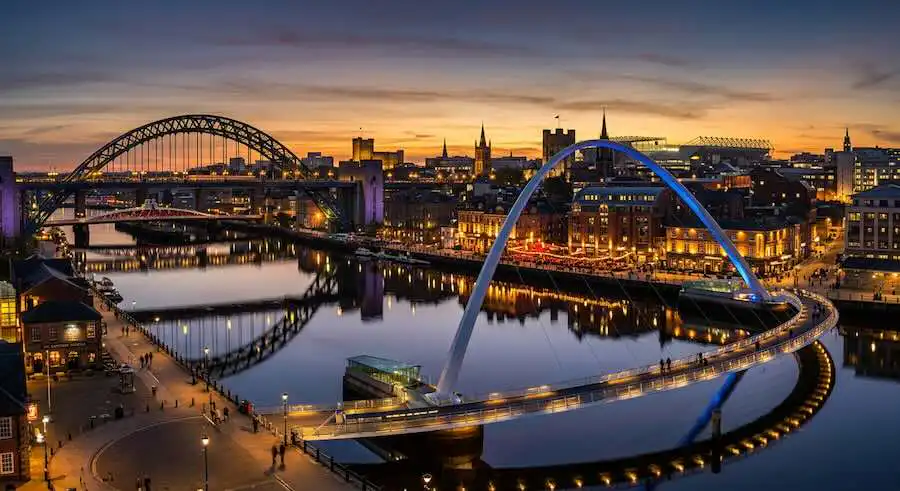
Newcastle upon Tyne is the biggest city in North East England and serves as the regional hub for the entire North. It sits on the banks of the River Tyne, close to where the river meets the North Sea, and it’s roughly a 30-minute train ride from the Scottish border.
A Quick Overview Of Newcastle
Newcastle is large geographically, and its reputation matches. It’s often called the unofficial Northern Capital thanks to its close ties to music, football, and nightlife. Universities near the city centre keep a young, trendy crowd in steady supply, and the city’s football culture runs deep — Newcastle United’s home ground alone gives the city a presence that punches well above its size.
Newcastle is a happening place where there’s genuinely no shortage of things to do. There’s the traditional nightlife scene set against spectacular bridges and arches, pubs and clubs full most nights, and big-name concerts passing through regularly. For a break from the urban energy, there are green spaces and walking tours, art galleries, and museums enough to spend a full history-focused day on their own.
Newcastle’s history stretches back to Roman times, and it’s easy to see why tourists keep getting drawn in by the mix of deep cultural heritage and a genuinely booming city life. If that sounds like the kind of place worth exploring, here’s a detailed guide to the best places to eat, drink, party, and explore in Newcastle:
- Getting Around
Once in Newcastle, the metro or the bus will cover most journeys. The general rule holds here as in most major cities: metro for short trips, buses for longer journeys that need two or more changes.
The Newcastle metro runs on a combination of standard track and “guided bus,” where the vehicle runs on tracks but follows white lines painted directly onto the road.
- Party Newcastle’s Style
People from Newcastle genuinely love drinking beer and dancing, and the two pair naturally here. Bars and clubs are scattered across the city centre, but the main nightlife concentration sits around Collingwood Street and Bigg Market.
For rock music, Central Station is the place to head — a cluster of live music venues surrounds it. For something quieter, The Central bar, right inside the station itself, is a solid option for a low-key drink.
A taste of authentic local ale is worth seeking out too, usually served in traditional pubs passed down through generations. The Old George Inn, tucked into the Bigg Market since 1582, holds the title of Newcastle’s oldest pub — a genuinely good spot to try the classic local beers in a setting that’s earned its history rather than staged it.
- Shopping
Newcastle’s main shopping street is Northumberland Street, near Central Station. It’s lined with high-street shops, mostly aimed at tourists and everyday errands alike.
For trendier clothes and vinyl, Ouseburn Valley is the place to head. It’s one of Newcastle’s more modern pockets and home to a large share of the student population. A handful of good cafes down there make for a pleasant afternoon, with plenty of backdrop for anyone building out their Instagram.
A trip to Newcastle also isn’t complete without the Quayside Markets. This award-winning market runs every day and offers plenty of local produce and artisan crafts — the ideal spot for a proper souvenir, or just a good browse.
- Places To Visit
There’s no risk of running out of places to visit in Newcastle — here’s a breakdown of the activities worth building a trip around:
- Pleasure Cruises And Bridges: NewcastleGateshead has the most extensive collection of bridges in Europe, and a river cruise is genuinely the best way to see them from an entirely different angle. Several operators run pleasure cruises up and down the river, including Captain Cook Cruises.
For a closer look at the bridges themselves, the Swing Bridge is worth the walk. For something more traditionally handsome, the High Level Bridge has a genuinely lovely pub built into the top of it.
- Castles: Newcastle Castle remains a must for anyone interested in the city’s medieval roots — it’s the most complete medieval castle in the North East and a major draw for visitors. The castle is open year-round and offers sweeping views over the city, along with regular events including jousting tournaments.
For something further off the well-worn path, Dunston Staiths is genuinely worth the detour — a 19th-century timber coal-loading structure on the River Tyne, and reputedly the largest surviving timber structure in Europe. It’s an atmospheric, slightly surreal thing to walk out onto, and unlike almost anything else in the region.
- Museums: Railway enthusiasts should head for the Stephenson Railway Museum in North Shields, just outside the city centre. It’s dedicated to George and Robert Stephenson, the father-and-son railway pioneers who spent two decades developing the ideas that shaped railways worldwide — the museum houses “Billy,” an early Stephenson locomotive and one of the oldest surviving steam engines anywhere. It’s a genuinely good family day out, with regular events throughout the year including seasonal Santa Specials.
The Laing Art Gallery, in the heart of Newcastle city centre on New Bridge Street, is also well worth the visit. Free exhibitions rotate regularly, alongside a permanent collection featuring work by J.M.W. Turner, Henry Moore, and Paul Gauguin, plus a selection of art classes for anyone interested in developing their own skills.
- Leisure And Entertainment
Newcastle’s theatre heritage runs deep across several distinct venues. The historic Theatre Royal on Grey Street hosts major touring productions and opera. Northern Stage, based in its own building near the university, focuses on fresh, thought-provoking new work. And just across the river in Gateshead, the Glasshouse International Centre for Music (long known as Sage Gateshead) delivers world-class music performances in a striking riverside building — home to the Royal Northern Sinfonia and a packed calendar spanning classical, folk, and jazz.
- Getting Out Into Nature
For runners, the Town Moor is arguably the best spot in Newcastle to get a proper session in. It’s a stretch of grassland running from the city centre out toward the business district and beyond, free to visit at any time, with paths suited to every fitness level — a good place for interval training, or simply working off the previous night out.
Heaton Park offers a gentler pace, with an outdoor gym, a bowling green, and tennis courts, plus plenty of paths for walking a dog or just enjoying the surroundings.
And for the day’s final note, few things beat watching the sunset from Walker Park, which offers genuinely impressive views over the River Tyne — an ideal spot for a picnic, or just a glass of wine and the view.
Conclusion
Newcastle has it all, whatever the mood calls for — a night of partying, a quiet walk through nature, an architecture-focused afternoon, or peaceful relaxation to close out the day. It’s a genuinely solid choice for a break from routine, and this guide should offer a strong starting point for planning the visit.
FAQ: Visiting Newcastle upon Tyne
Q: How many days should I spend in Newcastle? A: A long weekend — three to four days — covers the highlights comfortably: the castle, the Quayside, a museum or two, and a proper night out. A single extra day allows for Dunston Staiths or a trip further along the coast without feeling rushed.
Q: Is Newcastle expensive compared to other UK cities? A: Generally no — Newcastle tends to run noticeably cheaper than London and most southern English cities for food, drink, and accommodation, which is part of why it’s popular for both weekend trips and stag or hen parties.
Q: What’s the best way to get from Newcastle city centre to Gateshead? A: Walking across the Millennium Bridge or the Tyne Bridge takes about 10–15 minutes and is genuinely one of the better ways to see the riverfront. The metro also connects the two sides in a couple of minutes for anyone short on time.
Q: When is the best time of year to visit Newcastle? A: Late spring through early autumn (May–September) brings the mildest weather and the fullest events calendar. Winter has its own appeal too, particularly around the Quayside Christmas markets, though it’s considerably colder and wetter.