




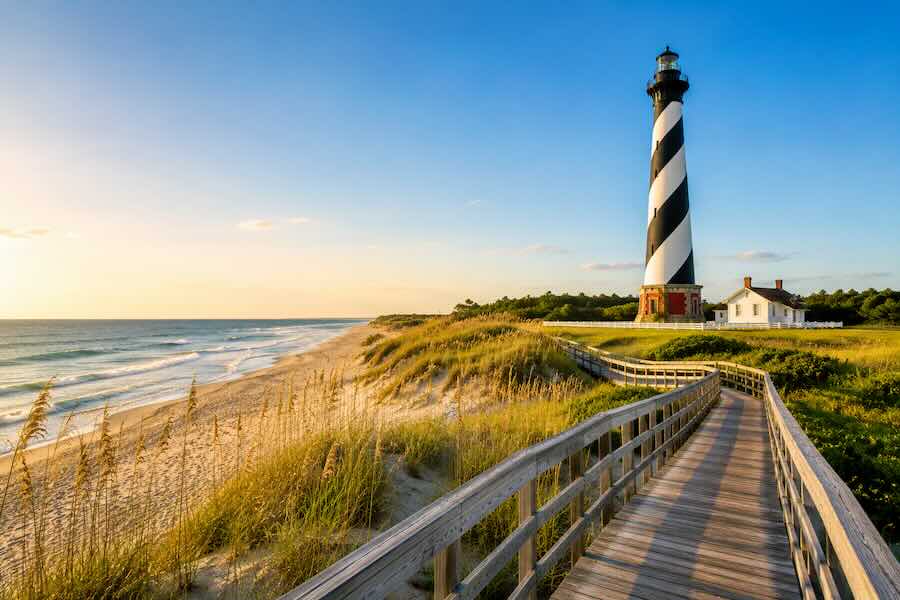
North Carolina’s Outer Banks has a particular rhythm. Atlantic surf rolls against long barrier islands, maritime history sits close to the sand, and stretches of open coastline can still feel remarkably removed from the mainland. For travelers who want beaches without giving up history, wildlife and outdoor exploration, it remains one of the East Coast’s most distinctive escapes.
Rather than treating the Outer Banks as a single beach destination, it helps to think of it as a string of communities and landscapes. Corolla and its wild horses occupy the north. Kill Devil Hills carries the story of powered flight. Farther south, Cape Hatteras brings dunes, maritime history and one of America’s most recognizable lighthouses into view.
Corolla Beach and the Wild Horses
Corolla combines Atlantic beaches with access to the quieter waters and landscapes around Currituck Sound. It is a natural base for swimming, paddling, long shoreline walks and slow days beneath a beach canopy. Visitors who want a comfortable setup can also arrange beach cabana rentals on the Outer Banks.
The landscape becomes more unusual as you travel north, where the famous Corolla wild horses roam the northern Currituck Outer Banks. Known as Banker horses, the herd is protected and managed by the Corolla Wild Horse Fund. Their presence gives this corner of North Carolina an atmosphere that feels genuinely different from a conventional beach resort.
Seeing the horses should be done responsibly. They are wild animals rather than a tourist attraction to approach, feed or touch. A reputable guided tour can provide a closer understanding of the herd while reducing unnecessary disturbance to the horses and their habitat.
Wright Brothers National Memorial
A few miles of coastline can separate a relaxing beach morning from one of the defining locations in aviation history. At Wright Brothers National Memorial in Kill Devil Hills, visitors can stand near the ground where Wilbur and Orville Wright achieved controlled, sustained powered flight on December 17, 1903.
The visitor center provides context through exhibits and a reproduction of the 1903 Wright Flyer in the Flight Room. Outside, the experience becomes more physical: visitors can follow the first flight line, explore reconstructed 1903 camp buildings and walk toward Big Kill Devil Hill and the Wright Brothers Monument.
It is this combination of landscape and history that makes the memorial worth more than a quick stop. The wind, open ground and broad horizon help explain why the brothers chose the Outer Banks for their experiments in the first place.
Cape Hatteras Lighthouse
Farther south stands the black-and-white spiral of Cape Hatteras Lighthouse. The present brick lighthouse was first lit in 1870, replacing an earlier sandstone tower dating to 1803. Its location is tied closely to the dangerous waters around Diamond Shoals and generations of Atlantic navigation.
There is an important update for anyone visiting in 2026: the Cape Hatteras Lighthouse is undergoing a major restoration and is not open for climbing this year. The National Park Service says the surrounding outdoor areas remain accessible, while restoration work includes masonry, metalwork, architectural details, walkways and the eventual installation of a first-order Fresnel lens.
That closure does not remove Cape Hatteras from the itinerary. The lighthouse remains a powerful sight from ground level, while the wider Cape Hatteras National Seashore offers beaches, maritime landscapes and other historic sites. Travelers specifically hoping to climb a lighthouse can check seasonal access at Bodie Island Lighthouse before their trip.
Roanoke Island Festival Park
Roanoke Island adds another layer to the region’s story. At Roanoke Island Festival Park, history is presented through interactive experiences connected to the early English voyages and the cultures that shaped the island.
The Elizabeth II, a representation of a 16th-century sailing ship, is one of the central attractions. The Settlement Site and museum experiences make the destination particularly useful for families because the history is tactile rather than confined to display cases.
Allow enough time to explore rather than treating Roanoke Island as a brief stop between beaches. The slower pace works well after several days of driving the barrier islands, and it gives younger visitors a change from surf and sand without abandoning the character of the Outer Banks.
How to Plan an Outer Banks Getaway
The Outer Banks rewards travelers who resist packing every landmark into one day. Distances along the islands can be deceptive, particularly during busy periods, so grouping attractions geographically makes for a calmer trip. Corolla works well as a northern base, Kill Devil Hills and nearby communities place visitors near aviation history, while Hatteras Island suits travelers interested in national seashore landscapes and lighthouse history.
Weather also shapes the experience. Bring sun protection and water for exposed historic sites, leave room in the itinerary for changing coastal conditions, and check official attraction pages before setting out. Seasonal opening hours, restoration projects and access conditions can change.
Conclusion
The Outer Banks works because the landscape never feels like background scenery. Sand, wind and water connect almost everything here, from the Wright brothers’ experiments to the horses roaming the northern beaches and the lighthouse standing over Cape Hatteras.
Come for the Atlantic shoreline, but give the islands time. The most memorable Outer Banks trip is usually the one that leaves enough space for an empty beach road, an unexpected historical stop and a few quiet hours with nothing scheduled at all.
FAQ
What are the best things to do in the Outer Banks?
Popular experiences include visiting Corolla and its wild horses, exploring Wright Brothers National Memorial, seeing Cape Hatteras Lighthouse, spending time on the beaches and visiting Roanoke Island Festival Park.
Can you climb Cape Hatteras Lighthouse in 2026?
No. Cape Hatteras Lighthouse is closed to climbing during 2026 because of a major restoration project. Outdoor areas around the lighthouse remain accessible.
Where can you see wild horses in the Outer Banks?
The wild Banker horses roam the northern Currituck Outer Banks around Corolla. Visitors should observe them responsibly and maintain the required distance from the animals.
Is the Outer Banks good for a family vacation?
Yes. Beaches can be combined with wildlife, aviation history, maritime landmarks and interactive attractions, giving families alternatives to spending every day on the sand.
How many days should you spend in the Outer Banks?
Four to seven days provides a comfortable amount of time for beaches and several major attractions without turning the trip into a continuous drive between islands.