




Some destinations are made for slowing down. A vineyard road winding through sunlit hills, a long lunch overlooking rows of vines, and a glass poured just a few miles from where the grapes were grown can turn an ordinary trip into something memorable.
From the historic estates of Bordeaux to the high-altitude vineyards of Mendoza, the world’s great wine regions offer much more than tastings. They combine food, landscapes, culture and centuries of winemaking tradition — making them rewarding destinations even if you aren’t a wine expert.
If a wine-focused escape is on your travel wish list, these ten regions deserve a place near the top.
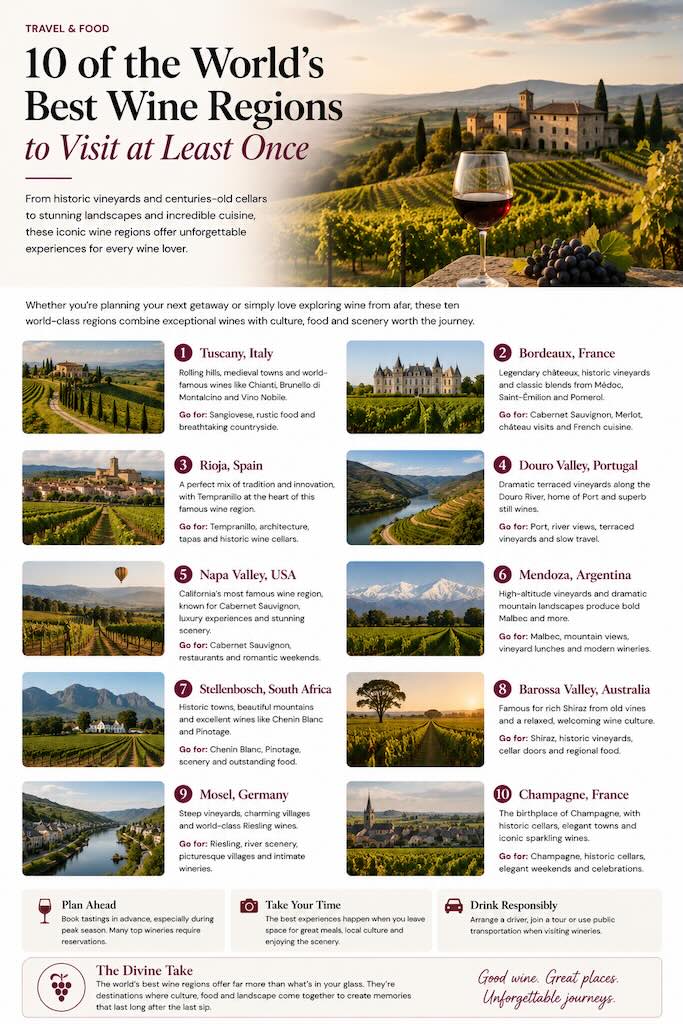
1. Tuscany, Italy
Few wine destinations deliver the fantasy quite like Tuscany. Cypress-lined roads weave between medieval towns, stone farmhouses and vineyards stretching across rolling hills.
Chianti is the obvious starting point, particularly for travelers interested in Sangiovese, but Tuscany’s wine map extends far beyond it. Montalcino is famous for Brunello di Montalcino, while Montepulciano offers its own combination of historic streets, vineyard views and long lunches.
Go for: Sangiovese, hill towns, rustic food and impossibly beautiful countryside.
2. Bordeaux, France
Bordeaux is one of the names that helped define fine wine around the world, but visiting the region makes it feel considerably less abstract.
Beyond the elegant city of Bordeaux are celebrated vineyard areas including Médoc, Saint-Émilion and Pomerol. Cabernet Sauvignon and Merlot dominate many of the region’s famous blends, while centuries-old châteaux give the landscape its unmistakable character.
Saint-Émilion is particularly appealing for a first visit, combining vineyards with a beautiful historic village that can easily become a destination in its own right.
Go for: Cabernet Sauvignon, Merlot, château visits and French gastronomy.
3. Rioja, Spain
Rioja offers an appealing balance between tradition and experimentation. Historic cellars sit alongside striking contemporary wineries, while Tempranillo remains at the heart of many of the region’s best-known wines.
The landscape is part of the attraction. Vineyards stretch beneath mountain ranges and surround small towns where a tasting can easily turn into an afternoon of tapas and local conversation.
For travelers who want serious wine without an overly formal atmosphere, Rioja is particularly easy to love.
Go for: Tempranillo, architecture, tapas and historic wine cellars.
4. Douro Valley, Portugal
The Douro Valley looks almost engineered for dramatic photographs. Steep vineyard terraces descend toward the Douro River, creating one of Europe’s most distinctive wine landscapes.
The region is historically associated with Port, but its still wines have given travelers another reason to explore beyond Porto. One of the most memorable ways to experience the valley is simply to move slowly through it — by road, rail or river — stopping at wineries along the way.
Go for: Port, river views, terraced vineyards and slow travel.
5. Napa Valley, California
Napa Valley turned California wine country into an international destination, and it remains one of the easiest places to combine vineyard visits with a luxury weekend.
Cabernet Sauvignon is the headline attraction, but the experience extends well beyond what’s in the glass. Acclaimed restaurants, spa resorts, design-focused tasting rooms and scenic drives make Napa as much a lifestyle destination as a wine region.
Reservations have become increasingly important at popular wineries, so this is one wine trip that rewards planning ahead.
Go for: Cabernet Sauvignon, restaurants, polished tasting experiences and romantic weekends.
6. Mendoza, Argentina
Few vineyard backdrops can compete with the Andes. Mendoza’s combination of high-altitude vineyards, dry climate and dramatic mountain scenery has helped make it the center of Argentina’s wine culture.
Malbec is the grape most closely associated with the region, but visitors will find far more variety once they begin exploring its wineries. Areas including Luján de Cuyo and the Uco Valley make particularly strong bases for tasting trips.
The experience is often wonderfully unhurried: vineyard lunches can stretch across an afternoon while the Andes sit on the horizon.
Go for: Malbec, mountain scenery, vineyard lunches and contemporary wineries.
7. Stellenbosch, South Africa
Less than an hour from Cape Town, Stellenbosch combines historic architecture, mountain scenery and one of South Africa’s most established winemaking traditions.
Cabernet Sauvignon, Chenin Blanc and the distinctly South African Pinotage are among the wines worth discovering here. Neighboring Franschhoek can easily be added to the same trip, creating one of the world’s most appealing combinations of wine and food tourism.
Go for: Chenin Blanc, Pinotage, mountain views and excellent food.
8. Barossa Valley, Australia
South Australia’s Barossa Valley has built an international reputation around Shiraz, including wines produced from remarkably old vines.
Despite that reputation, a visit doesn’t need to feel intimidating. Cellar doors, restaurants, farm shops and small producers make the region easy to explore at your own pace.
Its proximity to Adelaide also makes Barossa relatively simple to incorporate into a wider Australian itinerary.
Go for: Shiraz, historic vineyards, relaxed cellar doors and regional food.
9. Mosel, Germany
For white-wine lovers, Germany’s Mosel Valley belongs on the shortlist. Vineyards climb remarkably steep slopes above a winding river, with small villages appearing between the hills.
Riesling is the star, ranging from dry and mineral-driven styles to beautifully balanced sweeter wines. The landscape makes the region equally attractive for road trips, cycling and slow weekends between vineyard stops.
Go for: Riesling, river scenery, picturesque villages and intimate wineries.
10. Champagne, France
Champagne needs little introduction, but drinking it in the region where it is produced changes the experience completely.
Reims and Épernay provide access to famous Champagne houses, while smaller surrounding villages reveal another side of the region through independent growers and quieter tasting rooms.
Underground cellars, vineyard roads and elegant French towns make Champagne an easy choice for a celebratory weekend — although no celebration is actually required.
Go for: Champagne, historic cellars, elegant weekends and celebratory dinners.
How to Plan a Wine-Region Trip
The best wine trips leave room between tastings. Rather than trying to visit as many wineries as possible, choose two or three experiences in a day and leave time for lunch, exploring nearby towns and enjoying the landscape.
Many wineries now require reservations, particularly for guided tastings and vineyard tours. Check opening days and transportation options before you arrive, and arrange a driver, tour or other transportation whenever alcohol will be part of the day.
You also don’t need expert wine knowledge to enjoy these destinations. Ask questions, try something unfamiliar and pay attention to what you actually enjoy rather than what you’re told you should prefer.
The Divine Take
The best wine regions aren’t memorable simply because of what ends up in the glass. They’re places where landscape, food and local culture come together naturally. Tuscany might give you a long lunch overlooking the hills; Mendoza, an afternoon beneath the Andes; the Mosel, a quiet drive beside the river.
Choose the region whose atmosphere appeals to you first. The wine can be the discovery that follows.
Frequently Asked Questions
What is the best wine region for a first wine trip?
Tuscany, Napa Valley and Stellenbosch are particularly approachable because they combine established wine tourism with restaurants, accommodation and plenty to do beyond tasting wine.
Do you need to know about wine before visiting wineries?
Not at all. Tastings can be one of the easiest ways to learn. A good host will explain the wines without expecting visitors to arrive with specialist knowledge.
Should winery visits be booked in advance?
Yes, whenever possible. Many wineries operate primarily through scheduled tastings, and sought-after estates can fill their available appointments well ahead of busy weekends and harvest season.