




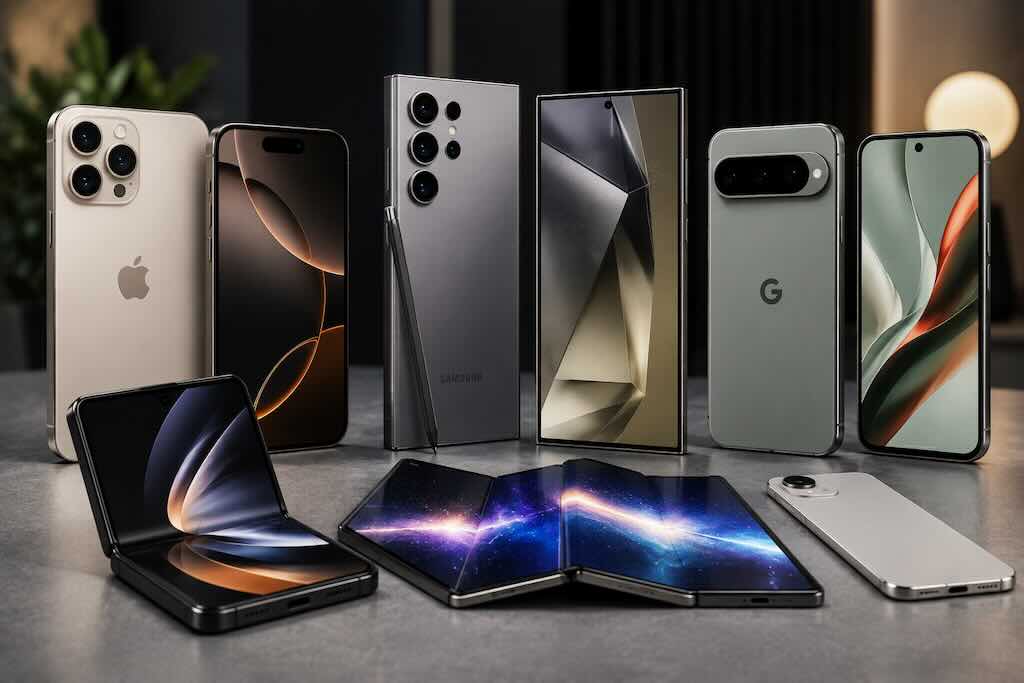
The most interesting smartphone story of 2026 is not another incremental camera upgrade. It is shape.
Apple has pushed flagship hardware into a 5.64mm-thin iPhone Air. Samsung has expanded its foldable range with two very different Fold models and already tested the limits of the category with a phone that unfolds twice. Google, meanwhile, is treating its newest Pixel as an increasingly AI-centered camera and computing device.
The familiar glass rectangle is still dominant, but choosing a premium phone now involves more than deciding which processor wins a benchmark. Size, software support, cameras, charging, ecosystem and even the physical form of the device can matter more.
Editor’s note: This guide has been fact-checked for September 2026 using current manufacturer specifications and availability. Several launch, pricing and availability claims have been clarified, particularly around Google’s Pixel 11 Pro XL and Samsung’s rapidly changing foldable range.
The Three Flagships to Know in 2026
There is no single best smartphone for everyone. At this end of the market, the more useful question is which expensive phone is best suited to the way you actually use it.
1. iPhone 17 Pro Max: Best for Serious Mobile Video
The iPhone 17 Pro Max remains Apple’s top conventional iPhone as September 2026 begins. Its A19 Pro chip sits inside an aluminum unibody design with an Apple-designed vapor chamber intended to improve thermal management during demanding workloads.
The camera system is equally important. All three rear cameras use 48MP sensors, while the telephoto system provides 4x optical zoom and an 8x, 200mm-equivalent option that Apple describes as optical-quality zoom.
Video is where the Pro models make their clearest case for creators. ProRes RAW, Apple Log 2 and genlock support move the phone closer to professional production workflows than the usual collection of social-video modes.
- Standout hardware: A19 Pro, vapor-chamber cooling and three 48MP rear cameras.
- Best suited to: Video creators, photographers already working inside Apple’s ecosystem and buyers who prioritize consistency over experimentation.
- Worth knowing: The 6.9-inch display reaches up to 3,000 nits of peak outdoor brightness, according to Apple.
2. Samsung Galaxy S26 Ultra: Best for S Pen Productivity
The Samsung Galaxy S26 Ultra remains one of the most feature-dense conventional Android phones available in 2026.
Its 6.9-inch QHD+ Dynamic AMOLED 2X display supports the S Pen, which remains the clearest hardware distinction between Samsung’s Ultra and most competing flagships. For people who actually annotate documents, sketch, edit or take handwritten notes on a phone, that matters more than another abstract AI claim.
The rear camera system combines a 200MP f/1.4 wide camera with a 50MP ultrawide and 50MP telephoto offering 5x optical zoom and 10x optical-quality zoom.
- Standout hardware: 200MP main camera, 5x telephoto, 6.9-inch display and integrated S Pen support.
- Best suited to: Android power users who want one large device for photography, handwriting, work and media.
- Worth knowing: Samsung’s software features are extensive, but the S Pen remains the more tangible reason to choose the Ultra over many other large Android flagships.
3. Google Pixel 11 Pro XL: Best for Google’s Camera and AI Experience
The Pixel 11 Pro XL is Google’s newest large-screen flagship. It pairs Google’s Tensor G6 processor with the Titan M3 security coprocessor and a 6.8-inch Super Actua LTPO OLED display.
Google’s approach remains heavily computational. The rear system includes a 48MP telephoto with 5x optical zoom, while Pro Zoom extends digitally assisted reach to 120x. Magic Capture joins features such as Camera Coach, Add Me, Best Take, Night Sight and Google’s growing collection of AI-assisted editing tools.
Wireless charging has also become more interesting. The Pixel 11 Pro XL supports Qi2.2-certified Pixelsnap charging at up to 25W, bringing magnetic wireless charging deeper into Google’s hardware ecosystem.
- Standout hardware: Tensor G6, Titan M3, 6.8-inch Super Actua display and 5x telephoto camera.
- Best suited to: Buyers who want Google’s newest photography, Gemini and Pixel software features in the largest Pro format.
- Worth knowing: Google specifies more than 30 hours of battery life under its testing conditions and up to 25W Pixelsnap wireless charging.
The previous Pixel generation may still be worth considering when discounted. As always, compare the actual retailer price rather than assuming an older flagship is automatically the better-value purchase.
The Bigger 2026 Story: Phones Are Changing Shape
The flagship battle is no longer confined to three large rectangular phones. Samsung and Apple are now exploring opposite ends of the physical spectrum: screens that become dramatically larger and devices that become unusually thin.
Galaxy Z Fold8 and Fold8 Ultra Take Different Approaches
Samsung’s 2026 foldable family introduced an unusual split between the Galaxy Z Fold8 and the more traditionally proportioned Galaxy Z Fold8 Ultra.
The Fold8 is the stranger and arguably more interesting design. Its 7.6-inch internal display uses a squarer 4:3 format, while the device folds into a short, wide shape. Samsung lists it at 201g, making it lighter than the 215g Fold8 Ultra.
The Fold8 Ultra follows the taller book-style formula more closely, with an 8-inch main display, 6.5-inch cover screen, 5,000mAh battery and a 200MP main camera. Both launch with Android 17 and Samsung’s One UI 9, use the Snapdragon 8 Elite Gen 5 for Galaxy and are promised seven generations of operating-system upgrades plus seven years of security updates.
This is a more meaningful choice than “regular versus expensive.” The two devices have genuinely different proportions. Anyone considering either should handle the phone in person if possible, because folded dimensions affect everyday comfort in a way specification tables struggle to communicate.
Galaxy Z TriFold Was the Wild Experiment
The Galaxy Z TriFold showed how far the concept could go. Samsung launched it in the United States on January 30, 2026, at $2,899, with a display that unfolds twice to create a 10-inch workspace.
Its technical ambition was substantial: a 200MP camera, 5,600mAh three-cell battery and a body measuring only 3.9mm at its thinnest point when unfolded.
Availability is the important caveat. Samsung currently describes the U.S. TriFold as a limited-run device that is completely sold out. That is different from saying the phone was formally discontinued after three months, so shoppers should not treat secondary-market claims about its status as official confirmation.
As a technology demonstration, though, the TriFold matters. It proved that a phone-sized object could open into something approaching a small tablet without using the familiar single-hinge book design.
iPhone Air Goes in the Opposite Direction
The iPhone Air is built around subtraction rather than expansion.
At 5.64mm deep and 165g, its appeal is immediately physical. The titanium body contains a 6.5-inch OLED display with ProMotion up to 120Hz, A19 Pro processor and a 48MP Fusion main camera.
The compromise is equally visible. Buyers do not get the three-camera versatility of an iPhone 17 Pro. Instead, the Air’s single 48MP rear camera also provides a 2x optical-quality crop.
That trade is the point. The Air asks whether a phone that feels noticeably lighter and thinner in the hand can be more desirable than one carrying every possible camera.
2026 Flagship Comparison
| Feature | iPhone 17 Pro Max | Galaxy S26 Ultra | Pixel 11 Pro XL |
|---|---|---|---|
| Display | 6.9-inch Super Retina XDR | 6.9-inch QHD+ Dynamic AMOLED 2X | 6.8-inch Super Actua LTPO OLED |
| Processor | A19 Pro | Flagship Snapdragon platform | Tensor G6 |
| Main Camera | 48MP Fusion | 200MP f/1.4 wide | Pro triple-camera system |
| Telephoto Highlight | 4x optical; 8x optical-quality | 5x optical; 10x optical-quality | 5x optical; Pro Zoom up to 120x |
| Distinctive Feature | Professional video tools | S Pen | Google AI and computational photography |
| Best For | Video and Apple users | Productivity and Android versatility | Pixel photography and Google AI |
Prices vary considerably by country, storage configuration, carrier and promotion, so current regional pricing is more useful than a single global figure when comparing these phones.
What Actually Matters When Buying a Flagship Phone?
Ignore Megapixels in Isolation
A 200MP camera is not automatically better than a 48MP camera. Sensor size, optics, image processing, stabilization, focal length and the conditions in which you shoot all affect the finished photograph.
Look at the complete camera system instead. If you frequently photograph concerts, travel or distant subjects, telephoto quality may matter more than the headline resolution of the main sensor. If you record video professionally, codec and workflow support may matter more still.
Brightness Matters, but Peak Nits Are Not the Whole Display
Outdoor visibility has improved substantially. Apple specifies up to 3,000 nits of peak outdoor brightness for both the iPhone 17 Pro line and iPhone Air, while Google’s Pixel 11 Pro XL reaches a stated peak of 3,600 nits.
Those numbers are not always measured under identical conditions, so avoid treating them as a laboratory ranking. Anti-reflective coatings, automatic brightness behavior and sustained brightness can be just as noticeable outdoors.
Software Support Changes the Value Equation
A phone kept for five or six years needs more than fast hardware on launch day. Security updates and operating-system support determine how gracefully an expensive device ages.
Samsung explicitly promises seven generations of OS upgrades and seven years of security updates for its 2026 Fold8 models. When comparing any two phones, check the manufacturer’s current support policy for the exact model rather than assuming every device from the same brand receives an identical commitment.
Choose the Form Factor Before the Specification Sheet
A Fold8, iPhone Air and S26 Ultra solve very different physical problems.
If you read documents and multitask constantly, a foldable may justify its extra complexity. If you are tired of carrying a heavy phone, the Air’s thin body could matter every hour of the day. If you want a stylus and a large conventional display without a folding hinge, Samsung’s Ultra remains unusual.
The phone you enjoy holding is often more useful than the one that wins the longest specification table.
Conclusion
Premium smartphones in 2026 have reached a curious point. Conventional flagships are extraordinarily capable, yet the most interesting developments are happening around their edges.
The iPhone 17 Pro Max remains a compelling choice for demanding video work. Samsung’s S26 Ultra combines a large display, long zoom and S Pen in a format that still fits familiar expectations. Google’s Pixel 11 Pro XL puts its newest computational photography and AI tools at the center of the experience.
Then the rules begin to loosen. Fold8 becomes wider. TriFold opens twice. iPhone Air becomes thinner.
That may be the defining shift of 2026: after years of phones looking increasingly alike, manufacturers are finally asking what else a smartphone could feel like.
FAQ: Smartphones in 2026
Is 8K video worth having on a smartphone?
For most people, 4K remains more practical because it offers excellent image quality with smaller files and easier editing. 8K can be useful for particular production workflows, cropping flexibility or high-resolution archival footage, but it should not be a deciding feature for the average buyer.
Are physical SIM cards disappearing?
eSIM adoption continues to grow, but physical SIM cards have not disappeared globally. SIM configurations vary by manufacturer, model and market, so international travelers should check the exact regional version before buying.
Does Apple have a foldable iPhone in September 2026?
Apple has not officially announced a foldable iPhone as of September 1, 2026. Rumors about future Apple hardware should therefore be treated separately from products the company has actually announced.
Can you still buy the Samsung Galaxy Z TriFold?
Samsung currently describes the U.S. Galaxy Z TriFold as a limited-run device that is completely sold out. Availability may differ by country and can change, so check Samsung directly rather than relying on secondary-market listings.
Should I buy a foldable phone in 2026?
A foldable makes most sense when you will regularly use the larger internal screen for reading, multitasking, media or work. If those benefits are occasional, a conventional flagship may provide better simplicity for the money. Try the folding mechanism and dimensions in person before committing if possible.
Which 2026 flagship phone is best?
For video-focused creators, the iPhone 17 Pro Max has an unusually strong professional toolset. The Galaxy S26 Ultra stands out for S Pen productivity and camera versatility, while the Pixel 11 Pro XL is particularly attractive for buyers who want Google’s newest camera and AI experience. Ecosystem, size and software preferences should decide between them.