




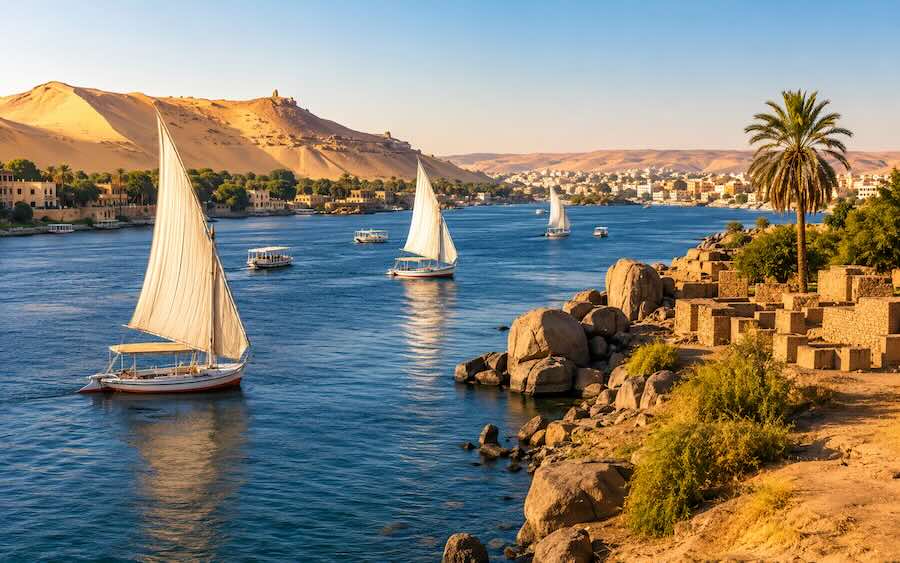
Aswan is one of Egypt’s most captivating destinations, where ancient temples, Nubian culture, desert landscapes and life along the Nile come together. Quieter in rhythm than Cairo and deeply connected to the river, the southern Egyptian city rewards travelers who give it more than a quick stop on the way to Abu Simbel.
From monumental archaeological sites rescued from the rising waters of Lake Nasser to colorful markets and contemporary Nubian culture, Aswan offers an unusually varied introduction to southern Egypt. Here’s what to see, when to go and how to make the most of your visit.
Best Places to Visit in Aswan
Some of Aswan’s landmarks rank among Egypt’s most extraordinary archaeological achievements, but the city is more than an open-air museum. Its appeal also comes from the Nile, Nubian heritage, bustling markets and the contrast between ancient monuments and modern engineering.
Abu Simbel Temples
The temples of Abu Simbel are among the most remarkable sights in southern Egypt. Originally carved into a cliff on the west bank of the Nile, the complex now stands near Lake Nasser after an extraordinary international rescue operation relocated the monuments during construction of the Aswan High Dam.
Built during the reign of Ramses II in the 13th century BC, the complex consists of two temples. The Great Temple is dominated by four colossal seated statues of Ramses II carved into its façade, creating one of ancient Egypt’s most instantly recognizable sights.
The temples are also known for a celebrated solar phenomenon in which sunlight penetrates the Great Temple and illuminates figures within its inner sanctuary on specific days of the year. The relocation of Abu Simbel formed part of UNESCO’s international campaign to preserve Nubian monuments threatened by rising waters.
For more on the preservation effort, see UNESCO’s Nubia Campaign.
Temple of Philae
Philae is one of Aswan’s most atmospheric archaeological sites, in part because reaching it involves crossing the water by boat.
The temple complex was moved from Philae Island to nearby Agilkia Island as part of the international effort to protect Nubian monuments from flooding. Dedicated principally to the goddess Isis, the site developed across different periods of Egyptian history and later shows Greek, Roman and Byzantine influences.
Columns, courtyards, monumental gateways and detailed reliefs make the temple worth exploring slowly rather than treating it simply as another stop on a packed sightseeing itinerary.
Background and visitor information can be found on Egypt’s official monuments page for Philae.
Aswan High Dam
The Aswan High Dam represents a completely different chapter of Egyptian history. Constructed during the 20th century, the enormous engineering project transformed the country’s relationship with the Nile and created Lake Nasser.
The dam was designed to help control flooding, provide a more reliable water supply and generate hydroelectric power. Its construction also had enormous environmental, cultural and archaeological consequences, including the international effort to relocate monuments that would otherwise have been submerged.
Today, visitors can stop at viewpoints overlooking the dam and Lake Nasser. For historical background, Encyclopaedia Britannica’s overview of the Aswan High Dam provides additional context.
The Unfinished Obelisk
Some archaeological sites impress because they were completed. Aswan’s Unfinished Obelisk is fascinating for precisely the opposite reason.
Still lying in the ancient granite quarry where it was being carved, the enormous unfinished monument provides a rare look at how ancient Egyptian stoneworkers approached projects of extraordinary scale. It is generally associated with the reign of Hatshepsut.
A crack in the granite appears to have contributed to the project’s abandonment, leaving the obelisk attached to the bedrock. Walking around it makes the sheer ambition of ancient Egyptian stoneworking easier to comprehend.
For additional historical context, see The Metropolitan Museum of Art’s introduction to Egyptian obelisks.
The Nubian Museum
Ancient Egyptian monuments understandably dominate many itineraries, but visiting Aswan without learning about Nubian history leaves an important part of the region’s story unexplored.
The Nubian Museum presents the history and cultural heritage of Nubia through archaeological objects, pottery, sculpture, jewelry and other artifacts spanning different periods.
The museum itself is also notable. Designed by Egyptian architect Mahmoud al-Hakim, its architecture draws inspiration from the landscape and traditional Nubian forms.
Learn more through Egypt’s official Nubian Museum page.
Kom Ombo Temple
North of Aswan, Kom Ombo stands dramatically beside the Nile and is unusual for its symmetrical double design.
The temple was dedicated to two divine figures: Sobek, associated with the crocodile, and Horus the Elder. This dual dedication is reflected in the architecture, with corresponding entrances, halls and sanctuaries.
A nearby museum displays mummified crocodiles and objects connected to the cult of Sobek. Kom Ombo is also a familiar stop on Nile cruise itineraries between Aswan and Luxor, making the journey along the river part of the experience.
Experience Nubian Culture Near Aswan
Contemporary Nubian culture remains an essential part of Aswan’s identity. Communities around the region maintain distinctive traditions expressed through language, music, food, crafts and architecture.
Visits to Nubian communities are commonly included in Aswan itineraries, often reached by boat along the Nile. Brightly painted homes and geometric decoration have become especially recognizable to visitors, but it’s worth remembering that these are living communities rather than simply tourist attractions.
Approach a visit with curiosity and respect: buy crafts directly from local makers where possible, ask before photographing people and look beyond the most Instagrammed corners to learn something about Nubian history and contemporary life.
Kalabsha Temple
Kalabsha Temple is another important monument connected to the rescue of Nubian archaeological sites threatened by the creation of Lake Nasser.
Built during the Roman period and dedicated to the Nubian deity Mandulis, the temple was dismantled and reconstructed at a new location near the High Dam. Its relatively peaceful setting can make it particularly appealing for travelers looking beyond Aswan’s busiest attractions.
The wider collection of protected Nubian monuments is documented through UNESCO’s Nubian Monuments listing.
Aswan Old Souk
After days of temples and archaeological sites, Aswan’s market offers a welcome change of pace.
The Old Souk, sometimes referred to as Sharia el-Souk, runs through the city not far from the Nile. Stalls sell spices, dates, dried hibiscus, perfumes, textiles, baskets, clothing and souvenirs, creating a lively place for an evening walk.
Take your time rather than treating the market simply as a shopping stop. Even if you leave without buying much, the scents, conversations and changing displays offer a glimpse of everyday Aswan beyond its archaeological attractions.
When Is the Best Time to Visit Aswan?
Aswan has a hot desert climate with abundant sunshine. Winters are generally much more comfortable for sightseeing, while summer temperatures can become extreme.
For most travelers, October through April offers the most comfortable conditions for exploring outdoor archaeological sites. If visiting during hotter months, plan major outdoor attractions for early morning and allow time to rest during the hottest part of the afternoon.
Average Temperatures in Aswan
The figures below provide a general guide to Aswan’s seasonal temperature pattern. Actual conditions vary, so check a reliable weather forecast shortly before traveling.
| Month | Average High | Average Low |
|---|---|---|
| January | 22°C | 10°C |
| February | 24°C | 11°C |
| March | 29°C | 15°C |
| April | 34°C | 19°C |
| May | 38°C | 24°C |
| June | 40°C | 26°C |
| July | 41°C | 27°C |
| August | 41°C | 28°C |
| September | 39°C | 26°C |
| October | 35°C | 22°C |
| November | 29°C | 17°C |
| December | 23°C | 12°C |
How Many Days Do You Need in Aswan?
For most first-time visitors, three days is a good starting point.
- Day 1: Philae, the High Dam and the Unfinished Obelisk.
- Day 2: Abu Simbel as a dedicated excursion.
- Day 3: The Nubian Museum, time on the Nile and the Old Souk.
Add another day if you prefer a slower pace or want more time for Nubian cultural experiences, Kalabsha or simply enjoying the river. Travelers continuing by Nile cruise will naturally structure their itinerary differently.
FAQ: Visiting Aswan
What is the best time of year to visit Aswan?
October through April generally offers the most comfortable temperatures for sightseeing. Summers can be extremely hot, making early-morning planning particularly important.
How many days should you spend in Aswan?
Allow around three days for a first visit if you want to see Aswan’s principal attractions and make a dedicated excursion to Abu Simbel without rushing everything into a single day.
Is Aswan safe for tourists?
Travel conditions can change, so check the latest official travel advice issued by your own government before visiting Egypt. Follow local guidance while traveling and take the same practical precautions you would in other unfamiliar destinations.
How can you explore Aswan’s main sights?
Travelers can arrange individual transport, use local boats for certain attractions or join organized Aswan day tours that combine several major sights. A Nile cruise can also connect Aswan with destinations farther north. Compare itineraries carefully and check exactly what admission fees, transportation and guiding services are included before booking.
Why Aswan Belongs on Your Egypt Itinerary
From ancient temples rescued from the rising waters of Lake Nasser to Nubian culture, colorful markets and evenings beside the Nile, Aswan offers something distinctly different from Egypt’s larger cities.
Give the city enough time rather than treating it simply as a departure point for Abu Simbel or a Nile cruise. Some of Aswan’s appeal comes from its monumental sights, but much of it is found in the slower moments between them: crossing the Nile by boat, wandering through the souk and watching the desert light change along the river.