




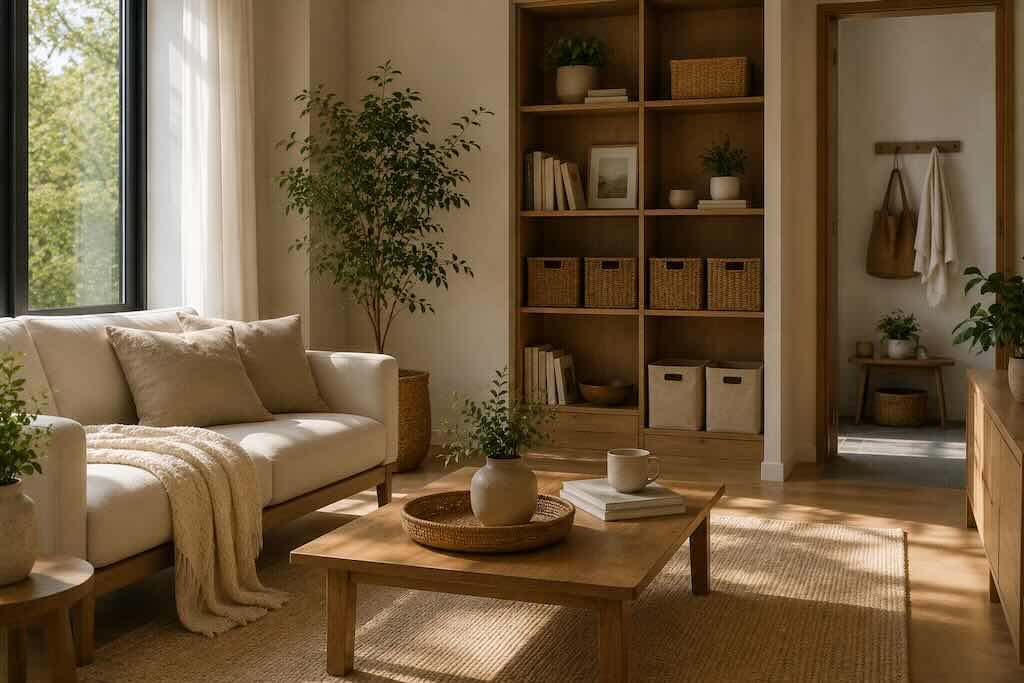
Clutter rarely arrives all at once. It accumulates quietly: unopened mail on the kitchen counter, clothes pushed to the back of a wardrobe, duplicate kitchen tools, boxes waiting for a future use that never quite comes. Eventually, a home can begin to feel less like somewhere to recover and more like another unfinished task.
Editor’s note: This article has been updated to remove outdated clutter statistics, unsupported claims about stress and addiction, and a commercial storage link, while adding research-backed context on clutter, spending and practical ways to simplify your home.
Decluttering will not permanently eliminate stress, make everyone happier or transform productivity overnight. Those promises turn a useful household practice into something it cannot realistically deliver. What reducing clutter can do is remove some of the visual and practical friction from everyday life.
If stress itself is the larger issue, Divine’s guide to easy ways to reduce stress explores additional strategies. Decluttering works best as one part of that wider picture.
Can Clutter Really Affect Stress?
There is research connecting perceptions of a cluttered home with stress, although the evidence is more nuanced than the internet’s familiar “clutter causes anxiety” shorthand.
In a UCLA study published in Personality and Social Psychology Bulletin, researchers examined how 60 dual-income couples described their homes and compared those descriptions with patterns of mood and cortisol. Women who described their homes using more stressful and clutter-related language showed different daily cortisol patterns and reported worsening mood across the day.
The study was small and observational, so it cannot establish that clutter itself caused those responses. It does, however, illustrate something many people recognize intuitively: whether a home feels restorative or unfinished can matter to the person living inside it.
Why Clutter Can Create Everyday Friction
Imagine getting ready on a rushed morning. Your keys are somewhere beneath yesterday’s post. The shirt you want is hidden behind clothes you no longer wear. You buy another charging cable because you cannot find the three already sitting in a drawer.
None of these moments is catastrophic. Together, though, they create small interruptions that consume time and attention.
This is where decluttering becomes useful without needing exaggerated wellness claims. Fewer unnecessary possessions can mean fewer things to organize, clean, store, maintain and search through. The practical benefit is not minimalism for its own sake. It is making the objects in your home easier to use.
Clutter and Spending Often Meet at the Front Door
Decluttering usually focuses on what leaves the house. A more durable strategy also pays attention to what enters it.
The Consumer Financial Protection Bureau has found that consumers often want to manage their spending but can struggle to apply budgets and plans at the moment they make purchasing decisions. Its research also found strong consumer interest in real-time spending feedback as a way to curb impulse purchases and stay within a budget.
A crowded wardrobe or cupboard can therefore become useful information. Instead of treating every decluttering session as preparation for another shopping trip, notice what you repeatedly remove. Clothes bought because they were heavily discounted? Kitchen gadgets used once? Decorative objects that never found a natural place?
Patterns like these can tell you more about future purchasing decisions than another storage box ever will.
Decluttering Is Not the Same as Compulsive Decluttering
The original version of this article described excessive shopping and attachment to possessions broadly as “addiction.” That language is too imprecise.
People accumulate belongings for many reasons: convenience, sentiment, hobbies, family circumstances, limited storage, shopping habits or simply the gradual accumulation of ordinary life. Having a cluttered room does not mean someone has an addiction or a psychiatric condition.
Likewise, decluttering should not become an exercise in throwing things away simply to achieve an immaculate aesthetic. A functional home can contain books, collections, photographs, children’s toys and objects with emotional significance. The question is whether your possessions support the way you live or repeatedly get in its way.
How to Declutter Without Making It Overwhelming
The worst place to begin may be the entire house. “Declutter everything” is not a task; it is a project large enough to make procrastination understandable.
Choose one contained area instead. A bathroom drawer. One shelf. The surface beside your bed. Twenty minutes spent finishing a defined space can be more satisfying than spending an afternoon moving objects between rooms without making decisions.
1. Start With the Easy Decisions
Begin with obvious rubbish, expired products, broken objects you have no intention of repairing and duplicates you clearly do not need. These decisions require relatively little emotional energy and create visible space quickly.
Leave photographs, inherited objects and deeply sentimental possessions until later. Starting with the hardest category can stop a decluttering session before it gains momentum.
2. Give Frequently Used Things a Home
Organization becomes easier when everyday objects have predictable locations. Keys by the door. Chargers in one drawer. Documents in a designated file. Frequently used kitchen equipment within easy reach.
This is less visually dramatic than an empty countertop, but it addresses one of clutter’s most irritating consequences: wasting time searching for things you already own.
3. Use a Simple Keep, Move, Donate, Recycle System
Sorting becomes faster when every object has a destination. Keep what belongs in the space. Move misplaced objects to their correct rooms. Set aside usable items for resale or donation. Recycle or responsibly dispose of things that cannot reasonably remain in use.
Avoid creating a permanent “decide later” pile. If you genuinely need time, use one small container and set a date to review it.
4. Be Thoughtful About Storage
Storage can be useful, particularly during a move, renovation or temporary life transition. But moving ordinary household clutter into a paid storage unit does not necessarily solve the underlying problem. It can simply move possessions out of sight while adding another monthly expense.
Before buying organizers, baskets or storage furniture, decide what genuinely needs to remain. Storage works best after editing, not before it.
5. Create Friction Before Buying Something New
Decluttering becomes repetitive if possessions leave through one door while replacements continually arrive through another.
Try introducing a waiting period for nonessential purchases. Save the item rather than immediately checking out. Review your bank or credit-card history periodically. The Consumer Financial Protection Bureau’s spending guidance recommends looking back across several months to understand actual spending patterns rather than relying on what you think you spend.
That pause can separate “I want this now” from “I will actually use this.”
Should You Spend More on Experiences Instead?
The idea that experiences can bring more happiness than material purchases has some research behind it, but it should not become another rule telling people how to spend money.
The American Psychological Association has summarized research finding that experiential purchases generally produce greater happiness than material purchases, potentially because experiences can strengthen social connection and become part of personal memories.
Context still matters. An expensive holiday financed with unaffordable debt is not automatically a healthier purchase than a useful sofa. Financial well-being depends on what you can afford as much as what category the purchase belongs to.
How to Stay Decluttered
A perfectly organized home photographed immediately after a weekend cleanout tells us very little. The more useful test comes six months later.
Instead of repeatedly staging large decluttering sessions, build small maintenance habits into ordinary routines. Deal with mail when it arrives. Return objects to their places. Keep a donation bag somewhere accessible. Review one wardrobe category when seasons change. Repair useful items before replacing them.
Most importantly, slow the rate at which unnecessary possessions enter your home. Decluttering becomes much easier when it is no longer competing with constant accumulation.
Conclusion
A calmer home does not have to be sparse. It needs to work.
The goal is not empty shelves, color-coded drawers or a prescribed number of possessions. It is being able to find your keys, open the wardrobe without fighting through forgotten clothes and sit down at the end of the day without every surface reminding you of another unfinished decision.
Start with one drawer. Notice what you keep, what you release and what you continue buying. The most effective decluttering habit may ultimately happen long before anything reaches your front door.
Frequently Asked Questions
Can clutter cause stress?
Research has found associations between stressful perceptions of the home, mood and cortisol patterns, but that does not prove clutter directly causes stress in every person. Individual circumstances and perceptions matter.
Where should I start decluttering?
Choose one small, clearly defined area such as a drawer, shelf or countertop. Start with obvious rubbish, broken objects and unnecessary duplicates before moving to sentimental possessions.
Does decluttering improve mental health?
A more functional environment may reduce everyday frustrations and make a home feel easier to manage, but decluttering is not a mental-health treatment and should not be presented as one.
Should I rent a storage unit while decluttering?
Temporary storage can make sense during moves, renovations and other transitions. For routine clutter, however, paying to store unwanted possessions may postpone decisions rather than solve the underlying issue.
How do I stop clutter from coming back?
Combine regular small cleanups with more deliberate purchasing. Give frequently used possessions permanent locations, deal with incoming items promptly and pause before nonessential purchases.