


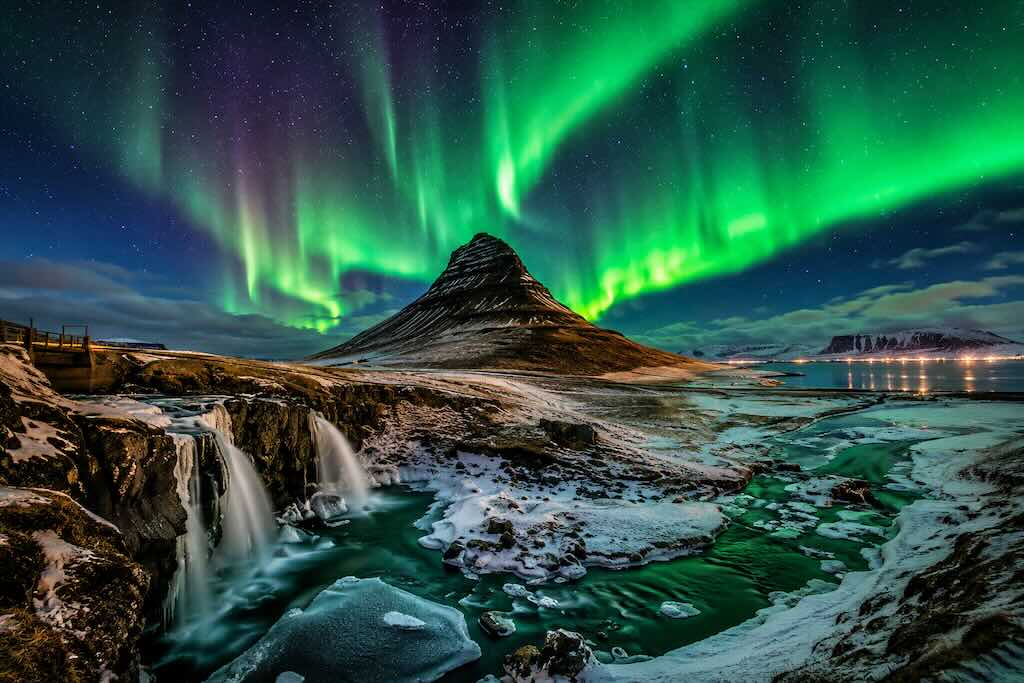
The Northern Lights can make Iceland feel almost unreal. Green ribbons move across a black winter sky, snow catches the faint color below, and beyond the towns there are long stretches where artificial light almost disappears. For travelers willing to wait for clear skies, Iceland remains one of Europe’s most compelling destinations for an aurora-focused road trip.
Editor’s note: This article has been updated for the 2026–27 aurora season to strengthen winter-driving and coastal safety advice, remove the commercial camper-van recommendation, clarify that Northern Lights sightings can never be guaranteed, and prioritize official Icelandic weather, road and destination information.
The Aurora Borealis is never guaranteed. Solar activity, cloud cover, darkness and location all have to cooperate, which is why flexibility matters more than chasing one supposedly perfect viewing spot. Iceland’s advantage is that an aurora trip can be built around extraordinary landscapes, so even a quiet night still leaves glaciers, volcanic coastlines, geothermal water and small towns to explore.
The best strategy is simple: give yourself time, watch the weather and build a trip you would still enjoy if the sky remained dark.
When to See the Northern Lights in Iceland
Iceland’s useful aurora-viewing period generally stretches from late August into April, when nights become sufficiently dark. The deepest winter months provide much longer periods of darkness, but darkness alone does not produce an aurora.
Before heading out, check the Icelandic Meteorological Office aurora forecast. Its forecast combines information about auroral activity with cloud cover, which is crucial: an active sky remains invisible beneath thick cloud.
Give yourself several nights rather than designing an entire journey around one evening. Conditions can change quickly, and a flexible itinerary gives you more opportunities to find clearer skies.
Light pollution matters too. Reykjavík can occasionally produce memorable urban aurora views during stronger displays, but darker countryside generally provides better contrast.
5 Places for an Iceland Northern Lights Trip
1. Reykjanes Peninsula
Reykjanes provides an immediate introduction to Iceland’s volcanic character. Black lava fields spread beneath low horizons, geothermal areas release steam into cold air, and the Atlantic meets a coastline that can feel remarkably exposed.
The Blue Lagoon is the peninsula’s most famous attraction, but Reykjanes deserves particular care when planning a trip. Volcanic activity has repeatedly affected parts of the region, including roads and access around Grindavík and nearby geothermal areas.
Check current information from the Icelandic Meteorological Office and SafeTravel Iceland before entering affected areas. Do not cross closures or approach active volcanic terrain simply to find a darker photography location.
When conditions and access allow, Reykjanes can work well at the beginning or end of an aurora road trip because of its proximity to Keflavík International Airport.
Best for: volcanic landscapes, geothermal scenery and shorter itineraries near the airport.
2. Reykjavík
Reykjavík gives an Iceland itinerary an urban counterpoint. Hallgrímskirkja rises above the city’s low skyline while cafés, restaurants, galleries and museums provide somewhere warm to retreat when Atlantic weather closes in.
The National Museum of Iceland adds useful historical context before a longer journey around the country.
The Northern Lights can appear above the capital when skies are clear and auroral activity is sufficient. However, artificial light reduces contrast, so travellers primarily interested in the aurora will generally benefit from moving beyond the brightest parts of the city.
Reykjavík still makes an excellent first-night base. Instead of driving for hours immediately after a flight, settle in, check the forecast and decide where the weather suggests going next.
Best for: first and final nights, museums, restaurants and weather-proof itinerary flexibility.
3. Jökulsárlón Glacier Lagoon
Jökulsárlón barely needs an aurora to feel cinematic. Icebergs move through dark water beneath the edge of Vatnajökull’s immense glacial landscape. Across the road, fragments of ice reach the black shoreline commonly called Diamond Beach.
On a clear winter night, the lagoon can provide an extraordinary foreground for Northern Lights photography. Water, ice and open sky create opportunities for reflections that a featureless field cannot.
The landscape also demands restraint. Stay on safe ground and never climb onto floating or stranded ice for a photograph. Glacier environments change continuously.
Anyone considering an ice-cave or glacier excursion should use an appropriate qualified operator rather than entering glacial terrain independently. Check current conditions and safety information through SafeTravel Iceland before setting out.
Best for: photographers, glacial landscapes and travellers continuing along the South Coast.
4. Snæfellsnes Peninsula
Snæfellsnes compresses an extraordinary amount of Icelandic scenery into one peninsula. Lava fields, fishing settlements, beaches, cliffs and the glacier-capped Snæfellsjökull create a landscape that can change dramatically within a relatively short distance.
The volcano has a literary connection too. Jules Verne used Snæfellsjökull as the entrance to the subterranean adventure in Journey to the Center of the Earth.
Elsewhere, Arnarstapi reveals basalt formations along the coast, while Ytri-Tunga is known for seal sightings. Kirkjufell, farther north, has become one of Iceland’s most photographed mountains.
The peninsula’s relatively sparse settlement makes dark skies easier to find than in central Reykjavík. That does not mean every roadside pull-off is safe, particularly in winter. Park only where permitted and never stop in the carriageway because the aurora has suddenly appeared.
Best for: varied landscapes, photography and a road trip within reach of Reykjavík.
5. Vík and the South Coast
Vík sits beneath steep slopes on Iceland’s South Coast, surrounded by waterfalls, black beaches and volcanic terrain. Nearby Reynisfjara is famous for its basalt columns, black sand and views toward the Reynisdrangar sea stacks.
Those features can create spectacular aurora photographs, but Reynisfjara is not a place to become absorbed in a camera screen.
Powerful sneaker waves can travel unexpectedly far up the beach. The official SafeTravel Iceland service should be checked for current conditions, and all local warning lights, signs and closures should be obeyed. Never turn your back on the ocean or approach the surf for a photograph.
Reyniskirkja, positioned above Vík, offers another distinctive view, while Dyrhólaey provides broad coastal scenery when access and weather permit.
Best for: black-sand landscapes, South Coast itineraries and dramatic photography.
How to Plan an Iceland Aurora Road Trip
Winter rewards flexible travellers. It punishes unnecessarily rigid itineraries.
A route that appears straightforward on a map can become much slower in snow, ice or strong wind. Instead of trying to collect destinations, build breathing room into the schedule and check conditions before every significant drive.
Iceland’s official road information service provides current road conditions, while the Icelandic Meteorological Office provides weather forecasts and warnings.
Check both. A promising aurora forecast is never a reason to ignore a poor road or weather forecast.
Winter Driving Requires a Different Pace
Iceland’s winter roads can involve snow, ice, darkness, sudden wind and rapidly changing visibility. Drivers unfamiliar with those conditions should be conservative about distances and willing to change plans.
Never stop on a road to photograph the Northern Lights. Find a legitimate parking area where the vehicle is completely clear of traffic.
If authorities advise against travel or close a road, change the itinerary. No photograph is worth testing a closure.
For more general trip preparation, Divine’s guide to travelling light can help reduce unnecessary luggage while keeping essential layers accessible.
How to Photograph the Northern Lights
You do not need professional equipment to photograph an aurora, but darkness changes how a camera behaves.
A tripod helps keep a camera steady during longer exposures. Start with a wide aperture, raise ISO as necessary and experiment with exposure time according to how quickly the aurora is moving. A bright, rapidly moving display may require a much shorter exposure than a faint arc.
Modern phones can also capture surprisingly strong results when their night modes are supported by a stable surface or tripod.
Keep spare batteries warm because cold conditions can reduce battery performance. More importantly, keep looking up. It is surprisingly easy to spend an aurora display staring at camera settings instead of the sky.
What to Pack for an Aurora Night
- Warm base and insulating layers
- Windproof and waterproof outerwear
- Warm hat and gloves
- Sturdy footwear suitable for winter conditions
- Charged phone and power bank
- Headlamp or flashlight
- Water and something to eat
- Tripod if photography is a priority
- Spare camera batteries where appropriate
Standing still beneath a winter sky can feel considerably colder than walking through the same temperature during the day. Dress for waiting, not merely for travelling between the vehicle and a viewpoint.
A Practical Northern Lights Checklist
- Check cloud cover: A clear section of sky can matter more than an impressive aurora number beneath complete cloud.
- Check weather warnings: Never let an aurora forecast override official weather advice.
- Check roads: Review current conditions before driving beyond your base.
- Find darkness safely: Use proper parking areas rather than stopping beside or on the road.
- Dress for waiting: Several stationary hours outdoors can feel much colder than expected.
- Protect batteries: Keep spare batteries warm and devices charged.
- Allow several nights: More opportunities improve your chances, but no itinerary guarantees a display.
- Stay flexible: Clouds, wind, closures and volcanic activity can all change the plan.
Conclusion
The Northern Lights may be the reason you book the ticket, but Iceland rarely allows them to remain the entire story.
A winter road trip can move from geothermal steam to glacial ice, from Reykjavík’s warm windows to a black beach where Atlantic waves disappear into darkness. Sometimes the clouds stay closed. Sometimes the forecast disappoints.
Then, on another night, a pale line begins almost imperceptibly above the horizon. It brightens. The shape bends, green gathers across the sky, and for a few minutes everyone stops checking the forecast.
Plan for Iceland first. Let the aurora remain the unpredictable extra.
Frequently Asked Questions
What is the best time to see the Northern Lights in Iceland?
The useful viewing season generally runs from late August into April, when nights are sufficiently dark. Actual visibility depends on cloud cover, auroral activity, darkness and local light pollution.
Can you see the Northern Lights from Reykjavík?
Yes. Strong displays can sometimes be visible from the capital, but artificial light reduces contrast. Darker locations away from the brightest urban areas generally provide better viewing conditions.
How many nights should I spend in Iceland to see the aurora?
There is no guaranteed number. Several nights give you more opportunities to encounter suitable weather and auroral activity than a single-night stop. A longer itinerary also makes it easier to enjoy Iceland when conditions are unsuitable for viewing.
Is Jökulsárlón good for Northern Lights photography?
Yes, when skies are clear and an aurora is present. Icebergs and water can create striking foregrounds and reflections, but visitors should remain on safe ground and avoid climbing onto ice.
Is it safe to drive around Iceland in winter?
It can be when conditions are suitable and the driver is properly prepared, but snow, ice, wind and road closures can change quickly. Check official weather and road information before driving and follow warnings and closures.
Do I need an aurora tour?
No. Independent travellers can use official forecasts and safely accessible dark locations. A guided tour can still be useful for visitors who do not want to drive in winter or who prefer local assistance interpreting conditions.
Guest Post by The Villa Escape
Yogi and Suchna believe in taking the road less traveled and discovering unexpected places along the way. For more than a decade, they have traveled across continents, explored unusual routes, discovered new flavors and stayed in distinctive accommodations. The Villa Escape is their expression of travel shaped by curiosity and discovery.