




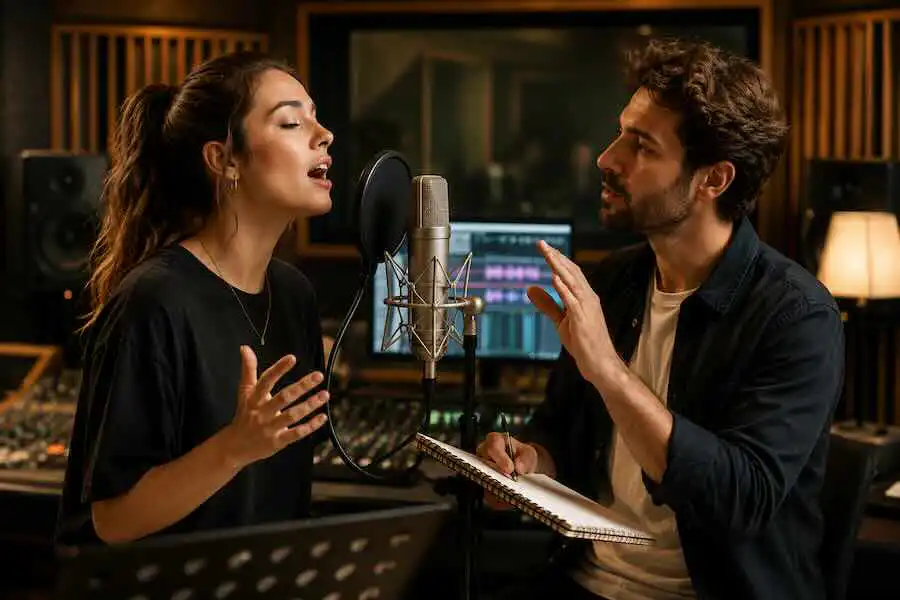
Natural talent may open the door, but professional singing is built through repetition, technique, recovery, and the ability to reproduce a performance when the lights come on. That is why vocal coaching remains part of the working lives of artists at every level.
Ever wonder how famous singers keep demanding songs performance-ready through rehearsals, recording sessions, touring, television appearances, and long promotional schedules? The effortless moment audiences hear is usually the final layer of considerably less glamorous work: warming up, listening closely, adjusting technique, resting, and doing it again.
That work often involves another pair of ears. A vocal coach or voice teacher can help a singer hear technical habits they may not notice themselves, prepare difficult material, develop consistency, and approach demanding performances more deliberately.
And this is not simply something beginners do until they become “good enough.” Lady Gaga, Beyoncé, Katy Perry, Katharine McPhee, Ariana Grande, and other established performers have all been publicly connected with vocal training or coaches during different stages of their careers.
Why Do Famous Singers Still Use Vocal Coaches?
A professional singer is not only trying to hit the right notes. They may need to deliver the same material repeatedly while preserving phrasing, dynamics, breath control, emotional detail, and physical stamina.
That changes the purpose of training. Once a singer already has considerable ability, coaching can become less about learning how to sing from scratch and more about refining how the voice behaves under specific demands.
A coach can listen while the singer concentrates on performing. That outside perspective is valuable because what a note feels like internally and what an audience actually hears are not always identical.
Professional coaching can also focus on repertoire, interpretation, range, transitions, preparation, and repeatability. When vocal health concerns arise, however, singers should seek appropriately qualified medical professionals rather than expecting coaching to diagnose or treat an injury.
Lady Gaga: Technique Behind the Theatrics
Lady Gaga is a useful reminder that theatrical confidence does not eliminate preparation. Her performances can demand sustained singing alongside movement, characterization, costume, staging, and the pressure of major live broadcasts.
Gaga has discussed intensive vocal preparation around major performances, and vocal coach Gordon Grody has been associated with her training. Grody’s professional history also includes work with other recording artists, making him part of that largely invisible network of specialists behind performances audiences experience as spontaneous.
The interesting lesson is not that Gaga needs someone to give her a voice. Clearly, she already has one. It is that an accomplished performer can still benefit from another expert listening to how that instrument is being used.
Beyoncé: Vocal Training Started Early
Beyoncé’s reputation for precision can make her performances look almost inevitable. They are anything but.
Her relationship with vocal training reaches back to childhood. Vocal teacher David Lee Brewer has documented working with Beyoncé during her formative years, long before the scale of Destiny’s Child and her solo career transformed her into a global performer.
That early foundation matters. Young singers are not simply collecting impressive notes; they are developing habits around listening, breathing, pitch, musicality, and practice. Years of performance experience can then build on those fundamentals.
Beyoncé’s career also illustrates something aspiring singers sometimes underestimate: reaching an elite level does not make preparation disappear. The stakes simply become larger.
Katy Perry: Coaching at Pop Scale
Pop vocals bring their own challenges. A song needs personality, but it also has to survive promotion, rehearsals, television, touring, choreography, and the repeated performances that follow a major release.
Katy Perry has worked with celebrity vocal coach Eric Vetro, whose client history includes singers such as Ariana Grande and other major performers. Vetro’s approach is particularly interesting because the relationship between singer and coach cannot be purely technical. Trust matters.
A singer needs enough psychological room to make an ugly sound, miss something, try another placement, change an interpretation, and repeat a phrase until it works. The polished performance comes later.
Ariana Grande: Training an Extraordinary Instrument
Ariana Grande’s range, agility, and recognizable tone have made her one of contemporary pop’s most distinctive vocalists. Her association with Eric Vetro also reinforces the central point: exceptional natural ability and vocal coaching are not opposing ideas.
In fact, the more capable the instrument becomes, the more nuanced the work can get. Coaching may involve tiny adjustments in phrasing, transitions between registers, interpretation, consistency, or how a demanding section fits within an entire performance rather than treating one spectacular note as the goal.
For aspiring singers, that is a healthier model than treating technique as remedial. Training is part of musicianship.
Katharine McPhee: Preparation Doesn’t End After the Audition
Katharine McPhee entered public consciousness through American Idol, where vocal ability is placed under an unusually bright spotlight. Yet succeeding in a televised competition does not remove the need to prepare difficult songs afterward.
McPhee has worked publicly with singer and vocal coach Natalie Weiss. In a filmed coaching session, viewers can watch the less glamorous mechanics behind preparing material for performance.
That is perhaps more useful for developing singers than another flawless live clip. You can see that professional-level singing still involves stopping, listening, adjusting, and trying again.
What Does a Vocal Coach Actually Do?
The terminology can become confusing because “vocal coach” and “voice teacher” are sometimes used interchangeably, even though their roles may differ.
A voice teacher generally concentrates on vocal technique and how the instrument is being produced. A vocal coach may focus more heavily on applying technique to repertoire, including phrasing, interpretation, diction, style, and performance preparation. Some professionals competently work across both areas.
Before booking lessons, ask what the teacher or coach specializes in and whether that matches your goal. Someone preparing for musical theatre auditions may need something different from a songwriter trying to record intimate alternative-pop vocals.
What You Can Learn From Celebrity Vocal Training
- Preparation is part of the performance: The audience sees the final minutes, not the hours that created them.
- Technique does not replace personality: Good training should give a singer more control over their individual sound, not erase it.
- Consistency matters: Singing one difficult note once is different from delivering an entire set reliably.
- Feedback accelerates learning: experienced listener can identify habits that are difficult to hear while you are simultaneously singing.
- Rest matters too: More practice is not automatically better practice. Persistent pain, unexplained hoarseness, or other concerning vocal symptoms deserve appropriate medical assessment.
How to Find the Right Vocal Coach
You do not need access to Los Angeles or a celebrity budget to begin training. In-person and online lessons have made specialized instruction considerably easier to find. Singers in New York, for example, can explore NYC singing and voice coaching lessons, while remote coaching can widen the field beyond your immediate location.
Look for relevant experience rather than famous names on a client list alone. Ask how the coach approaches your genre, what a typical lesson involves, whether they distinguish technique from repertoire coaching, and how they respond when something feels physically uncomfortable.
Most importantly, pay attention to communication. You should be able to ask questions and experiment without feeling embarrassed. Singing is physical and unusually personal; a productive teaching relationship requires trust.
Practical Takeaway: Treat Your Voice Like an Instrument
If you want to become a stronger singer, start with consistency rather than intensity. Establish a sensible practice routine, learn how your voice responds on different days, record yourself, and bring specific problems into lessons instead of simply asking to “sing better.”
A good coach cannot manufacture artistry for you. They can, however, help you understand the instrument carrying it.
Conclusion: Even Great Singers Keep Learning
The most useful thing about discovering that famous singers use vocal coaches is not the celebrity connection. It is what that connection says about mastery.
Lady Gaga can still prepare. Beyoncé can build on training that began in childhood. Katy Perry and Ariana Grande can work with experienced ears despite years of commercial success. Katharine McPhee can return to the rehearsal room and work through a difficult performance phrase by phrase.
Talent matters. So does curiosity, repetition, and the willingness to remain teachable after everyone else thinks you have already arrived.
FAQ: Famous Singers and Vocal Coaches
Do professional singers really use vocal coaches?
Yes. Professional singers may work with voice teachers or vocal coaches for technique, repertoire, interpretation, preparation, and consistency. The exact role varies according to the artist and performance.
Which famous singers have worked with vocal coaches?
Artists publicly associated with vocal coaches or formal vocal training include Lady Gaga, Beyoncé, Katy Perry, Ariana Grande, and Katharine McPhee, among many others.
Who was Beyoncé’s vocal teacher?
David Lee Brewer has documented teaching Beyoncé during her childhood and early development as a singer.
Who is Ariana Grande’s vocal coach?
Ariana Grande has worked with vocal coach Eric Vetro, who has coached numerous professional recording and performing artists.
Can beginners benefit from vocal coaching?
Yes. Beginners can use lessons to develop foundational technique, listening skills, repertoire, and productive practice habits. Choose a qualified teacher whose experience matches your goals and musical style.
Can a vocal coach treat vocal damage?
A vocal coach should not replace medical diagnosis or treatment. Persistent pain, voice loss, unexplained hoarseness, or other concerning symptoms should be assessed by an appropriately qualified healthcare professional.