




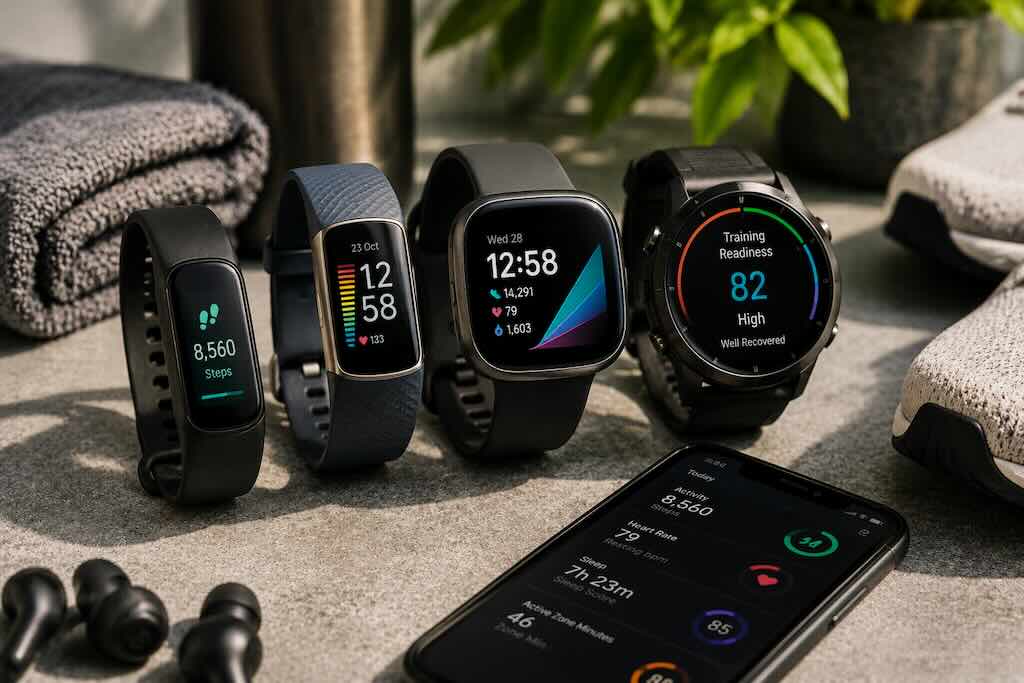
A fitness tracker can count thousands of steps, record a restless night and display a neat graph of your heart rate before breakfast. The harder question is what any of those numbers actually mean.
Editor’s note: This article has been updated for 2026 to remove outdated product rankings, correct claims about wearable accuracy, calories and blood-oxygen measurements, and distinguish useful fitness trends from measurements that should not be treated as medical data.
Modern wearables can make movement visible in a way that a vague intention to “exercise more” cannot. Steps accumulate. Runs appear on a map. Resting heart-rate trends stretch across weeks. Sleep and recovery estimates can encourage you to notice patterns that previously passed quietly in the background.
That makes fitness trackers useful tools for self-monitoring. It does not make every number precise, and it certainly does not turn a consumer smartwatch or ring into a doctor on your wrist.
Do Fitness Trackers Actually Help You Become More Active?
There is reasonable evidence that they can help some people.
An umbrella review of systematic reviews and meta-analyses covering more than 160,000 participants found that interventions using activity trackers were associated with increases in physical activity. Another systematic meta-analysis of wearable activity trackers reported increases in daily steps and weekly moderate-to-vigorous physical activity, although results varied according to the people using the devices and the interventions surrounding them.
That distinction matters. Buying a tracker does not automatically change behavior. Its real value comes when the information prompts something useful: an evening walk, another training session, a more realistic goal or simply greater awareness of how much of the day has been spent sitting.
If staying active is the larger goal, Divine’s guide to improving energy and staying active offers a broader approach beyond wearable data.
What Fitness Trackers Measure Well — and What They Don’t
Consumer wearables combine sensors with proprietary algorithms to estimate different aspects of movement and physiology. Accuracy varies according to the device, activity, fit, skin contact and metric being measured.
A systematic review of commercial wearable devices found reasonably good results for some step and heart-rate measurements under laboratory conditions, but performance varied between manufacturers and devices.
Energy expenditure was much less convincing. The same review found that none of the evaluated brands met its accuracy criteria for energy expenditure.
In practical terms, a watch telling you that you burned 642 calories should not be interpreted as a laboratory measurement of exactly 642 calories.
Steps Are Simple — and Still Useful
Step counts are one of the least glamorous features on a modern wearable, yet they can also be among the easiest to understand.
A daily total gives you a consistent reference point. Instead of obsessing over a universal target, watch your own pattern. A person averaging 3,000 steps does not need to jump instantly to an arbitrary five-digit number for the tracker to become useful. A gradual increase can be more realistic.
The World Health Organization frames its adult recommendations around time and intensity rather than a universal daily step target: adults should generally accumulate 150–300 minutes of moderate-intensity aerobic activity per week, or 75–150 minutes of vigorous activity, alongside muscle-strengthening activity.
A tracker can help you monitor movement toward that broader goal. It does not replace the goal itself.
Heart Rate Is Better Read as a Pattern
Optical heart-rate sensors have become standard across many wrist-based trackers. They can be useful for following resting heart-rate trends and estimating workout intensity, but readings are not infallible.
Movement, device position, fit and activity type can affect measurements. Accuracy can also vary considerably between models.
That is why trends are often more informative than isolated numbers. If your resting heart rate normally follows a fairly stable pattern, changes across days or weeks may provide useful context around training, recovery or routine.
Unexpected or concerning readings should not be diagnosed from an app. Symptoms or persistent concerns belong with an appropriate healthcare professional.
Treat Calorie-Burn Numbers With Caution
Calorie estimates are one of the easiest wearable metrics to overinterpret.
A systematic review and meta-analysis of Fitbit measurements found variation in estimates of energy expenditure, heart rate and steps compared with reference measurements, with energy expenditure potentially too inaccurate for some research purposes.
This does not make the feature worthless. Looking at approximate changes within the same device may provide context around activity. The problem begins when an estimated calorie total is treated as an exact accounting system for food and exercise.
Use the number as an estimate. Not permission to eat an exact number of calories back.
Sleep Tracking Is Useful for Patterns, Not Perfect Sleep Stages
Sleep has become one of the biggest battlegrounds in wearable technology. Watches and rings may estimate total sleep, awakenings, sleep stages and various recovery scores.
The interface can look remarkably clinical. The measurement method is not the same as a clinical sleep study.
A wearable may still help you notice practical patterns. Perhaps sleep duration drops whenever bedtime drifts later. Maybe alcohol, travel or an irregular schedule corresponds with poorer nights. Those observations can be useful without assuming every minute assigned to deep or REM sleep is exact.
If a device consistently reports poor sleep and you also experience symptoms such as significant daytime sleepiness, persistent insomnia or suspected breathing problems during sleep, seek professional assessment rather than trying to solve the problem from the wearable score alone.
Blood-Oxygen Readings Need Even More Context
Some consumer wearables estimate blood oxygen saturation, often labelled SpO2. The presence of the feature can make a device feel medically sophisticated, but consumer wellness measurements should not automatically be treated as clinical measurements.
The U.S. Food and Drug Administration warns that pulse-oximetry measurements have limitations and can be inaccurate under some circumstances. It also notes that general-wellness pulse oximeters sold directly to consumers are not evaluated for clinical decision-making in the same way as medical-purpose devices.
A wearable oxygen reading should therefore never override symptoms or professional medical advice.
Which Fitness Tracker Features Actually Matter?
The best tracker is not necessarily the one with the longest specification sheet. Start with the behavior you actually want to monitor.
- Daily activity: Look for comfortable wear, clear step and activity tracking, and battery life that fits your routine.
- Running or cycling: GPS, heart-rate tracking and useful workout screens may matter more than lifestyle features.
- Swimming: Check the manufacturer’s specific water-resistance rating and supported swimming activities rather than assuming “water resistant” means suitable for every aquatic use.
- Sleep: Comfort and battery life become especially important because the device has to remain wearable overnight.
- Recovery: Pay attention to long-term trends rather than allowing one daily score to dictate whether you should feel energetic or tired.
- Phone independence: Built-in GPS, cellular connectivity or offline music may matter if you prefer exercising without carrying a phone.
Don’t Buy a Tracker for Features You Won’t Use
Product rankings age quickly. Models change, software evolves and features that once required an expensive smartwatch eventually move into less costly devices.
Instead of declaring one device the universal “best,” compare a few practical details before buying:
- Which phone operating systems does it support?
- How often will you realistically tolerate charging it?
- Are the metrics you care about available without a paid subscription?
- Is GPS built in or dependent on a connected phone?
- Is the size comfortable enough for overnight wear?
- What water-resistance rating does the manufacturer specify?
- Can you export or delete your health and activity data?
- How long does the manufacturer typically support its devices and software?
The last questions are easy to overlook. A wearable collects unusually personal information about routines, location, sleep and physiology. Privacy settings deserve as much attention as strap color.
Fitness Trackers Can Motivate — Until the Numbers Take Over
Streaks, badges and daily goals can make movement satisfying. A small vibration at the wrist can be enough to interrupt an afternoon spent sitting.
But the same mechanisms can become counterproductive when every missed target feels like failure.
Rest is not a broken streak. A recovery day is not wasted because a ring remains unfinished. Exercise does not become meaningless because a battery died halfway through it.
The tracker should serve the routine, not control it.
A Better Way to Use Your Fitness Tracker
- Establish a baseline: Wear the device normally before setting aggressive targets.
- Choose one useful goal: More daily movement may be easier to act on than monitoring ten different metrics.
- Watch trends: Weekly and monthly patterns are often more meaningful than individual readings.
- Question calorie estimates: Treat energy-expenditure figures as approximations.
- Keep symptoms separate from scores: A reassuring wearable reading does not rule out a health problem.
- Allow rest: Do not let streak mechanics push you to exercise when recovery is appropriate.
- Review privacy: Understand what information the associated app collects, stores and shares.
For another practical approach to making exercise fit around everyday life, see Divine’s guide to getting in shape without wasting time and energy.
Conclusion
A good fitness tracker makes patterns easier to see. That is its strongest role.
It can show that weekday movement has quietly declined, that a running routine is becoming more consistent or that sleep duration changes when the schedule does. Research suggests wearable-based interventions can help increase physical activity, but the device itself is only part of that equation.
Wear the technology lightly. Use the data that changes something useful, question measurements that pretend to be more precise than they are, and remember that a healthy walk still counts when the watch is charging at home.
Frequently Asked Questions
Are fitness trackers accurate?
Accuracy depends on the metric, model and activity. Step counts and heart-rate measurements can be reasonably useful on some devices, while calorie expenditure and other estimates may contain substantial error. Consumer trackers should not be assumed to provide clinical-grade measurements.
Can a fitness tracker help with weight loss?
A tracker can support activity monitoring and behavior change, but it does not guarantee weight loss. Research suggests wearable interventions can increase physical activity, while evidence for weight outcomes is more variable. Calorie-burn estimates should also be treated cautiously.
How many steps should I take every day?
There is no single step target that is appropriate for everyone. WHO physical-activity guidelines are based primarily on activity duration and intensity rather than requiring a universal daily step number. Your current activity level, health and abilities should shape your goal.
Can a fitness tracker diagnose a health condition?
No. Some wearables include health-related features, and particular devices or functions may have regulatory authorization for specific uses, but general fitness data should not be used to diagnose a medical condition independently.
Are blood-oxygen readings from smartwatches reliable?
They can provide estimates, but pulse-oximetry technology has known limitations. Consumer wellness readings should not replace medical evaluation, particularly when symptoms are present.
Is a smartwatch better than a fitness band?
Not automatically. A smartwatch may provide a larger display, apps and communication features, while a simpler band can offer longer battery life and less distraction. The better choice depends on what you intend to track and how you want to wear it.