




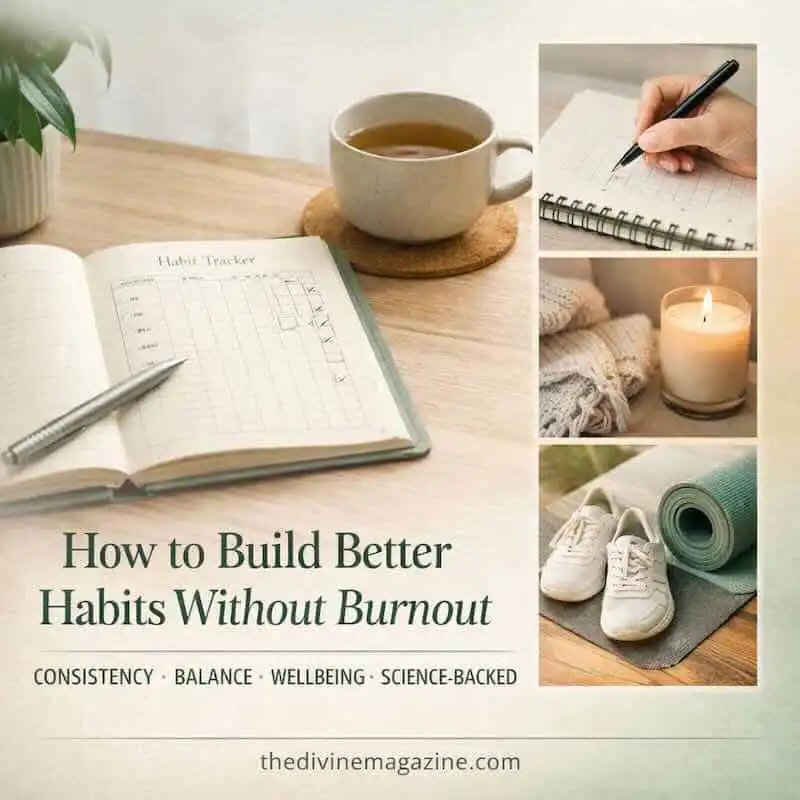
Building better habits in 2026 doesn’t have to mean pushing yourself to the edge of exhaustion. The most sustainable changes come from small, consistent actions that respect your energy, not fight against it. Instead of chasing “all or nothing” routines, you can design habits that support your goals and your wellbeing — without burning out in the process.
In this guide, we’ll explore how to build better habits without burnout using science-backed strategies, gentle structure, and realistic expectations. You’ll learn how to work with your brain, not against it, and how to create systems that make good choices easier and sustainable over time.
Why Traditional Habit Advice Often Leads to Burnout
Many habit-building approaches focus on intensity: 5 a.m. alarms, extreme routines, and rigid rules. While this can work for a short burst of motivation, it often collapses when life gets busy, stress rises, or energy dips. Research on behavior change and self-discipline shows that sustainable habits are built on consistency, not perfection. For a deeper dive into this, see James Clear’s habit framework and APA’s insights on stress.
Burnout happens when the demands you place on yourself consistently exceed your emotional, mental, and physical resources. If your habit strategy ignores rest, flexibility, and recovery, it’s not sustainable — no matter how “disciplined” it looks on paper.
Principle 1: Start Smaller Than You Think You Need
One of the most effective ways to avoid burnout is to shrink your starting point. Instead of committing to an hour at the gym every day, start with 10 minutes of movement. Instead of writing 2,000 words, start with 200. Tiny habits reduce resistance and make it easier to show up, even on low-energy days. For inspiration, check out BJ Fogg’s Tiny Habits method.
Ask yourself: “What is the version of this habit I could do even on my most tired day?” That’s your true baseline. You can always build from there.
Principle 2: Design Systems, Not Willpower Tests
Relying on motivation alone is a fast track to inconsistency. Instead, design systems that make the desired behavior the default. This might mean laying out your workout clothes the night before, prepping healthy snacks in advance, or blocking focused time on your calendar. Environment design is a powerful tool — as highlighted in many behavior studies and resources like Harvard Business Review’s habit formation insights.
Good systems reduce friction. The less effort it takes to start, the more likely you are to keep going.
Principle 3: Align Habits With Your Energy, Not the Clock
Not everyone thrives on early mornings — and that’s okay. Instead of forcing yourself into someone else’s ideal schedule, pay attention to your natural energy patterns. Are you more focused in the late morning? More creative at night? Aligning your habits with your chronotype and energy peaks makes them feel less like a battle and more like a flow. For more on this, explore Sleep Foundation’s guide to chronotypes.
When your habits match your biology, you need less willpower to maintain them — which means less risk of burnout.
Principle 4: Build Recovery Into Your Routine
Rest is not a reward; it’s a requirement. Sustainable habits include recovery as a core component, not an afterthought. That might look like scheduling rest days, using active recovery (like stretching or walking), or setting digital boundaries to protect your focus and mental health. Burnout research consistently shows that chronic stress without recovery leads to exhaustion and disengagement. You can read more about this in resources like WHO’s definition of burnout.
Think of recovery as part of the habit, not a break from it. A sustainable system is one you can keep living inside.
Principle 5: Use Gentle Accountability, Not Self-Criticism
Harsh self-talk might push you for a day, but it erodes motivation over time. Gentle accountability — tracking progress, reflecting weekly, and adjusting without judgment — keeps you engaged without draining your emotional reserves. Tools like habit trackers, journaling, or check-ins with a friend can help. Apps such as Notion habit templates or Habitica can make this process more fun and visual.
When you miss a day, the goal isn’t to feel guilty — it’s to get curious. Ask: “What got in the way, and how can I make this easier next time?”
Principle 6: Focus on Identity, Not Just Outcomes
Lasting habits are rooted in identity. Instead of only aiming for a result (“I want to lose 5 kg” or “I want to write a book”), focus on who you’re becoming (“I’m someone who moves daily” or “I’m a person who writes regularly”). Identity-based habits are more resilient because they’re tied to how you see yourself, not just a single milestone. This approach is echoed in many modern habit frameworks and mindset research, including work shared by Mindset Works.
When your habits express your values and identity, they feel meaningful — and meaningful habits are easier to sustain.
Conclusion
Building better habits without burnout is not about doing more — it’s about doing what matters in a way that’s sustainable. Start smaller than you think, design supportive systems, align your routines with your energy, and treat rest as non-negotiable. When you combine gentle accountability with identity-driven goals, your habits stop feeling like a punishment and start feeling like a natural extension of who you are.
If you’re ready to refine your routines, consider choosing just one habit to redesign using these principles. Over time, small, sustainable changes compound into a life that feels both productive and humane. For more science-based strategies, explore resources like Greater Good Science Center and Psychology Today on habit formation.
FAQ: Building Better Habits Without Burnout
1. How do I know if my habit routine is causing burnout?
Signs include constant exhaustion, dread before doing the habit, irritability, and feeling like you’re “failing” if you miss a day. If your routine leaves you more drained than energized over time, it’s a signal to scale back, simplify, or add more recovery. For deeper insight, see Mayo Clinic’s overview of burnout.
2. How many habits should I work on at once?
Most people see better results focusing on one to three habits at a time. Spreading your attention across too many changes increases cognitive load and decision fatigue. Start with one high-impact habit, stabilize it, then layer in another.
3. What should I do if I keep “falling off the wagon”?
Instead of restarting with stricter rules, analyze what made the habit hard to maintain. Was it too big? Poorly timed? Dependent on willpower? Adjust the design: make it smaller, move it to a better time, or change your environment. Remember, consistency comes from iteration, not perfection.
4. Can I build strong habits if my schedule is unpredictable?
Yes. Use “anchor habits” tied to events rather than fixed times — for example, stretching after brushing your teeth, journaling after lunch, or a 5-minute tidy-up before bed. This event-based approach is more flexible and works well for shifting schedules.
5. How important is tracking my habits?
Tracking isn’t mandatory, but it helps you see progress, spot patterns, and stay engaged. You can use a simple notebook, a calendar, or digital tools like Todoist or Loop Habit Tracker. Choose a method that feels easy enough to maintain.
6. How do I balance ambition with self-care?
Start by defining what “enough” looks like for your habit on a normal day and on a low-energy day. Build a flexible range instead of a rigid rule. Ambition is sustainable when it includes compassion — for your body, your mind, and the realities of your life.