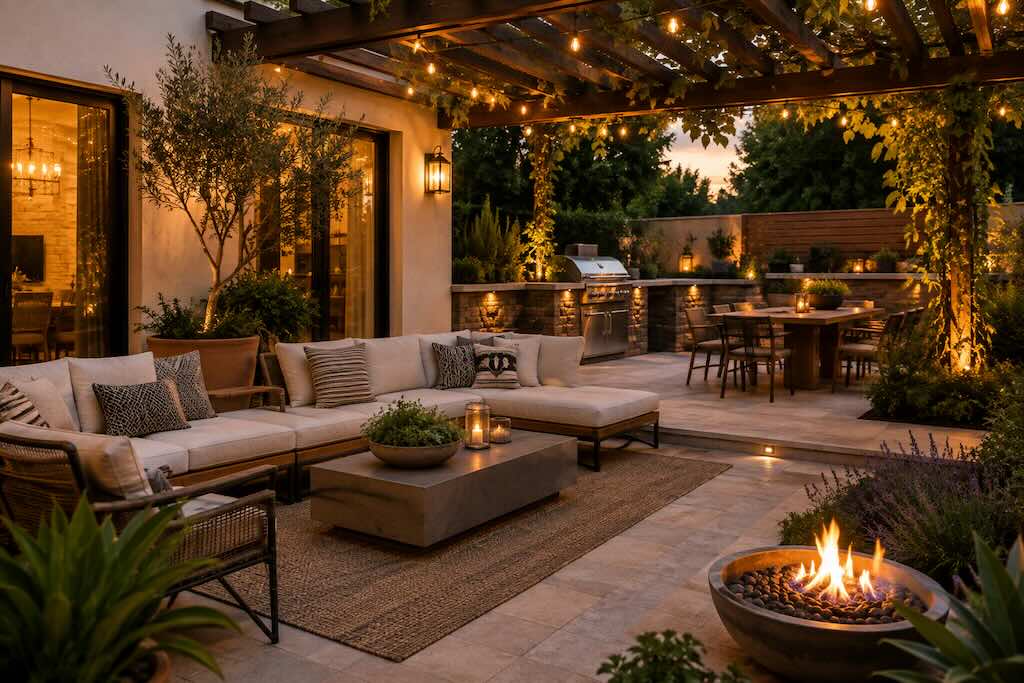
A good patio begins before the furniture arrives. Its comfort depends on quieter decisions: where afternoon sun falls, how easily dinner can move outside, where rainwater drains and whether the space still feels inviting after sunset.
- 1. Choose the Patio Location Around How You Live
- 2. Solve Drainage Before Decorating
- 3. Build a Simple Material and Color Palette
- 4. Design the Seating Around Conversation
- 5. Plan Shade as Part of the Architecture
- 6. Use Several Layers of Outdoor Lighting
- 7. Treat Fire Features as a Safety Decision
- 8. Make the Patio Easier to Use for Everyone
- 9. Set the Budget in the Right Order
- A Practical Patio Planning Order
- Conclusion
- FAQ
Planning those fundamentals first also makes it easier to build the patio in stages. Structure, drainage, shade and utilities can come before decorative details, allowing the space to develop without repeatedly undoing earlier work.
Editor’s note: This guide has been updated for 2026 with clearer advice on patio placement, drainage, outdoor lighting, fire safety, accessibility and phased budgeting.
1. Choose the Patio Location Around How You Live
Before choosing paving or furniture, decide what the patio is actually supposed to do.
An outdoor dining area usually benefits from being close to the kitchen. Carrying plates, drinks and serving dishes across a long garden quickly becomes inconvenient. A quieter reading or conversation area, on the other hand, might work better farther from the house.
Watch the site at different times of day before committing. Morning and evening light can make the same corner feel completely different, while existing trees and buildings may create useful shade. Divine’s guide to using natural light at home explores the same principle indoors.
Also consider privacy, prevailing wind, views from neighboring properties and how naturally people can move between the house, patio and garden.
2. Solve Drainage Before Decorating
Water is less exciting than outdoor furniture, but it deserves attention first.
A patio should be designed so that rainwater does not collect against the house or create persistent puddles. The appropriate slope, base construction and drainage solution depend on the site, surface material, soil and local conditions.
The U.S. Environmental Protection Agency notes that permeable paving can allow rain and snowmelt to filter through the surface rather than immediately becoming runoff. It will not suit every patio, but it is worth discussing when drainage and stormwater management are priorities.
Check local planning, drainage and building requirements before excavation or structural work begins. Rules vary considerably between locations.
3. Build a Simple Material and Color Palette
Outdoor spaces tend to feel calmer when they use a limited collection of materials rather than competing finishes.
Start with the permanent elements: paving, walls, fencing and the exterior of the house. Furniture, cushions, planters and planting can then introduce smaller shifts in color and texture.
Warm stone, weathered timber, terracotta, muted greens and soft neutral fabrics can create a natural transition into a garden. Dark metal can introduce sharper architectural definition. Brighter colors work well as accents because cushions and pots are considerably easier to change than paving.
If existing exterior surfaces need professional preparation or painting, the original guide’s recommendation to hire quality painting services remains an option. Compare the contractor’s current services, insurance, preparation process and suitability for exterior work before commissioning a project.
4. Design the Seating Around Conversation
A patio can look beautifully styled and still feel uncomfortable if people cannot sit naturally together.
Instead of filling every edge with furniture, create a clear social zone. A sofa and two chairs around a low table may be enough. Smaller patios can use individual chairs or a bench to preserve circulation space.
Measure furniture before buying it and mark its footprint on the patio. Leave comfortable routes to doors, steps, dining areas and the garden rather than forcing people to squeeze around chair backs.
A hanging chair or porch swing can create an appealing place to read or rest, but it should only be attached to a structure designed to carry the relevant loads. Do not assume an existing roof, beam or pergola is suitable simply because it appears substantial.
5. Plan Shade as Part of the Architecture
Shade determines how often many patios actually get used.
A pergola, awning, umbrella or strategically positioned tree can make an exposed dining area considerably more comfortable. The right solution depends on orientation, climate, wind exposure and whether you want permanent or adjustable coverage.
Think seasonally as well. A deciduous tree can provide shade in summer while allowing more sunlight through after its leaves fall. An adjustable canopy gives you more immediate control.
Divine’s guide to designing a comfortable outdoor retreat offers more ideas for balancing shelter, furniture and atmosphere.
6. Use Several Layers of Outdoor Lighting
A single bright exterior light can illuminate a patio while making it feel surprisingly uninviting.
Layered lighting works more naturally. Use practical illumination around doors, steps and walking routes, then add softer light around seating, planting or architectural details.
For efficiency, the U.S. Department of Energy recommends LED lighting as a highly energy-efficient option. Controls such as timers, sensors and separately switched lighting zones can reduce unnecessary use while giving you more control over the mood.
Any permanent outdoor electrical installation should use components suitable for exterior conditions and comply with applicable electrical requirements.
7. Treat Fire Features as a Safety Decision
A fire pit can make a patio feel warmer and extend its usefulness into cooler evenings, but placement should be determined by safety rather than appearance alone.
The U.S. Fire Administration recommends keeping fire pits and outdoor fireplaces at least 10 feet away from a home or anything that can burn. Local regulations, seasonal fire restrictions and manufacturer instructions may impose additional requirements.
Consider nearby trees, fences, furniture, overhead structures and wind before deciding whether an open-flame feature belongs on the patio at all. In some settings, lighting and textiles can create a warmer atmosphere without introducing fire.
8. Make the Patio Easier to Use for Everyone
Accessibility is easiest to incorporate before construction.
Wide circulation routes, stable surfaces, good lighting and avoiding unnecessary level changes can make an outdoor space more comfortable for children, older adults, guests carrying food and people with limited mobility.
If steps are unavoidable, make them easy to see after dark. If you are planning a substantial renovation, consider how the patio might continue to work as your household changes rather than designing exclusively around how you use it today.
9. Set the Budget in the Right Order
Patio budgets become difficult when decorative purchases begin before the structural costs are understood.
Price the essentials first: site preparation, drainage, foundations or base layers, paving, structural elements, electrical work and any required permits. Furniture, planting and accessories come later.
Keep a contingency within the project budget rather than spending every available amount on the initial estimate. Ground conditions, material changes and repairs discovered during construction can alter costs unexpectedly.
Phasing can also work well. Complete the parts that are expensive or disruptive to revisit first, then add furniture, planters, shade and decorative lighting as resources allow.
A Practical Patio Planning Order
- Decide how the patio will be used.
- Study sunlight, shade, privacy and wind.
- Check local planning and construction requirements.
- Plan levels, foundations and drainage.
- Allow for electrical services and permanent structures.
- Choose paving and the main material palette.
- Plan circulation before buying furniture.
- Add shade, lighting, planting and softer details.
If planting will form an important part of the finished space, Divine’s summer flower garden guide can help with the softer layer around the hard landscaping.
Conclusion
The most successful patio is not necessarily the largest or most expensive. It is the one that fits naturally into everyday life.
Place it where people genuinely want to sit. Keep dining close enough to the kitchen to be practical. Solve water and structural issues before buying furniture. Give summer sun somewhere to go, and make evening routes easy to see.
Once those decisions are right, the softer details can arrive gradually: a comfortable chair, herbs beside the table, warm light across stone and enough open space to make stepping outside feel effortless.
FAQ
What should you plan first when designing a patio?
Start with function and location. Decide how you want to use the patio, then assess sunlight, shade, privacy, drainage, access from the house and local construction requirements before choosing finishes or furniture.
Should a patio be next to the house?
Not necessarily. A dining patio usually benefits from easy access to the kitchen, while a quiet seating area may work farther into the garden. The best location depends on how the space will be used.
What type of lighting is best for a patio?
Use a combination of practical lighting for steps, doors and paths with softer ambient lighting around seating and landscaping. Exterior-rated LED fixtures can provide efficient illumination, while separate controls allow different areas to be used only when needed.
Can you build a patio in stages?
Yes. Complete difficult-to-change work such as drainage, foundations, paving, utilities and structural elements first. Furniture, planting, shade and decorative features can often be added later without compromising the original construction.
Does adding a patio increase home value?
A well-designed outdoor space may improve a home’s usefulness and appeal, but there is no universal return on investment. Property values depend on location, construction quality, market conditions, project cost and what local buyers value, so avoid assuming the project will automatically recover a particular percentage of its cost.