




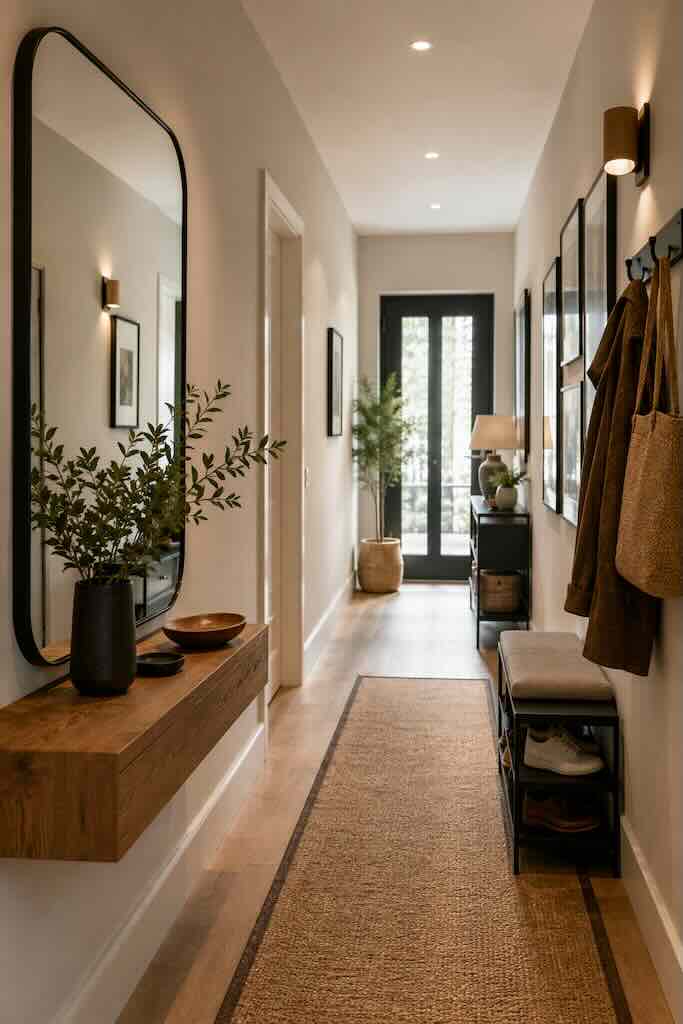
A small hallway is easy to overlook because nobody stays there for long. Yet it is often the first part of a home you see when you walk through the door, and one of the hardest spaces to keep calm when shoes, coats, bags and keys begin to accumulate.
The answer is not to squeeze more decoration into it. A better hallway uses light, proportion, storage and a small number of carefully chosen details to make limited space feel intentional.
Editor’s note: This article has been updated for 2026 with more practical advice on hallway proportions, storage, mirrors, color and lighting, while removing decorating ideas that can make narrow spaces feel unnecessarily cluttered.
1. Use a Large Mirror to Work With the Light
A mirror earns its place in a hallway twice. It gives you somewhere to check your appearance before leaving, while reflected light can make a dark entrance feel brighter and visually more open.
Scale matters. A collection of tiny mirrors can make a narrow wall look busy, while one generous mirror creates a stronger, cleaner focal point.
A tall vertical mirror works particularly well where wall width is limited. In a wider entrance, a large horizontal mirror above a slim console can bring the composition together.
Position it where it can reflect something worth seeing: daylight from a nearby window, a pendant light, artwork or a view into another room. Divine’s guide to using natural light to transform your home explores the relationship between daylight and interior space in more detail.
2. Give Everyday Clutter Somewhere to Go
A beautiful hallway will not remain beautiful if there is nowhere to put the things that arrive home with you.
Think about what actually accumulates near the door. Shoes need a defined place. Coats need hooks or a cupboard. Keys need a small tray or drawer. Bags need somewhere that is not the floor.
In a narrow hall, shallow furniture is usually more useful than conventional storage. A slim shoe cabinet, wall-mounted shelf or narrow bench can provide function without consuming the walking route.
Closed storage is particularly useful for visually noisy everyday objects. A calm surface with one bowl and a lamp will usually make a hallway feel larger than an open unit filled with shoes, scarves and miscellaneous accessories.
If clutter has spread beyond the entrance, Divine’s guide to creating a less cluttered home offers a useful place to start.
3. Let Color Give the Hallway an Identity
Small does not automatically mean white.
Pale warm neutrals can create an airy transition between rooms, but narrow hallways can also carry deeper shades surprisingly well. Olive, muted blue, clay, chocolate and smoky grey can make a transitional space feel deliberate rather than forgotten.
Pay attention to the light before choosing a shade. The same paint can appear cooler, warmer, flatter or more saturated depending on daylight, artificial lighting and the colors surrounding it.
Paint manufacturers commonly recommend assessing color in the actual room rather than relying solely on a screen or small color chip. Sherwin-Williams’ Color to Go guidance, for example, is built around testing paint in the intended environment before committing to a larger project.
Observe samples during the morning, afternoon and evening. Hallways often receive borrowed light from adjacent rooms, so their appearance can change considerably over the course of a day.
4. Keep Furniture Slim and Proportional
A console table may look beautiful online and still be completely wrong for a narrow entrance.
Measure the hallway at its narrowest point before buying anything. Then consider how doors open, where people naturally stop to remove shoes and whether two people can pass comfortably.
If floor space is particularly tight, move the function onto the wall. A floating shelf can hold keys without creating bulky legs underneath. Wall hooks can replace a coat stand. A compact wall light can free a console from a table lamp.
This is the same principle that works elsewhere in compact interiors: protect the empty space as carefully as you choose the furniture.
5. Treat the Walls as Part of the Architecture
A hallway can carry artwork beautifully because you naturally experience it in motion.
Rather than filling every available patch of wall, choose a clear approach. One oversized artwork can create a strong visual destination at the end of a corridor. A tightly edited gallery wall can bring personality to a longer passage. Family photographs can make the entrance feel immediately personal.
Keep spacing consistent if you hang several pieces together. Similar frames can calm a collection containing different photographs or artwork, while mixed frames work better when another element — color, scale or subject — connects the composition.
Decorative wall treatments can do the same job without adding objects. Timber detailing, restrained wallpaper, paneling or a change in paint finish can introduce texture while leaving the floor completely clear.
If you want the space to feel individual rather than styled from a template, Divine’s ideas for making a home feel more personal translate particularly well to an entrance.
6. Layer the Lighting
A hallway lit by one harsh ceiling bulb can feel more like a passage in a commercial building than part of a home.
Where the electrical layout allows it, combine general illumination with softer sources. A pendant can establish the visual rhythm of a taller hall. Wall lights can wash surfaces with warmer light. A small lamp on a console creates a softer pool of illumination in the evening.
For artwork, directional lighting can draw attention to one piece without turning the entire hallway bright.
Safety still comes first. Stairs, thresholds and changes in floor level should remain clearly visible. The U.S. Department of Energy’s guidance on home lighting also recommends energy-efficient LED lighting, which is available across a wide range of brightness levels and color temperatures.
7. Use the Floor to Draw the Eye Through the Space
The floor occupies a large percentage of what you see in a narrow hallway, so it deserves more attention than it often receives.
A runner can soften acoustics, introduce pattern and visually connect one end of the hall with the other. Leave some flooring visible around it so the rug does not appear squeezed between the walls.
Entrances also deal with wet shoes, dirt and repeated foot traffic, so durability matters. Choose materials that suit how the household actually lives rather than selecting a delicate surface purely for appearance.
For a quieter Scandinavian-inspired effect, consider natural timber tones, warm stone colors and tactile woven textures instead of adding more decorative objects.
8. Give the Eye Somewhere to Land
Long hallways often benefit from a visual destination.
Look toward the far end of the corridor. If all you see is an empty wall, that surface is an opportunity. A large painting, sculptural wall light, small bench or carefully chosen color can pull the eye forward.
This is particularly effective when the rest of the hallway is restrained. The empty stretches of wall become part of the composition, allowing the focal point to feel stronger.
Architecture can subtly change how a space feels, even when we are not consciously analysing it. Divine explores that relationship further in the hidden ways architecture affects how you feel.
A Simple Formula for a Small Hallway
If the space feels difficult to decorate, start with four elements rather than trying to solve everything at once:
- One practical storage solution for the objects that normally create clutter.
- One mirror or piece of artwork large enough to create a clear focal point.
- One considered lighting decision that makes the hallway comfortable after dark.
- One coherent material or color direction connecting the hallway with the rest of the home.
Then stop. Live with the space before adding anything else.
Conclusion
A small hallway does not need to imitate a full-sized room. Its brevity is part of its character.
Give everyday objects somewhere to disappear, protect the walking space and choose one or two details with enough presence to carry the design. A tall mirror catching afternoon light, a slim timber shelf beneath it and a softly lit wall may be all the decoration the space needs.
The hallway then does exactly what a good entrance should: it quietly introduces the home before the next room takes over.
FAQ: Decorating a Small Hallway
What is the biggest decorating mistake in a small hallway?
Adding too much. Large furniture, numerous small decorative objects and several competing wall treatments can make an already narrow space feel busier. Prioritize circulation and choose fewer, stronger elements.
What colors make a small hallway look bigger?
Light colors can help a hallway feel airy, particularly when there is useful natural light to reflect, but they are not the only option. A consistent deeper color can also reduce visual fragmentation and create an intimate effect. Test the shade in the actual hallway before committing.
Where should you put a mirror in a hallway?
Choose a position where the mirror is useful and reflects an attractive source of light or another considered part of the interior. Avoid placing it where the main reflection will simply be clutter or an awkward corner.
How can you add storage to a very narrow hallway?
Look vertically and keep furniture shallow. Wall hooks, floating shelves, slim shoe cabinets and high-level storage can provide useful capacity while preserving more of the floor and walking route.
Should a hallway match the rest of the house?
It does not need to use exactly the same colors or furniture, but some visual connection helps. Repeating a timber tone, metal finish, wall color or textile can make the transition between spaces feel deliberate.