




Learning something new doesn’t have to mean signing up for another productivity challenge. Some of the best skills are the ones that make everyday life more interesting — helping you create something, solve a problem, feel more confident or simply spend your free time doing something other than scrolling.
And you don’t need to become an expert for a new skill to be worthwhile. Learning enough guitar to play a favorite song, cooking one genuinely impressive dinner or finally understanding how to use a camera beyond automatic mode can be satisfying on its own.
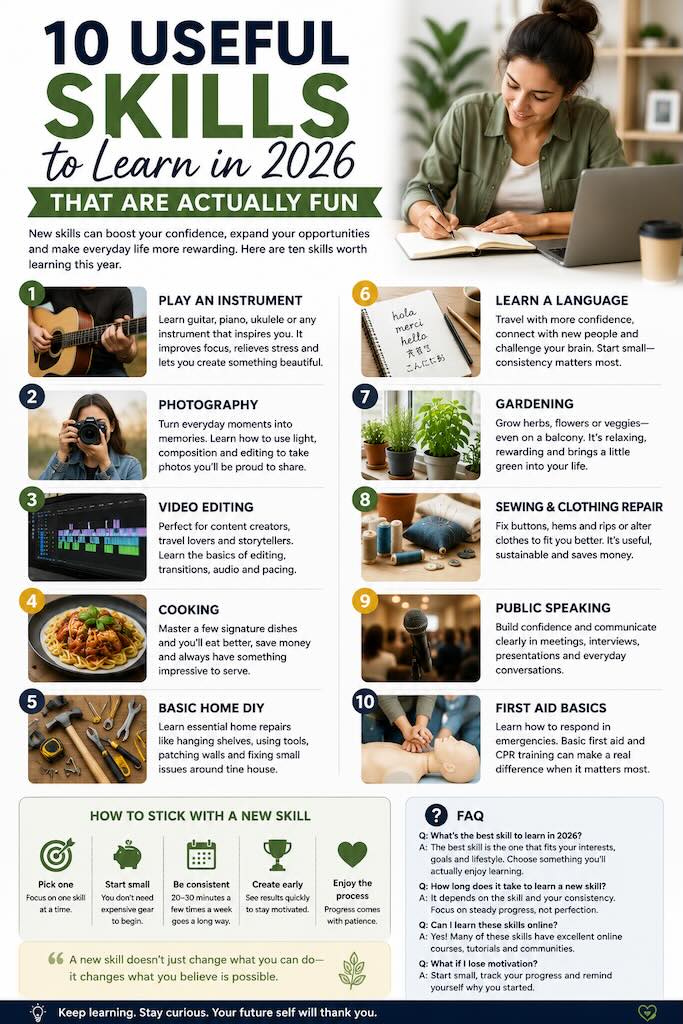
If you’re looking for inspiration, these ten useful skills are fun to learn in 2026 — and several may prove surprisingly valuable in everyday life.
1. Learn to Play an Instrument
There’s a particular satisfaction in realizing that the noise you’ve been making for weeks has suddenly started to sound like an actual song.
Guitar and piano are obvious starting points because beginner lessons are widely available, but there’s no reason to choose an instrument simply because it’s considered practical. Ukulele, drums, bass, violin and even music production can provide the same creative outlet.
Don’t begin with the goal of mastering music theory or becoming technically brilliant. Pick a song you genuinely want to play and work toward it. Having something recognizable to aim for makes those repetitive early practice sessions considerably easier to tolerate.
2. Get Better at Photography
You probably already carry a capable camera everywhere you go. Learning how to use it properly can completely change the photographs you take.
Start with composition, natural light, perspective and basic editing rather than immediately buying expensive equipment. Try photographing the same ordinary object from several angles or revisit a familiar place specifically to look for details you’ve never noticed before.
Photography is particularly rewarding because progress becomes visible. Compare the pictures you’re taking now with the ones you create six months later and you’ll probably notice a difference before you feel like you’ve learned very much at all.
3. Learn Video Editing
Video editing has moved far beyond something only filmmakers needed to understand. Short-form video, travel clips, family memories, creative projects and social media have made basic editing useful for almost anyone who creates digital content.
The fundamentals aren’t particularly glamorous: cutting clips, arranging a timeline, balancing audio, adding music and learning when not to use another transition.
Once those basics become intuitive, though, editing becomes much more creative. You start thinking about pacing, atmosphere and how individual shots work together to tell a story.
It’s also one of the few hobbies on this list that can naturally develop into a professional skill if you eventually decide to take it further — although there’s absolutely no requirement to turn it into work.
4. Master a Few Signature Dishes
You don’t need to become an accomplished home chef. Being able to cook five or six dishes exceptionally well is arguably more useful.
Choose food you genuinely enjoy eating and learn why each recipe works rather than mechanically following instructions. Understanding how to season properly, control heat, balance acidity and recognize when something is actually cooked will transfer to countless other meals.
For an extra challenge, develop one signature dinner you can confidently serve when friends come over — starter, main course and dessert included.
It’s practical, creative and considerably more rewarding than realizing you’ve been ordering the same takeout for three consecutive Fridays.
5. Learn Basic Home DIY
Knowing how to handle small jobs around the house can save time, money and the frustration of needing help with every minor repair.
Start safely and simply: learn how to use basic hand tools, fill small holes, hang shelves correctly, apply caulk, assemble furniture properly and understand where your home’s main water shutoff and electrical panel are located.
The important skill here is also knowing where DIY should stop. Significant electrical, plumbing, structural, roofing and gas work may require qualified professionals depending on the task and local regulations.
You don’t need to renovate an entire kitchen to become more capable around your own home.
6. Start Learning Another Language
Learning another language is one of those goals people often abandon because they imagine fluency as the only acceptable result.
It isn’t.
Being able to order dinner, understand signs, ask for directions and have a simple conversation can completely change the experience of visiting another country.
Choose a language connected to something you already care about — somewhere you travel regularly, films you watch, music you love or people you want to communicate with. Personal motivation tends to survive much longer than choosing a language because somebody said it would look useful on a résumé.
Ten or fifteen minutes of consistent practice can be more realistic than occasional marathon study sessions.
7. Learn to Grow Something
Gardening doesn’t require a sprawling backyard. A windowsill, balcony or sunny corner can be enough to get started.
Herbs are particularly satisfying for beginners because you can actually use what you grow. Basil, mint, parsley and other commonly used herbs can turn the experiment into part of your cooking rather than another decorative project demanding attention.
Gardening also teaches patience remarkably quickly. Plants don’t care about deadlines, notifications or how efficiently you’d prefer them to grow.
Start small, learn what the particular plant needs and resist the surprisingly common beginner instinct to solve every problem by adding more water.
8. Learn Basic Sewing and Clothing Repair
A missing button shouldn’t automatically mean a trip to a tailor — and a small tear doesn’t necessarily mean the end of a favorite piece of clothing.
Basic sewing skills can help you replace buttons, repair small seams, fix simple tears and make minor alterations. They’re useful even if you have absolutely no ambition to make clothing from scratch.
Learning to repair clothes also encourages a different relationship with your wardrobe. Instead of treating everything as disposable, you become better equipped to keep pieces you genuinely love in rotation for longer.
9. Become More Comfortable Speaking in Public
Public speaking isn’t just for people standing on conference stages.
Introducing yourself confidently, presenting an idea at work, giving a wedding speech, participating in a meeting or explaining something clearly to a group all draw on the same basic skills.
Practice speaking more slowly, removing unnecessary filler words and making your point without burying it beneath five minutes of explanation. Recording yourself can feel deeply uncomfortable at first, but it’s also one of the fastest ways to notice habits you don’t hear while you’re speaking.
The goal isn’t to become fearless. It’s to become comfortable enough that nerves don’t prevent you from saying what you wanted to say.
10. Learn Basic First Aid
Some skills are enjoyable because they’re creative. First aid is worth learning because there may be a moment when knowing what to do genuinely matters.
A reputable first-aid course can teach you how to respond to common injuries and emergencies and, depending on the course, may include CPR and the use of an automated external defibrillator (AED).
This is one skill where learning directly from an appropriate recognized training provider is considerably better than relying entirely on social media clips or trying to remember something you once read online.
Hopefully you’ll never need the most serious parts of that training. Knowing them anyway is still worthwhile.
Try a Martial Arts or Self-Defense Class
If you’d prefer something more physical, a beginner martial arts or reputable self-defense class can combine movement, coordination and confidence with learning something new.
The aim shouldn’t be to prepare yourself for imaginary confrontations. Good instruction should emphasize awareness, avoidance, appropriate responses and getting away from dangerous situations whenever possible.
Try an introductory class before committing to expensive equipment or a long membership. The instructor and atmosphere matter enormously, and finding somewhere you actually enjoy attending makes consistency far easier.
How to Actually Stick With a New Skill
Choosing a new hobby is easy. Still doing it three months later is the difficult part.
The solution usually isn’t more motivation. It’s making the skill small enough to fit into your actual life.
- Pick one thing. Starting guitar, Spanish, photography, gardening and pottery simultaneously is an excellent way to become good at none of them.
- Don’t buy everything immediately. Borrow, rent or start with beginner equipment until you know the hobby is going to last.
- Practice little and often. Twenty minutes several times a week is easier to sustain than waiting for an imaginary free Saturday.
- Create something early. Play one song, cook one meal, edit one video or hold one short conversation. A tangible result makes progress feel real.
- Expect to be bad at first. Being a beginner isn’t evidence that you lack talent. It’s simply the stage before getting better.
Not Every Hobby Needs to Become a Side Hustle
There’s a strange pressure to monetize almost everything we’re good at. Learn photography and somebody suggests selling prints. Start baking and suddenly you need an online store. Become good at knitting and you’re apparently one Etsy account away from entrepreneurship.
You don’t have to do any of that.
A hobby is allowed to be inefficient. You can spend three hours cooking something that would have cost less to order. You can play guitar without joining a band. You can take photographs nobody but you will ever see.
Sometimes the value of learning something is simply that you enjoy being the person who knows how to do it.
Choose the Skill You’ll Actually Enjoy Learning
The best new skill isn’t necessarily the most impressive one. It’s the one interesting enough to keep pulling you back after the initial enthusiasm disappears.
Learn to cook something brilliant. Pick up the guitar that’s been sitting untouched in the corner. Grow basil on the windowsill. Finally figure out what all those camera settings mean.
You don’t need to reinvent yourself. Just give yourself something new to get curious about.
FAQ: Learning New Skills
What are the most useful skills to learn in 2026?
Useful skills depend on your lifestyle, but cooking, basic home DIY, first aid, communication, photography, video editing, language learning and clothing repair all have practical applications beyond simply filling spare time.
What is an easy skill to learn as an adult?
Basic photography, simple cooking techniques, beginner gardening and basic sewing are relatively accessible because you can start small and see useful results without needing years of training.
How long does it take to learn a new skill?
There’s no universal number of hours. Becoming competent enough to enjoy a hobby can happen relatively quickly, while mastering it may take years. Setting a small, specific first goal is usually more helpful than focusing on how long mastery supposedly takes.
How do I choose a new hobby?
Start with what you naturally find interesting and how you like spending your time. Someone who enjoys making things may prefer cooking or sewing, while someone looking for a social activity might enjoy language classes, music lessons or martial arts.
Do I need to spend a lot of money to start a new hobby?
No. Starting with borrowed, rented, secondhand or beginner equipment can keep costs low while you decide whether you genuinely enjoy the activity. Upgrade later when your skills — rather than your initial enthusiasm — justify it.