

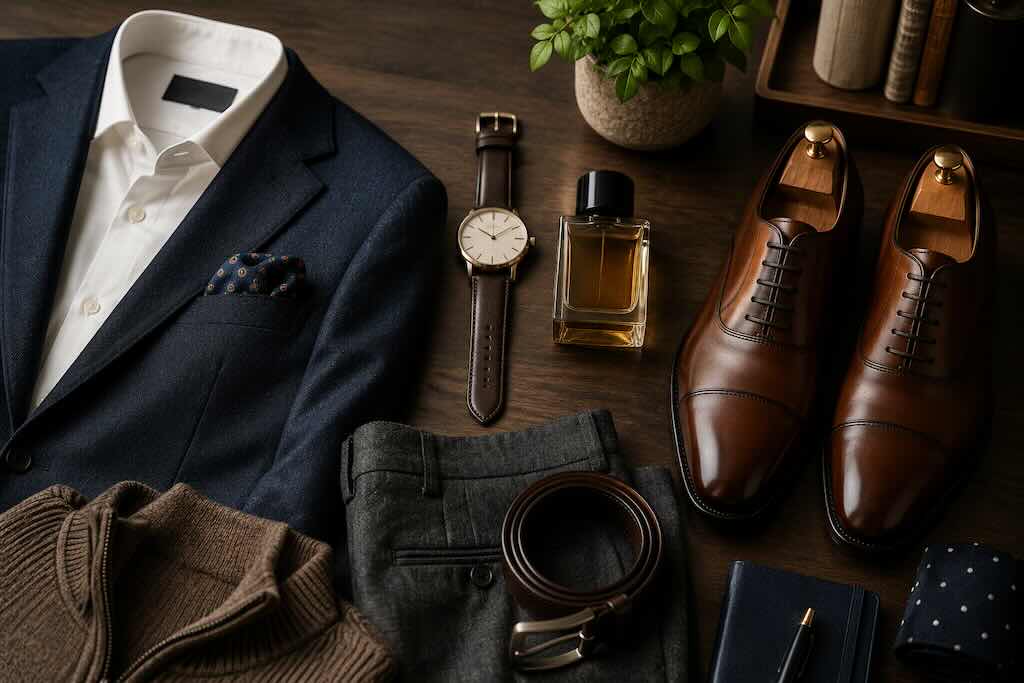
Personal style is often read in fragments. The line of a jacket. The condition of a pair of shoes. A watch glimpsed beneath a cuff. The trace of fragrance that remains after a conversation has moved on. None of these details defines a man, but together they can make an outfit feel deliberate rather than accidental.
Editor’s note: This article has been updated for 2026 to remove unsupported claims about what people universally notice first, correct misplaced internal links, reduce trend-driven brand claims, and focus on the more enduring principles of fit, proportion, condition and personal style.
There is no scientific ranking proving that everyone notices a man’s watch before his jacket or his shoes before anything else. Context changes the impression. At dinner, fragrance may register immediately. Across a room, silhouette and color dominate. During a handshake, a watch or cuff becomes more visible.
That makes dressing well less about following a rigid checklist and more about understanding how individual details work together. The strongest outfits usually share the same qualities: they fit properly, suit the setting and look cared for.
1. The Jacket Sets the Silhouette
Before anyone can inspect your watch or notice the stitching on your shoes, they can see your outline.
A jacket has an unusually strong influence because it covers such a large part of the body. Shoulder width, length, lapel shape and the way fabric falls through the torso can change the entire proportion of an outfit.
Fit matters more here than a recognizable label. The shoulder seam should sit naturally, sleeves should work with the shirt beneath them, and the jacket should close without obvious pulling or excessive fabric.
The modern wardrobe also gives you more room than traditional tailoring once did. An unstructured blazer can sit comfortably over knitwear or a T-shirt, while a sharper sports jacket can give denim and trousers more definition. Texture matters too: linen and cotton feel relaxed in warm weather; wool and heavier woven fabrics introduce depth when temperatures fall.
The best jacket is not necessarily the most formal one. It is the one whose proportions make sense on your body and whose level of formality matches where you are going.
2. Shoes Can Finish or Disrupt the Outfit
Shoes sit at the edge of an outfit, yet they can alter its entire direction.
A navy trouser with a polished loafer feels different from the same trouser with a clean minimalist sneaker. Neither is inherently better. The question is whether the footwear belongs with the rest of the clothes and the occasion.
Condition is often more important than price. Leather benefits from cleaning and conditioning. Suede needs an appropriate brush. Sneakers look sharper when midsoles, uppers and laces are kept clean.
For a broader wardrobe foundation, Divine’s guide to the types of shoes every man should own covers several useful categories, while our guide to finding the right shoes for an event can help when dress codes become less obvious.
3. A Watch Works Best When It Doesn’t Try Too Hard
The watch remains one of menswear’s most useful small details because it can introduce metal, leather, color and mechanical character without dominating the outfit.
Luxury is optional. Proportion is not.
A watch that sits comfortably on the wrist and suits the clothes around it will usually look more convincing than an expensive model chosen primarily to advertise its price. A restrained dress watch can disappear neatly beneath a shirt cuff. A field or sports watch can add weight to denim, knitwear and casual tailoring.
If you appreciate traditional mechanical watchmaking, NOMOS Glashütte represents a particularly clean approach to German watch design, while Longines offers a broad catalogue spanning dress, heritage and sports watches.
They are examples, not requirements. Vintage watches, independent makers and modest quartz pieces can be equally stylish when the design works with the wearer.
4. Grooming Frames Everything Else
A carefully assembled outfit loses some of its precision when the surrounding details appear neglected.
This does not require an elaborate grooming routine. Clean nails, maintained facial hair, healthy-looking hair and clothes free from obvious stains or heavy creasing establish a baseline that allows the wardrobe to do its work.
The same principle applies to maintenance. Remove lint from dark tailoring. Replace missing buttons. Repair loose hems. Steam garments when necessary. Give coats enough space on suitable hangers instead of compressing them into an overcrowded wardrobe.
Good style is often maintenance disguised as effortlessness.
5. Fragrance Should Be Discovered, Not Announced
Fragrance occupies a different space from clothing because people often encounter it before consciously thinking about it. Scent is closely connected with memory and emotion, but that does not mean stronger fragrance creates a stronger impression.
Usually, restraint works better.
Apply fragrance lightly and consider the environment. A scent that feels appropriate outdoors or at an evening event may become intrusive in a small office, restaurant or crowded train.
Do not choose solely from descriptions such as woody, clean, aquatic or smoky. Fragrance develops differently on skin, so sampling before buying a full bottle is useful whenever possible.
Houses such as Le Labo and Byredo are well-known contemporary options, but fragrance is particularly personal. The right scent is the one you enjoy wearing at a concentration that does not require everyone else in the room to experience it with you.
6. Fit Is More Noticeable Than the Label
A designer name cannot rescue poor proportions.
Expensive trousers that pool awkwardly over the shoes will often look less polished than an inexpensive pair altered to the correct length. The same applies to shirt sleeves, jacket waists and trouser rises.
This is why a good alterations tailor can be more valuable to a wardrobe than another shopping trip. Small adjustments can make existing clothes sit more naturally on the body, reducing the temptation to keep replacing pieces that were never fundamentally wrong.
Fit does not mean everything must be slim. Relaxed tailoring and wider trousers can look exceptionally controlled when their proportions are intentional. The distinction is between volume and clothing that simply fits badly.
7. Small Accessories Reveal the Point of View
Once the larger elements are working, accessories can introduce personality at close range.
A leather belt, ring, glasses, scarf, tie, bag or understated piece of jewelry can change the character of otherwise familiar clothes. Divine’s guide to men’s essential accessories offers a useful starting point.
The trick is editing. Wearing every interesting object you own at the same time can make each individual detail less effective.
If the watch is visually substantial, perhaps the jewelry can become quieter. If the jacket carries a strong pattern, a plain shirt gives it space. If the shoes introduce color, they do not necessarily need a matching belt in precisely the same shade.
How to Build a Better First-Impression Outfit
Instead of dressing around what strangers might supposedly notice first, build from the outside inward.
- Start with context. Decide how formal, relaxed or expressive the situation allows you to be.
- Check the silhouette. Look at the outfit from several feet away before studying individual details.
- Check the fit. Pay particular attention to shoulders, sleeves, trouser length and footwear proportions.
- Inspect condition. Clean shoes, remove lint and deal with obvious wrinkles.
- Add one or two personal details. A watch, ring, interesting texture or fragrance is often enough.
- Remove something if necessary. Editing is part of getting dressed.
For more seasonal inspiration, Divine’s men’s summer fashion guide for 2026 explores how those principles translate into warmer weather, while our guide to navigating fashion with confidence looks beyond individual garments.
Conclusion
The details people notice first will change with the room, the occasion and the person looking at you. That uncertainty is useful. It frees menswear from becoming a performance built around somebody else’s checklist.
Concentrate instead on proportion, condition and coherence. Let the jacket establish the silhouette. Keep the shoes cared for. Choose a watch because you enjoy wearing it. Apply fragrance with restraint. Alter clothes when the fit is close but not quite right.
Then stop adjusting.
The most convincing outfit is rarely the one shouting for attention. It is the one that allows the person inside it to enter the room first.
Frequently Asked Questions
What do people notice first about a man’s outfit?
There is no universal first detail. From a distance, silhouette, color and outerwear are likely to register before small accessories. At closer range, shoes, grooming, watches and fragrance may become more noticeable.
Do men need expensive clothes to look stylish?
No. Fit, proportion, condition and coordination usually matter more than price or designer labels. Altering an existing garment can sometimes improve an outfit more than replacing it.
What shoes should every man own?
The answer depends on lifestyle, but a practical wardrobe often benefits from clean casual sneakers, a versatile leather shoe or loafer and footwear suited to local weather and more formal occasions.
Should a belt always match the shoes?
Not exactly. Formal outfits generally benefit from visual harmony between leather accessories, but identical shades are unnecessary. Casual dressing allows considerably more flexibility.
How much cologne should a man wear?
Enough to be noticed at close range rather than across the room. Fragrance strength varies significantly between products, so start lightly and adjust according to concentration, environment and how the scent develops on your skin.
What defines men’s style in 2026?
There is no single 2026 uniform. Relaxed tailoring, wider proportions, vintage influences and restrained classics can coexist. A wardrobe built around personal fit and repeat wear will generally age better than one assembled entirely around short-lived trends.