




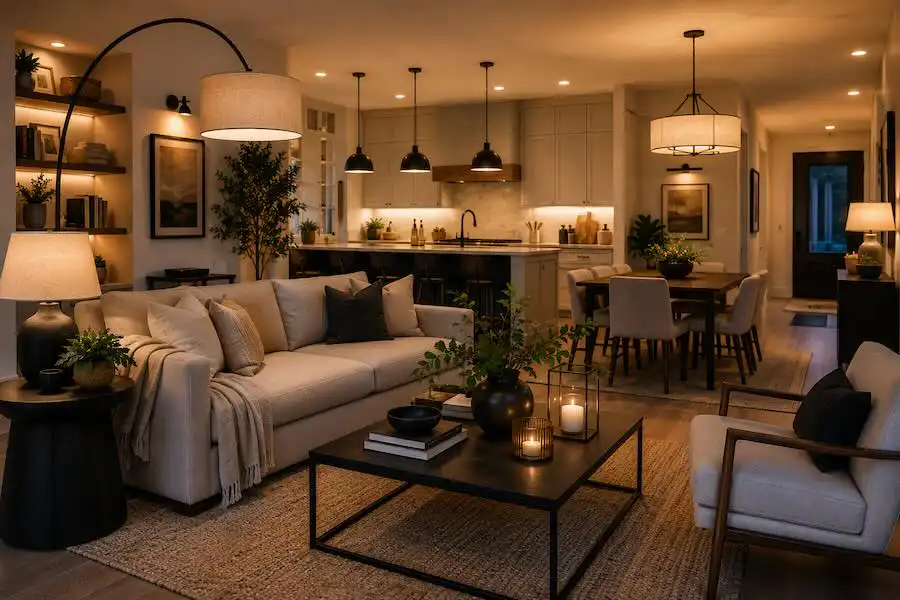
Good lighting changes more than visibility. It shapes how a room feels, where the eye settles, and how comfortably a space moves from bright mornings to quiet evenings. Yet lighting is often treated as a final detail rather than part of the interior architecture itself.
The strongest lighting schemes work in layers. They combine natural light, ceiling fixtures, lamps, focused task lighting, and softer ambient sources instead of asking one fixture to illuminate an entire room. With a few considered changes, you can make your home feel warmer, more functional, and visually coherent.
Use Lighting to Define Open Spaces
Open-plan interiors benefit from visual boundaries, even when there are no physical walls. Lighting can create them.
Rather than relying exclusively on overhead fixtures, give different areas their own pools of light. A pendant can anchor the dining table, while a floor lamp beside an armchair creates a quieter reading zone. Table lamps can soften the living area without visually separating it from the rest of the room.
This approach is particularly useful when designing a more considered living room. The furniture establishes the physical layout; lighting reinforces it after sunset.
Choose Fixtures That Belong to the Interior
A light fixture is visible architecture. Its shape, scale, finish, and material should have a relationship with the room around it.
Mid-century interiors might suit sculptural globes and warm metals, while contemporary spaces can carry restrained linear fixtures. Traditional rooms can accommodate more decorative silhouettes. There is no requirement for every fixture to match, but repetition helps establish rhythm.
For example, brass hardware in a kitchen can be quietly echoed through a brass floor lamp elsewhere. Black metal window frames might connect naturally with slim black sconces. Repeating a finish two or three times usually feels more intentional than filling the room with identical pieces.
Layer Light Instead of Relying on One Source
A single bright ceiling fixture can technically illuminate a room while doing very little for its atmosphere. Layering creates depth.
Think in three broad categories: ambient lighting for general illumination, task lighting for activities such as cooking or reading, and accent lighting for artwork, shelves, architectural details, or darker corners.
During the day, all three may barely be noticeable beside natural daylight. At night, the balance changes. A shaded lamp glowing against a textured wall, a pendant suspended above the table, and subtle illumination along a bookshelf can make the same room feel considerably softer.
Pay Attention to Color Temperature
Brightness is only part of the equation. The color temperature of a bulb has a significant effect on atmosphere.
Warmer light generally creates a softer feeling suited to bedrooms, dining rooms, and living spaces. Cooler or more neutral light can work well where clarity matters, particularly around kitchen work surfaces and home offices. The important detail is consistency: dramatically different bulb temperatures within the same sightline can make an otherwise polished interior feel disjointed.
Install Dimmers Where They Matter
A room rarely needs exactly the same amount of light throughout the day. Dimmer controls allow one fixture to serve several moods and activities.
Bright illumination may be useful while preparing dinner or cleaning. Later, reducing the same light can create a calmer setting without requiring a completely different arrangement of fixtures.
When installing dimmers, check that the bulbs, fixtures, and controls are compatible. The U.S. Department of Energy’s LED lighting guidance also provides useful background on choosing efficient LED lighting for the home.
Use LED Lighting Strategically
LED technology makes it easier to combine efficiency with design flexibility. LEDs are available across different brightness levels, color temperatures, fixture formats, and dimming configurations, so switching bulbs does not have to mean accepting cold or clinical light.
If you’re replacing older lighting, prioritize the fixtures used most frequently. Kitchens, hallways, living rooms, and exterior lights are sensible places to begin. Depending on where you live, qualifying upgrades may also be eligible for utility incentives or LED lighting rebates.
A Simple Lighting Audit Before You Buy
Before ordering new fixtures, walk through your home twice: once during daylight and again after dark. Notice where shadows collect, where you regularly perform detailed tasks, and which corners disappear at night.
Then consider what each area actually needs. Sometimes the answer is a statement pendant. Sometimes it is simply a small lamp on a side table. Good lighting does not require filling every ceiling and wall with fixtures; it requires placing light where it has a purpose.
Conclusion
The best home lighting feels almost effortless because each source has a clear role. Use fixtures to define spaces, layer different types of illumination, keep color temperatures considered, and introduce dimmers where flexibility matters. The result is a home that works better during the day and settles into something warmer after dark.
FAQ: Improving Home Lighting
What is the easiest way to improve home lighting?
Start by adding lamps rather than immediately replacing permanent fixtures. A floor or table lamp can introduce softer, directional light with minimal installation.
Should every light fixture in a room match?
No. Fixtures can differ in shape and style while sharing a common material, finish, proportion, or visual language.
What lighting is best for a cozy living room?
Combine warm ambient lighting with floor and table lamps positioned at different heights. Dimmers provide additional control when transitioning from daytime use to evenings.
Are LED bulbs suitable for warm interiors?
Yes. Modern LEDs are available in warm color temperatures, allowing you to gain their efficiency benefits without creating a harsh, blue-toned atmosphere.
Where should task lighting be used?
Use it wherever focused visibility matters, including kitchen counters, desks, reading chairs, bathroom mirrors, and other work surfaces.