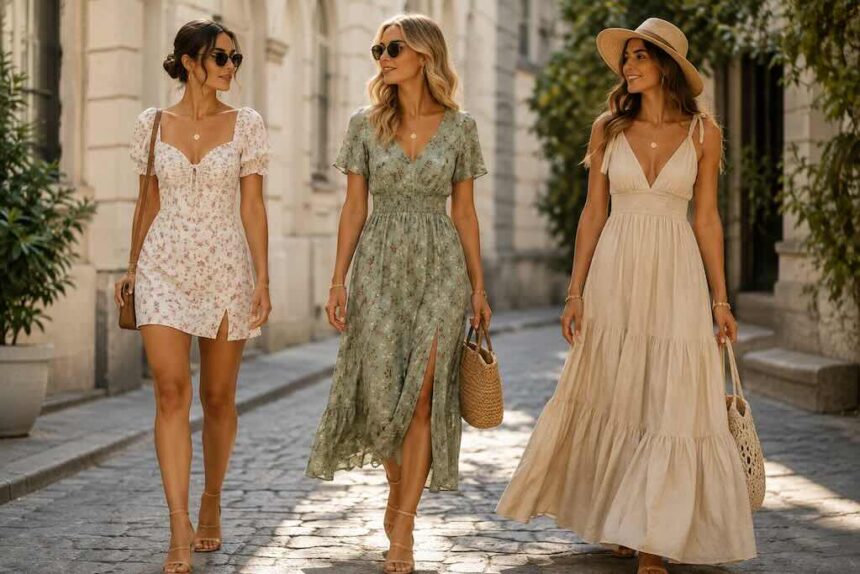
Sometimes the difference between a dress you like and a dress you absolutely love is only a few inches of fabric.
Mini, midi and maxi dresses can create completely different proportions, even when the colour, fabric and silhouette are nearly identical. One can make an outfit feel playful and sharp, another polished and understated, while the longest version can introduce movement and drama.
There isn’t a universally “best” dress length. The useful question is what you want the dress to do.
Mini: when you want the legs to lead the look
A mini dress generally finishes somewhere above the knee, although exactly where it lands can dramatically change the overall effect.
The shorter hem naturally puts more emphasis on the legs, which is why minis can feel energetic and confident without requiring an especially complicated design. A beautifully cut black mini, for example, may need very little else to make an impact.
Balance becomes particularly useful when styling one. If the hemline is very short, you might choose a higher neckline, an oversized blazer or a substantial flat shoe. Not because fashion requires a mathematical formula, but because contrasting proportions often make an outfit more interesting.
For daytime, try a mini with loafers, ballet flats, sneakers or boots. For evening, a sleeker shoe and minimal jewellery can shift the same silhouette into something considerably more polished.
Midi: the length that quietly does almost everything
The midi occupies that broad territory below the knee and above the ankle — and that’s precisely why two midi dresses can look surprisingly different.
A hem that finishes just below the knee can feel crisp and tailored. Move it farther down the calf and the effect becomes softer and more relaxed. Add a flowing skirt and you have movement; choose a straight silhouette and suddenly the same length feels architectural.
That adaptability makes the midi particularly useful when you’re building a wardrobe around pieces that need to work more than once. Depending on the fabric and styling, one can move between the office, dinner, a wedding, a weekend lunch and an ordinary day in the city.
Shoes make an especially noticeable difference here. Boots can give a floral midi some weight, while a delicate sandal makes it feel lighter. Loafers create a more structured everyday look, and heels can visually extend the line of the leg.
Maxi: less about formality, more about movement
A maxi dress reaches the ankle or floor, but don’t confuse length with formality. Some of the easiest summer dresses happen to be maxis.
What makes this length special is movement. Linen, cotton, jersey, chiffon and silk all behave differently when there’s more fabric involved, making the material almost as important as the silhouette itself.
A loose cotton maxi with flat sandals can feel wonderfully uncomplicated on holiday. The same length in satin with a more defined waist can become eveningwear. A knitted version with boots might carry the silhouette straight into autumn.
If a maxi feels overwhelming rather than effortless, look at its proportions before abandoning the length altogether. A defined waist, an open neckline, a side slit or simply a slightly shorter hem can break up a large expanse of fabric.
The overlooked question: where does the hem actually hit?
Labels such as mini, midi and maxi are useful when shopping, but they’re only approximations. Your height and proportions determine where the dress actually finishes on your body.
A midi that ends at an awkward point on the calf can suddenly look completely different when shortened by a few centimetres. Likewise, a maxi that pools on the floor may appear beautifully fluid on the model but simply feel too long when you put it on.
This is one reason tailoring can transform relatively inexpensive clothing. Don’t judge a dress solely by the hemline it arrived with.
Let your shoes help decide
If you’re unsure which length belongs in your wardrobe, start at the bottom.
Think about the shoes you actually wear rather than the imaginary pair you’ll supposedly buy later. If you live in chunky boots, you may love the contrast of a fluid midi. If summer means flat sandals, a breezy maxi can make getting dressed almost effortless. If your wardrobe revolves around loafers and ballet flats, minis and shorter midis can work beautifully with them.
The best dress isn’t necessarily the one that looks most impressive on the hanger. It’s the one that works with the wardrobe you already have.
So, mini, midi or maxi?
Choose a mini when you want a lighter, leg-focused silhouette. Reach for a midi when versatility matters. Let a maxi do the work when you want length, movement and an outfit that can feel complete with remarkably little styling.
And ignore the idea that your height, age or body shape assigns you to one category. Try different lengths, pay attention to where the hem falls, and notice how you feel when you move.
The centimetres on the label matter far less than what happens when you put the dress on.