




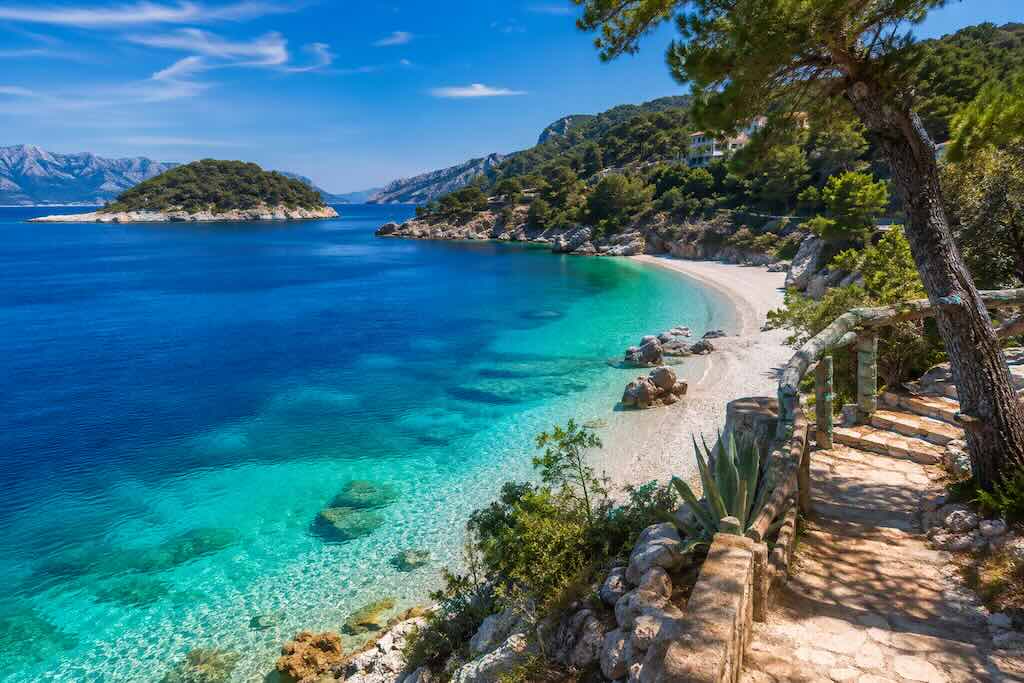
Croatia’s coastline rarely behaves like the classic image of a Mediterranean beach. Sand gives way to pale pebbles, pine trees lean toward clear water, and ferries carry swimmers from old stone harbors to islands where the road ends within walking distance of the sea.
Editor’s note: This article has been updated for the 2026 travel season to remove villa and commercial pet-travel links, correct descriptions of Croatia’s beaches, replace unsupported trend claims, and add current official tourism, ferry and European bathing-water information.
The Adriatic is the constant, but the experience changes considerably between islands. Brač brings one of the country’s most recognizable shorelines. Lopud offers shallow water and sand. Vis feels rougher around the edges, while Rab and the northern coast introduce yet another landscape.
Water quality remains another reason European beach travel is so appealing. The European Environment Agency’s 2025 assessment, published in 2026, found that 88 percent of EU coastal bathing waters were classified as excellent. Croatia’s coastal sites were among the countries falling within the 60–90 percent excellent-quality range, although individual beaches should always be checked separately.
For a 2026 Croatia itinerary, these five beaches offer distinctly different versions of a day beside the Adriatic.
1. Zlatni Rat, Bol, Brač
Zlatni Rat is the beach that appears repeatedly in photographs of Croatia: a long tongue of pale pebbles extending from the southern coast of Brač into intensely blue water.
Its shape is not completely fixed. Wind, waves and currents can alter the tip, giving the shoreline a slightly different profile over time. That is more accurate than describing it as a beach that simply changes shape with the tide.
The beach sits near Bol, which makes it easy to combine swimming with restaurants, cafés and an evening walk through town. Trees behind parts of the shore provide welcome contrast to the exposed pebble spit during hot summer days.
Zlatni Rat is not the place to seek complete isolation. Its fame brings summer visitors, watersports and considerable activity. Come early if you want to experience its geometry before the busiest part of the day.
Best for: first-time visitors, iconic scenery and watersports.
2. Šunj Beach, Lopud
Šunj offers something less common along Croatia’s predominantly rocky and pebble-fringed coast: sand.
The beach lies on Lopud, one of the Elaphiti Islands near Dubrovnik. Its relatively shallow approach makes it particularly attractive for travellers who prefer wading into the Adriatic rather than stepping immediately into deeper water from a pebble shore.
Part of Šunj’s character comes from the journey. Lopud is car-free, so reaching the beach involves travelling across the island rather than simply parking beside the water. Walking is an option, and local transport is also available.
If Dubrovnik is already part of the itinerary, Lopud can provide a useful change of scale: fewer city walls, more pine shade, sand underfoot and an afternoon organized around the water.
Current regional information and island planning resources are available through the Dubrovnik-Neretva County Tourist Board.
Best for: sandy shallows, families and a beach excursion from the Dubrovnik area.
3. Srebrna Beach, Vis
Srebrna is not really a hidden beach, at least not anymore. The Tourist Board of the City of Vis describes it as the island’s most famous beach.
Its name means “silver,” referring to the way the rounded stones shine under moonlight. By day, those pale stones meet transparent water beneath sections of pine shade, giving the beach a distinctly natural character.
Unlike the original description of Srebrna as completely secluded, access is relatively straightforward. The official tourism information notes that the road reaches a parking area roughly 250 metres from the beach.
Vis itself encourages a slower itinerary. Rather than treating Srebrna as a quick stop, leave enough time for the island’s villages, coves and evenings when ferry traffic has receded and the limestone seems to hold the day’s heat.
Travellers coming from Split can check current sailings through Jadrolinija. Ferry schedules vary seasonally, so confirm connections for your actual travel date rather than relying on an older itinerary.
Best for: clear water, pebble scenery and travellers spending several days on Vis.
4. Rajska Plaža, Lopar, Rab
Rajska Plaža translates as Paradise Beach, and its character is very different from the stone coves found elsewhere on this list.
The Rab Tourist Board describes Rajska as Lopar’s largest and best-known sandy beach, extending for almost two kilometres. Its size allows considerably more infrastructure and activity than a small Adriatic cove.
Beach volleyball, water activities and other tourist facilities make this the liveliest choice here. That can be an advantage for families or travellers who want an entire day of swimming and activities without leaving the beach area.
It is also one of the more useful choices for visitors travelling with a dog. Current Rab tourism information specifically directs dog owners to the southern part of the beach for swimming with their pets.
Rules can change, particularly around designated bathing areas, so pet owners should still check local signs when they arrive rather than assuming the whole beach is dog-friendly.
Best for: families, sand, activities and travellers with dogs.
5. Klančac Beach, Brseč
For a smaller and more dramatic setting, turn toward Brseč on the eastern side of the Istrian peninsula.
Klančac sits below the old hilltop settlement, where steep terrain drops toward a compact pebble cove and clear blue-green water. The cliffs surrounding the beach create a more enclosed atmosphere than the long open shore at Zlatni Rat or Rajska Plaža.
The setting comes with a practical consideration: access involves a steep descent and return climb. That makes footwear and mobility more important here than at a resort-style beach, and visitors carrying substantial beach equipment should plan accordingly.
Regional trip planning is available through the official Istria Tourist Board.
Best for: dramatic coastal scenery, a smaller cove and travellers comfortable with a steeper approach.
What to Know Before Visiting Croatian Beaches
The word “beach” can create the wrong packing list in Croatia. Many beautiful swimming spots are made from pebbles, rocks or stone rather than fine sand.
Water shoes can therefore be useful, particularly for swimmers uncomfortable walking across stones. A reusable water bottle, sun protection and a lightweight layer for ferry journeys also deserve space in the bag.
Divine’s guide to travelling light can help keep island luggage manageable.
Do not assume every cove provides umbrellas, food, toilets or lifeguards. Facilities vary considerably. Check the specific beach before setting out, especially when travelling with children or anyone with limited mobility.
Check Bathing Water Before You Swim
Clear-looking water and monitored bathing-water quality are not quite the same thing.
The European Environment Agency assesses designated bathing waters using microbiological indicators including E. coli and intestinal enterococci. Its interactive European bathing-water map allows travellers to check individual monitored sites and their classifications.
This is more useful than assuming every beach in a country has identical conditions. Local weather and short-term pollution events can matter, so pay attention to current notices at the beach as well.
Plan Island Ferries Before the Beach Day
Island travel is part of Croatia’s appeal, but ferry timetables can shape the entire day.
Check whether the service is a passenger catamaran or a vehicle ferry, where it departs, how early you should arrive and whether advance booking is available or advisable for your sailing.
If you are travelling with a car, do not assume the vehicle can accompany you on every connection. Confirm the specific route through the ferry operator before making accommodation or onward-driving plans.
A Practical Croatia Beach Checklist
- Pack water shoes if you are uncomfortable walking on pebbles or rocks.
- Carry drinking water and sun protection, particularly for smaller coves with limited facilities.
- Check ferry schedules for the exact date of travel.
- Confirm whether your chosen ferry accepts vehicles if travelling by car.
- Check access conditions before visiting beaches reached by steep paths.
- Verify local pet rules rather than assuming dogs are permitted across an entire beach.
- Use official bathing-water information and follow current local warnings.
- Arrive earlier at famous beaches during the busiest summer period.
- Leave enough time to explore the island or town around the beach rather than treating every stop as a photograph.
Conclusion
The most memorable Croatian beaches are not interchangeable strips of sand. Some barely have sand at all.
Zlatni Rat pushes into open blue water. Šunj offers soft shallows near Dubrovnik. Srebrna glows pale beneath Vis’s pines. Rajska stretches wide enough for an entire day of activity, while Klančac compresses the Adriatic between stone and steep coastal terrain.
Choose according to the kind of day you want rather than the longest list of superlatives. Then leave room for the smaller moments: hot stone beneath a towel, ferry spray, pine shade and the sudden blue that appears when a path finally reaches the sea.
Frequently Asked Questions
When is the best time to visit Croatia’s beaches?
Summer brings the warmest beach conditions and the greatest choice of seasonal services. June and September can be attractive for travellers seeking to avoid some of the peak July and August demand, although weather and ferry schedules should always be checked for the specific trip.
Are most beaches in Croatia sandy?
No. Many Croatian beaches are pebble, rock or stone beaches. Šunj on Lopud and Rajska Plaža on Rab are useful options for travellers specifically looking for sand.
Are Croatian beaches dog-friendly?
Some designated areas permit dogs, but rules differ between beaches and municipalities. Rab’s official tourism information currently identifies the southern part of Rajska Plaža as suitable for swimming with dogs. Check local signs wherever you visit.
Do I need water shoes in Croatia?
They are not essential for everyone, but they can make entering and leaving pebble or rocky beaches considerably more comfortable.
How can I check whether the water is safe for swimming?
The European Environment Agency provides an interactive map with classifications for monitored European bathing waters. Also follow any current warnings or notices posted by local authorities at the beach.
Should I book Croatian ferries in advance?
For popular routes and vehicle travel during busy periods, planning ahead is sensible. Check the operator’s current timetable, vessel type and booking arrangements because services and frequencies vary by route and season.