




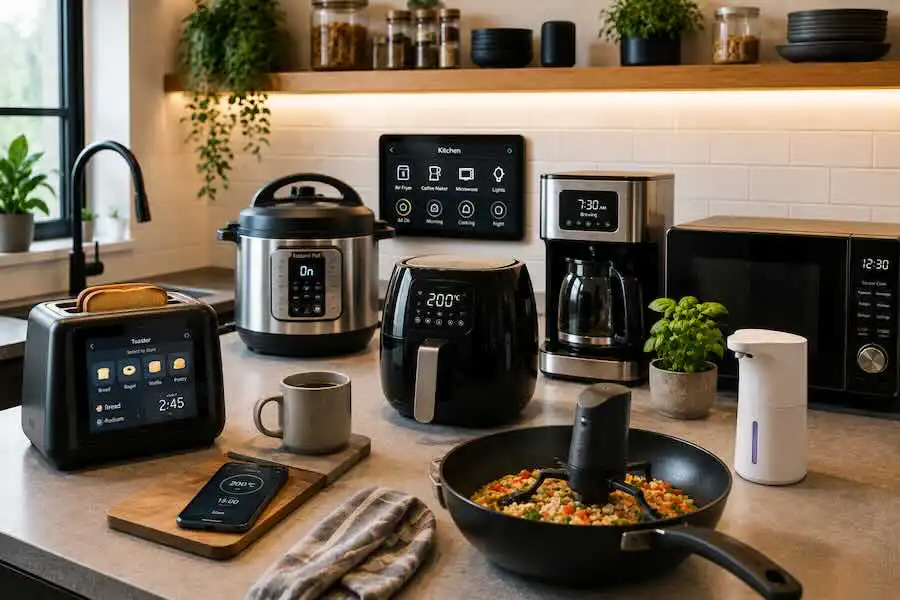
A smart kitchen works best when technology disappears into the rhythm of everyday life. Coffee begins brewing before the first meeting, dinner can be monitored from another room, and small repetitive jobs demand less attention. The result is not a kitchen crowded with screens, but one that quietly gives time back.
Connected appliances have moved well beyond novelty. Wi-Fi controls, app-based monitoring, automated cooking programs, sensors, and voice assistants can now handle specific kitchen tasks with surprisingly little intervention. The useful question is no longer whether an appliance is “smart,” but whether its connected features genuinely make cooking, cleaning, or preparing food easier.
7 Smart Kitchen Gadgets That Actually Make Sense
1. High-Speed Smart Toaster
Toast is simple. Getting exactly the same result every morning is less so. A high-speed smart toaster uses more precise controls to manage browning across different foods, with dedicated settings commonly available for bread, bagels, English muffins, frozen items, and reheating.
Models with touchscreen controls make those adjustments visible rather than relying on a vague numbered dial. For households with different breakfast preferences, saved or highly specific settings can also remove some of the morning guesswork.
2. Connected Multicooker
A connected multicooker is particularly useful because automation complements something the appliance already does well: largely unattended cooking. Depending on the model, an app can provide cooking updates, notifications, recipes, and remote controls for supported functions.
That can be useful for soups, stews, grains, beans, and slow-cooked meals. Ingredients go into one vessel, the cooker maintains the programmed conditions, and you are free to work elsewhere in the kitchen or house. Remote features should still be used according to the manufacturer’s safety instructions, particularly when heat and pressure are involved.
3. Touchless Soap Dispenser
Not every useful kitchen upgrade needs Wi-Fi. A touchless soap dispenser uses a proximity sensor to release soap without requiring you to press a pump with hands covered in dough, raw-food residue, or cooking oil.
Placed beside the sink, it is a small practical improvement that helps reduce unnecessary contact with a frequently used surface. Look for a stable base, an adjustable dispensing volume, and a reservoir that is easy to refill and clean.
4. Automatic Pan Stirrer
Some kitchen gadgets solve remarkably specific problems. An automatic pan stirrer is one of them. Designed to move continuously around a compatible pan, it can reduce the amount of hands-on stirring required for sauces, soups, custards, and similar dishes.
It does not make cooking completely unattended. Heat, consistency, ingredients, and the manufacturer’s operating limits still need attention. Yet for recipes that demand frequent stirring, freeing your hands for another preparation task can make the cooking process noticeably calmer.
5. Smart Air Fryer
Air fryers have earned permanent countertop space in many kitchens because they combine speed with relatively simple cleanup. Connected versions add app controls, cooking notifications, preset programs, and, on compatible models, remote monitoring.
The real appeal remains the cooking method itself. Rapidly circulating hot air can produce crisp surfaces with considerably less oil than deep frying. Removable dishwasher-safe components can make cleanup easier, while presets are useful when preparing familiar foods repeatedly.
6. Smart Coffee Maker
Few connected appliances fit naturally into a daily routine quite like a coffee maker. Scheduling a brew for the morning is already useful; app-connected models can add remote controls, notifications, adjustable brewing options, and automatic shutoff features depending on the machine.
The best smart coffee maker is still the one that produces coffee you enjoy. Prioritize brewing quality, an easy-to-clean carafe and basket, reliable temperature control, and straightforward physical controls before considering the app. Connectivity should make a good machine easier to use, not compensate for a mediocre one.
7. Smart Microwave Oven
Microwaves are particularly suited to automation because much of their work depends on selecting the correct power level and cooking time. Smart models can add Wi-Fi connectivity, voice-assistant compatibility, app controls, presets, and scan-to-cook functionality on supported products.
Scan-to-cook systems can identify compatible packaged foods and apply recommended cooking instructions, reducing button pressing and timing errors. Voice control can also be convenient when your hands are occupied, although traditional one-touch controls remain important for quick everyday use.
What to Check Before Building a Smart Kitchen
A kitchen filled with connected products is not automatically more convenient. Before buying, check whether the appliance still performs its essential functions without an internet connection or smartphone app. Physical controls matter, especially for equipment expected to remain in service for years.
- Compatibility: Check whether the product works with the smart-home platform and mobile devices you already use.
- Security: Choose established manufacturers that provide software and security updates, and protect connected accounts with strong, unique passwords.
- Cleaning: Removable, dishwasher-safe components can matter more in daily life than another app feature.
- Safety: Remote controls should never replace the manufacturer’s instructions for safely operating appliances that generate heat, pressure, or steam.
- Longevity: Consider whether the appliance remains functional if its companion app or cloud service eventually changes.
The Practical Takeaway
Start with the task you repeat most often. If coffee defines your morning, automation there may make sense. If weeknight cooking consumes too much attention, a multicooker or air fryer could have greater value. For a busy sink, something as inexpensive as a touchless dispenser may prove more useful than a sophisticated connected appliance.
The strongest smart-kitchen purchases solve an existing inconvenience. They should reduce friction rather than create another account, notification stream, or device that needs troubleshooting.
Conclusion: A Smarter Kitchen Should Feel Simpler
A well-designed smart kitchen is less about futuristic spectacle and more about quiet efficiency. Warm food, clean surfaces, coffee at the right moment. Technology sits behind those experiences rather than becoming the experience itself.
Choose appliances for cooking performance, safety, durability, and ease of cleaning first. Then consider connectivity. When those priorities align, smart gadgets can turn repetitive kitchen routines into something faster, calmer, and easier to manage.
FAQ: Smart Kitchen Gadgets
Do smart kitchen appliances need Wi-Fi?
Connected features generally require Wi-Fi, but many appliances retain basic physical controls. Check the specifications before buying if offline functionality matters to you.
Are smart kitchen gadgets worth the extra cost?
They can be when automation removes a task you perform frequently. Paying significantly more for connectivity you rarely use offers much less value.
Can smart appliances be controlled remotely?
Some can, although available controls vary by product and safety restrictions. Heating appliances may deliberately limit remote-start functions.
What is the easiest smart kitchen upgrade?
A touchless soap dispenser, programmable coffee maker, or connected countertop appliance can introduce useful automation without renovating the kitchen.
What should I prioritize when buying a smart appliance?
Start with core performance, safety, cleaning, reliability, and offline controls. App quality and smart-home integration should come after those essentials.