




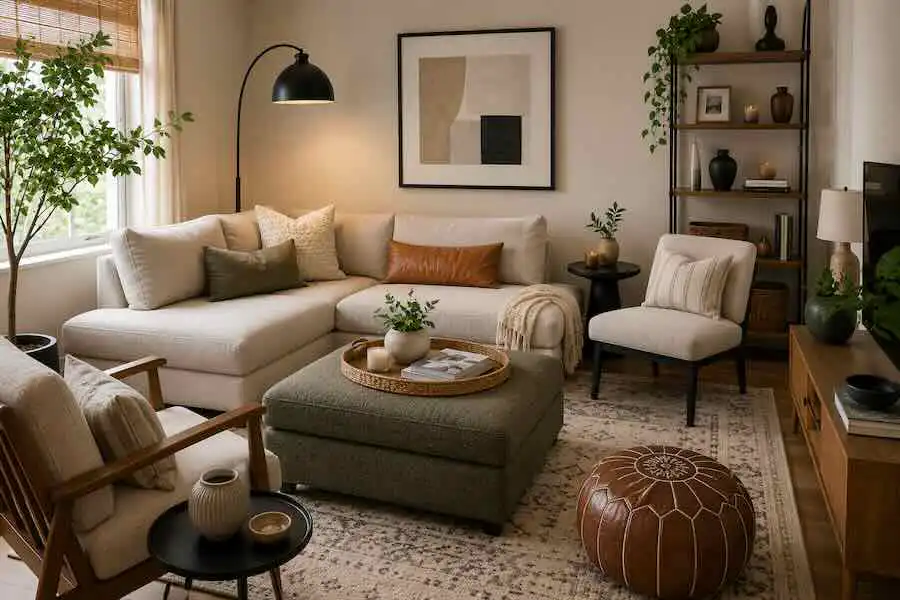
A small living room does not need to behave like one. The difference often comes down to what occupies the floor, what can disappear when it is not needed, and whether people can move through the room without navigating an obstacle course of chairs and tables.
Extra seating is where compact rooms become difficult. Add too much and the room closes in; add too little and hosting becomes awkward. The useful middle ground is furniture that earns its footprint, paired with a layout that leaves breathing room around it.
Start With the Way People Actually Move
Before buying another chair, look at the paths through the room. Where do you enter? Which route leads to the sofa, window, balcony, or adjoining room? Those lines matter more than perfect symmetry.
A sofa pushed against a wall is not automatically the most efficient solution. In some rooms, bringing seating slightly inward creates a clearer route behind it. In others, an L-shaped arrangement makes better use of a neglected corner. The goal is simple: people should be able to sit down without someone else having to stand up and move.
For conversation, angle chairs toward the main sofa rather than automatically pointing everything toward the television. A loose U- or L-shaped arrangement feels social while keeping the center visually connected.
Choose Furniture That Does More Than Sit There
In a compact room, single-purpose furniture is expensive in terms of space. An upholstered ottoman, for example, can become a seat when friends arrive, a footrest on quiet evenings and a coffee table with a sturdy tray on top.
Storage versions work even harder. Blankets, games, chargers and the everyday objects that quickly make a small room feel busy can disappear beneath the lid. There are good reasons to have ottomans in your living room, but their flexibility becomes especially valuable when square footage is limited.
Let Some Seating Disappear
Not every seat needs a permanent address.
A pair of stools tucked beneath a console can remain almost invisible during the week and appear when guests arrive. Nesting stools, folding chairs and compact poufs follow the same principle. They give the room temporary capacity rather than permanently filling it for the occasional evening when six people need somewhere to sit.
This works particularly well in apartments where the living room may also function as a dining area, workspace or exercise space. Lightweight pieces can shift with the day instead of dictating how the room must be used.
A Sectional Can Be Smaller Than Several Chairs
Sectionals have a reputation for dominating rooms, but scale matters more than category. A compact sectional fitted closely into a corner can occupy less usable floor space than a sofa surrounded by several freestanding armchairs.
Look for slim arms, raised legs and a relatively shallow seat depth. Those details reduce visual weight. Modular designs are particularly useful because individual sections can move when the layout changes. The same thinking applies when expanding a small living room’s seating: capacity matters, but circulation matters just as much.
Use Benches Where Chairs Feel Too Heavy
A narrow bench introduces a different silhouette. Against a wall or beneath a window, it can accommodate two people while occupying considerably less visual space than two substantial armchairs.
Backless designs are especially unobtrusive because the eye travels across them rather than stopping at a tall upholstered back. Add one or two cushions for comfort and leave the rest simple. The result feels intentional rather than squeezed in.
Think Vertically When the Floor Is Full
Once floor space becomes scarce, walls become useful. Fold-down wall seating can work in very tight rooms, while wall-mounted shelves replace bulky side tables and keep surfaces close to seating without introducing additional furniture legs.
A hanging chair can also make use of an awkward corner while keeping more of the floor visible. It is a stronger visual statement, though, and proper structural installation is essential. In a calm interior, natural fibers and a restrained palette can help this type of seating sit comfortably alongside a more relaxed home design.
Keep the Visual Weight Low
Two pieces of furniture with identical dimensions can feel completely different in the same room. Chunky arms, deep bases and dark uninterrupted upholstery create visual mass. Exposed legs, finer frames and softer tonal transitions reveal more floor and make the room appear less crowded.
This does not mean everything has to be white or beige. Rich green, rust, navy or patterned upholstery can work beautifully in a small room when the silhouettes remain clean. Texture can carry much of the character: woven wool, washed linen, timber and tactile cushions add warmth without requiring another decorative object.
Plan for Everyday Life, Not Maximum Capacity
One of the easiest mistakes is furnishing a living room for the largest gathering you might host rather than the way you live most days. If two people normally use the space, permanent seating for eight is likely to make the other 350 days of the year less comfortable.
Build the room around its everyday occupants first. Then add flexible capacity through stools, poufs, folding chairs or an upholstered coffee table. When friends arrive, the room expands. When they leave, it becomes quiet again.
A Simple Small-Room Seating Formula
Start with one appropriately scaled sofa or compact sectional. Add one lightweight accent chair if the room can carry it. Introduce an ottoman or upholstered table that can become another seat, then keep one or two easily stored options nearby for larger gatherings.
Most importantly, leave something empty. A visible strip of floor, an unobstructed corner or a clean line toward the window gives the eye somewhere to rest. Small rooms rarely need more furniture. They need better-performing furniture and enough space around it to breathe.
FAQ
What is the best extra seating for a very small living room?
Ottomans, poufs, nesting stools and folding chairs are particularly practical because they can perform another function or be stored when they are not required. A slim bench is another useful option when there is an open wall or window area.
Should all furniture be pushed against the walls?
No. Although it can work in some layouts, automatically pushing everything outward can produce an awkward empty center and make conversation difficult. Test the room according to circulation and sightlines instead.
Can a sectional work in a small living room?
Yes. A compact sectional can use a corner efficiently and may require less space than combining a conventional sofa with several chairs. Pay attention to overall dimensions, arm width and seat depth rather than assuming every sectional is too large.
How can I make a small living room look less crowded?
Keep walkways clear, choose furniture with lighter silhouettes, reduce unnecessary pieces and allow visible floor between key elements. furniture raised on legs can also create a greater sense of openness.