




Some landscapes are beautiful because of their scale. Others stop you because of their color. The world’s most extraordinary lakes somehow manage to do both.
Imagine impossibly blue water beneath snow-dusted mountains, waterfalls spilling between forested lakes or a mineral-rich landscape that transforms with the seasons. These are places where the journey feels worthwhile before you’ve even decided what to do when you arrive.
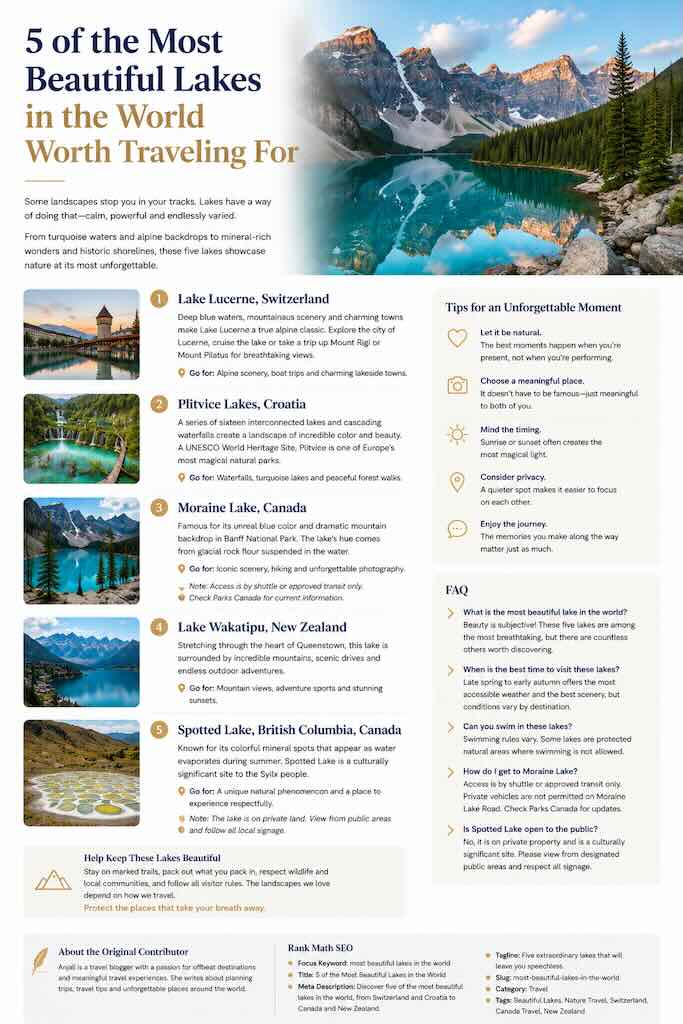
From Switzerland to New Zealand, here are five remarkable lakes that deserve a place on your travel wish list.
Editor’s note: This article from Divine Magazine’s earlier archive has been substantially rewritten and updated. Access, transportation and local visitor rules can change, so check official information before traveling.
1. Lake Lucerne, Switzerland
Lake Lucerne looks almost too perfectly Swiss to be real.
Deep blue water winds between mountains and historic lakeside communities in central Switzerland, with Lucerne itself sitting beautifully at the edge of the lake. The city’s medieval Chapel Bridge, waterfront promenades and mountain backdrop make this one of those destinations where simply walking around feels like sightseeing.
But the lake becomes even more impressive when you travel across it.
Boat journeys reveal how dramatically the landscape changes beyond the city, with mountain slopes rising around the water and small communities appearing along the shoreline. The lake also works naturally as part of a wider trip involving nearby peaks such as Mount Rigi or Mount Pilatus.
Go for: Alpine scenery, boat trips and a combination of city and mountain experiences.
2. Plitvice Lakes, Croatia
Plitvice doesn’t give you one spectacular lake. It gives you an entire landscape built around water.
Located within Plitvice Lakes National Park, the interconnected lakes are surrounded by forest and linked by waterfalls and cascades. Depending on the light, weather and mineral composition of the water, colors can appear to shift between shades of blue, green and turquoise.
The landscape is internationally significant, too. Plitvice Lakes National Park has been on UNESCO’s World Heritage List since 1979.
Wooden pathways and trails allow visitors to explore sections of the park without treating the lakes themselves like a conventional swimming destination. This is somewhere to slow down, walk and observe.
Arriving earlier in the day can also make the experience feel considerably calmer during busy travel periods.
Go for: Waterfalls, forest walks and extraordinary turquoise water.
3. Moraine Lake, Canada
You’ve probably seen Moraine Lake before even if you’ve never been to Canada.
Set in the Valley of the Ten Peaks in Banff National Park, the lake has become one of the Canadian Rockies’ defining images: intensely colored water surrounded by dramatic mountain peaks and dense forest.
The remarkable color isn’t the result of somebody turning up the saturation. Fine particles of rock carried by glacial meltwater influence the way light is scattered through the water, helping create its distinctive appearance.
There is an important practical detail for anyone planning a visit: you shouldn’t build your itinerary around simply driving your own car to the shoreline. Access arrangements have changed significantly in recent years, and visitors should check current Parks Canada transportation information and shuttle options before traveling.
It’s a useful reminder that some of the world’s most photographed natural places require considerably more planning than the photograph suggests.
Go for: Canadian Rockies scenery, hiking and one of the world’s most recognizable mountain-lake views.
4. Lake Wakatipu, New Zealand
Queenstown would be spectacular even without Lake Wakatipu. Fortunately, it doesn’t have to be.
The long lake stretches through a dramatic landscape of mountains on New Zealand’s South Island, giving Queenstown its unmistakable waterfront setting. The Remarkables mountain range provides an appropriately dramatic backdrop.
What makes Wakatipu especially appealing is the number of ways you can experience it. Walk beside the water, take a cruise, explore the surrounding region by road or simply find somewhere along the shoreline and watch the light move across the mountains.
Queenstown’s reputation for adventure also means the lake can become the calm center of a much more energetic vacation. Hiking, cycling and the region’s famous adrenaline activities are all within reach.
Go for: Mountain views, Queenstown and a mixture of relaxation and adventure.
5. Spotted Lake, Canada
Spotted Lake is different from every other destination on this list.
Located near Osoyoos in British Columbia, the mineral-rich lake is known for the unusual patterns that can become visible as water evaporates during warmer conditions. Instead of a conventional blue alpine lake, visitors may see a landscape of differently colored mineral pools.
But understanding this place requires looking beyond its appearance.
Known as kłlilx’w to the Syilx people of the Okanagan Nation, the lake is a culturally and spiritually significant place. It should therefore be approached with respect rather than treated simply as an unusual roadside photo opportunity.
The lake is on private property and is generally viewed from outside the protected area rather than entered by visitors. Respect signage, boundaries and current local guidance.
Go for: A remarkable natural phenomenon — experienced respectfully from an appropriate viewing point.
What Makes Lake Water Look So Blue?
Those extraordinary blues and turquoises aren’t all created in the same way.
At some glacial lakes, extremely fine particles of rock suspended in the water affect how light is scattered. Elsewhere, depth, minerals, algae, the surrounding landscape, weather conditions and the angle of sunlight can all influence the color you perceive.
That’s why the lake you photographed beneath brilliant midday sunshine may look completely different under clouds or evening light.
It also means photographs shouldn’t become a promise. Nature doesn’t guarantee that exact shade of turquoise just because you saw it on Instagram.
How to Visit Beautiful Lakes Without Loving Them to Death
Some of the world’s most beautiful lakes are also experiencing enormous visitor pressure.
A few simple choices can reduce your impact:
- Stay on marked trails and boardwalks where provided.
- Don’t enter protected water simply to recreate a photograph.
- Take everything you bring with you back out.
- Use official shuttles or public transportation when destinations restrict private vehicles.
- Respect private property and culturally significant places.
- Follow local wildlife guidance and keep your distance from animals.
- Consider visiting outside the busiest hours or seasons where practical.
The photograph isn’t worth damaging the landscape you traveled to see.
Five Lakes, Five Completely Different Experiences
Trying to name the single most beautiful lake in the world is probably impossible — and not particularly useful.
Lake Lucerne is about the meeting point between water, mountains and elegant Swiss towns. Plitvice is a landscape shaped by interconnected lakes and waterfalls. Moraine Lake delivers enormous glacial drama. Wakatipu gives Queenstown its cinematic setting. Spotted Lake shows just how unusual a lake can become when geology, climate and culture intersect.
And there are thousands more we could have included.
Perhaps that’s the real appeal of lakes: something as simple as water surrounded by land can look completely different depending on where in the world you find it.
FAQ: Beautiful Lakes Around the World
What are some of the most beautiful lakes in the world?
Lake Lucerne in Switzerland, the Plitvice Lakes in Croatia, Moraine Lake in Canada and Lake Wakatipu in New Zealand are among the world’s most visually striking lake destinations. Beauty is subjective, however, and there are extraordinary lakes on every continent.
Can you drive to Moraine Lake?
Access to Moraine Lake has changed and private vehicles are generally not permitted on Moraine Lake Road. Visitors should check current Parks Canada information for shuttle, transit and approved transportation options before their trip.
Can you swim in the Plitvice Lakes?
Swimming in the lakes within Plitvice Lakes National Park is not permitted. Follow the park’s current rules and remain on authorized visitor routes.
Why is Spotted Lake important?
Beyond its unusual mineral patterns, kłlilx’w (Spotted Lake) is culturally and spiritually significant to the Syilx people of the Okanagan Nation. Visitors should respect the protected site and observe current access restrictions.
When is the best time to photograph a lake?
Early morning and late afternoon often produce softer light and reflections, but conditions vary dramatically by destination. Weather, season and the direction of the sun can completely change a lake’s appearance.
About the Original Contributor
Anjali originally contributed this article to Divine Magazine’s earlier archive. This version has been substantially updated and rewritten for current publication.