




You want to learn an instrument, but there’s one problem: piano or guitar? Both are brilliant first instruments, both can take years to master, and both can completely change the way you understand music. But the experience of learning them is surprisingly different.
The piano gives you a beautifully visual introduction to notes, chords and harmony. The guitar is portable, tactile and lets you start strumming recognizable songs surprisingly quickly once you’ve mastered a few basic shapes.
So which one should you learn first? The answer depends less on which instrument is supposedly “easier” and more on the kind of music you want to make, how you like to learn and where you imagine yourself playing.
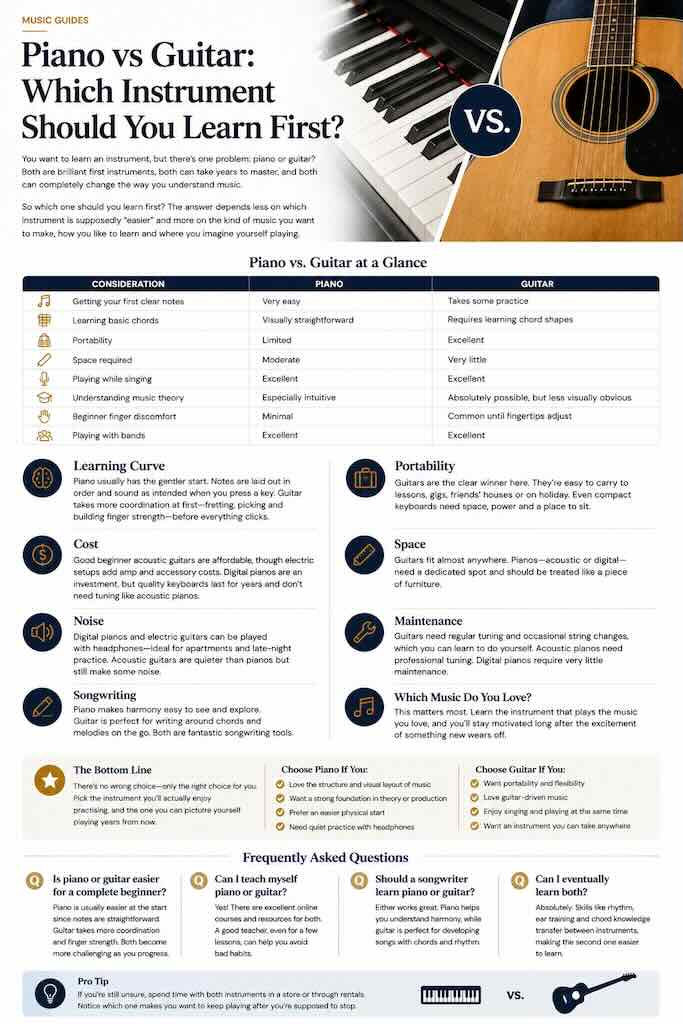
Piano vs. Guitar at a Glance
| Consideration | Piano | Guitar |
| Getting your first clear notes | Very easy | Takes some practice |
| Learning basic chords | Visually straightforward | Requires learning chord shapes |
| Portability | Limited | Excellent |
| Space required | Moderate | Very little |
| Playing while singing | Excellent | Excellent |
| Understanding music theory | Especially intuitive | Absolutely possible, but less visually obvious |
| Beginner finger discomfort | Minimal | Common until fingertips adjust |
| Playing with bands | Excellent | Excellent |
Which Is Easier to Learn: Piano or Guitar?
For the absolute beginner, piano usually has the gentler first few hours.
Press a piano key and you get the intended note. You don’t have to hold a string at exactly the right point, develop calluses or coordinate fretting with picking simply to produce a clean sound.
The keyboard also makes musical relationships unusually easy to see. Notes progress from low to high from left to right, while the repeating pattern of black and white keys gives you a visual map of the instrument.
A guitar asks more of you physically at the beginning. Your fretting hand has to create chord shapes while applying enough pressure to multiple strings, and your other hand has to strum or pick them. Beginners inevitably encounter buzzing strings, muted notes and fingertips that suddenly have very strong opinions about their new hobby.
Get through that initial stage, however, and the guitar becomes remarkably rewarding. A relatively small collection of open chords can unlock a huge number of songs.
Choose the Instrument That Plays the Music You Love
This may matter more than every technical comparison on this page.
If the songs that made you want to become a musician revolve around guitar, learn guitar. If you’re constantly drawn toward piano-led songs, learn piano.
Motivation is much easier to maintain when practice eventually leads toward music you genuinely want to play.
Neither instrument locks you into one genre. Piano moves comfortably through pop, classical, jazz, R&B, soul, electronic music and songwriting. Guitar is equally at home in rock, indie, folk, country, blues, metal, pop and countless styles beyond them.
Instead of asking which instrument has the most possibilities, ask a simpler question: which one can you picture yourself picking up—or sitting down at—when nobody is telling you to practise?
Piano Has an Advantage for Understanding Music
There’s a reason keyboards are frequently used when explaining music theory.
The layout makes intervals, scales and chords relatively easy to visualize. Play a C major chord and its three notes are sitting directly in front of you. Move through a scale and you can physically see the distance between the notes.
On guitar, the same note can appear in several positions across different strings. That’s enormously useful once you understand the fretboard, but it can make the instrument feel less intuitive when you’re first trying to understand how music is constructed.
If learning harmony, composing or eventually producing your own music is a major goal, basic keyboard skills are particularly valuable.
Guitar Wins on Portability
This contest isn’t particularly close.
A guitar can travel to rehearsals, lessons, a friend’s house or a gig in a case over your shoulder. An acoustic guitar doesn’t even require electricity.
A digital piano is considerably easier to accommodate than an acoustic piano, but even a compact keyboard generally needs a stand or desk, somewhere to sit and access to power.
If you live in a very small apartment, move frequently or want an instrument you can easily take with you, guitar has an obvious advantage.
What About Noise?
This is worth considering before buying either instrument, particularly if you share walls with other people.
A digital piano has one enormous advantage: headphones. You can practise late at night without forcing everyone else in the building to hear you work through the same four bars for the 27th time.
Electric guitar can also be surprisingly apartment-friendly when paired with a headphone-compatible practice amp or audio interface. An acoustic guitar is harder to silence completely, although it’s still considerably less imposing than an acoustic piano.
Which Is Cheaper to Start?
You don’t need a concert grand or a professional guitar to start learning.
Entry-level acoustic guitars and basic digital keyboards make both instruments accessible at relatively modest prices. Guitar usually requires less physical space and fewer large accessories, although an electric guitar setup may also require an amplifier, cable and eventually other equipment.
For piano, look beyond price alone. A keyboard with full-size, touch-sensitive keys gives a beginner a much more useful learning experience than a very basic keyboard that responds identically no matter how softly or firmly you play.
You don’t necessarily need 88 weighted keys on day one, but if you’re serious about progressing toward traditional piano technique, they become increasingly worthwhile.
Maintenance Is Different
Guitar ownership involves a little routine maintenance. Strings eventually need replacing, the instrument needs tuning regularly and occasional adjustments may be necessary as it ages.
Most of those basic jobs are inexpensive and easy to learn.
Acoustic pianos are another matter. They need periodic professional tuning and are large, heavy instruments to move. Digital pianos avoid most of that maintenance entirely: they don’t need tuning and require little beyond ordinary care.
Which Is Better for Songwriting?
Both—and they encourage slightly different ways of writing.
Piano makes harmony extremely visible, which can be useful when experimenting with chord progressions, melodies and arrangements. It’s also closely connected to modern music production because MIDI keyboards and software instruments are central to many home studios.
Guitar encourages a different relationship with rhythm and chord shapes. For singer-songwriters especially, being able to grab an acoustic guitar and develop a melody over a progression can make songwriting feel immediate and spontaneous.
If your ultimate goal is writing songs, there really isn’t a wrong choice.
What If You Want to Sing at the Same Time?
Again, both instruments are excellent companions for singers.
Guitar has the portability advantage and is practically synonymous with the singer-songwriter setup. Piano, meanwhile, gives singers enormous harmonic control and makes changing keys relatively straightforward once you understand chord structures.
The difficult part isn’t the instrument you choose. It’s teaching your hands to continue playing while your brain concentrates on lyrics and melody. That coordination takes practice on either instrument.
So, Should You Learn Piano or Guitar?
Choose piano if: you like seeing music laid out logically, want a strong foundation for music theory or production, prefer an easier physical start, or need the convenience of silent headphone practice with a digital instrument.
Choose guitar if: portability matters, guitar-driven music is what excites you, you want to play casually with friends or take your instrument anywhere, or the idea of strumming and singing appeals to you more than sitting at a keyboard.
And if you’re still completely undecided, don’t choose based on which instrument someone tells you is easier. Find a piano and a guitar and spend a little time with both.
One of them will probably make you want to keep playing after you’re supposed to stop. That’s the one to learn first.
Frequently Asked Questions
Is piano or guitar easier for a complete beginner?
Piano generally makes producing your first clean notes and understanding their layout easier. Guitar has a steeper physical learning curve at first because beginners must coordinate fretting, picking or strumming and develop finger strength. Both become progressively more challenging as you advance.
Can I teach myself piano or guitar?
Yes. There are excellent learning resources available for both instruments. Occasional lessons with an experienced teacher can still be valuable for correcting technique before bad habits become difficult to change.
Should a songwriter learn piano or guitar?
Either can be an excellent songwriting instrument. Piano makes harmony and music theory particularly easy to visualize, while guitar is portable and naturally suited to developing songs around chords, rhythm and vocals.
Can I eventually learn both?
Absolutely. Skills such as rhythm, ear training, chord construction and understanding harmony transfer between instruments. Learning your second instrument can therefore feel very different from starting music completely from scratch.