




From the oval window of the Shinkansen bound for Tokyo, I silently said goodbye to Hiroshima.
The rain had finally begun to fall, and my heart felt heavy. Hiroshima had shown me something difficult to put into words: the terrible cost of war, but also the extraordinary ability of people and cities to rebuild after unimaginable destruction.
The darkest days of its past haven’t been forgotten. They remain part of Hiroshima’s identity. Yet the city I was leaving behind was alive, welcoming and quietly resilient — a place shaped not only by what happened to it, but by everything that came afterward.
After almost three weeks of travelling through Japan, I had begun noticing other things too: the patience of everyday life, the discipline, the small acts of consideration between strangers.
Now I was returning to Tokyo for another four days.
Back Into the Current of Tokyo
It didn’t take long before I was lost again in the endless levels and corridors of Shinjuku Station.
Eventually I found my way toward Ameya Yokocho — better known as Ameyoko — near Ueno.
Emerging from Okachimachi Station felt like stepping onto a film set. Trains rattled overhead on the elevated railway. Signs flickered in Japanese and English. Crowds poured from the station and disappeared into shops and narrow lanes.
The sky had begun to clear. Pale blue appeared between the clouds while a cold breeze moved through the street.
Ameyoko runs alongside the railway between Ueno and Okachimachi. There seemed to be almost no logic to what belonged next to what — and that was part of its charm.
Seafood stalls sat near shops selling sneakers and clothes. Smoke curled from grills. Vendors called to passing customers. Tourists perched on little stools waiting for food while the trains continued to thunder somewhere above us.
I stopped trying to navigate and simply allowed myself to move with the crowd.
In Ameyoko, it was difficult to feel alone.
Then Night Fell
Tokyo felt different after dark.
It was seductive and restless, illuminated by signs and windows and streams of people who always seemed to know where they were going.
I loved it.
And somehow, surrounded by millions of people, I felt intensely lonely.
That may be one of the strangest things about a city this large. Being surrounded by people doesn’t necessarily make you feel less alone. Sometimes it makes the feeling sharper.
I walked through Shinjuku watching couples, office workers, tourists and groups of friends disappear into restaurants and bars.
I had spent part of the evening searching for a restaurant recommended by a guidebook. Eventually I found it in Nishi-Shinjuku.
I stood outside.
A group of men in dark business suits went in. A young couple came through the doorway holding hands. Through the window I could see the carefully designed interior and hear laughter from inside.
I looked down at my feet.
For reasons I couldn’t quite explain, I didn’t want to walk through that door alone.
A Little Ramen Sign in Shinjuku
So I kept walking.
Music competed with the lights along the streets of Shinjuku. The temperature had dropped and I was cold.
Then I noticed a ramen sign glowing above a small doorway.
People kept slipping through it, one after another.
What caught my attention was that almost everyone seemed to be alone.
No couples. No groups deciding where to sit. No friends waiting outside for someone running late.
Just individual diners walking in.
I followed them.
A Restaurant Designed for One
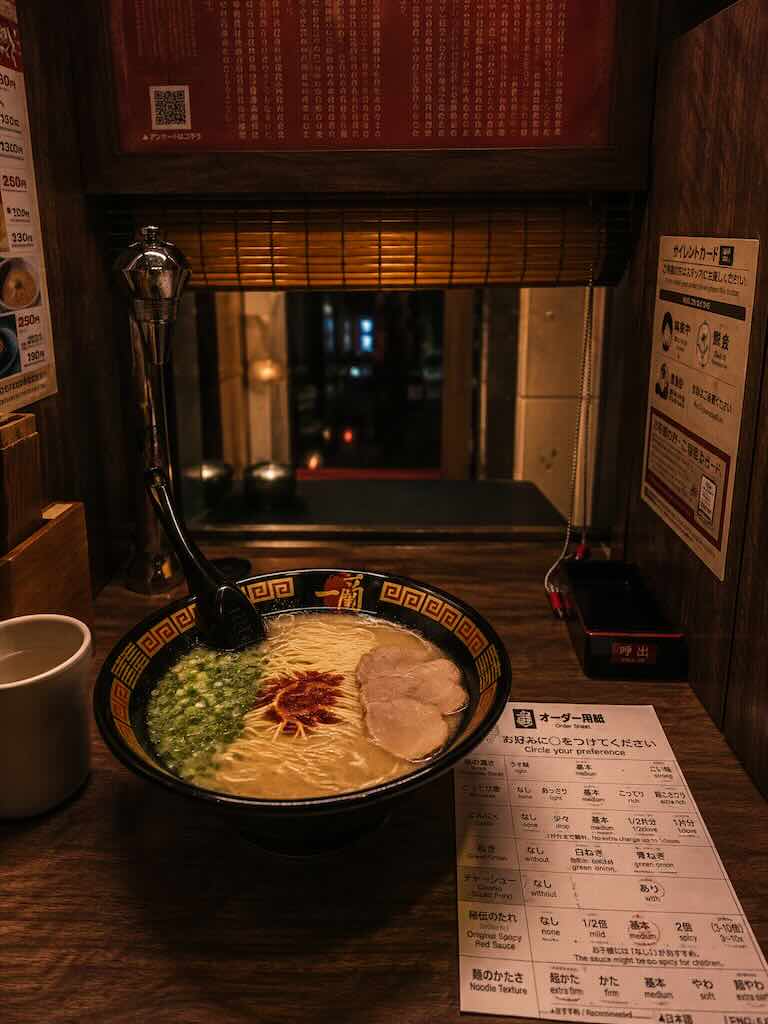
Inside, I ordered from a machine and walked down a dim corridor toward the dining area.
Dark wooden counters faced the wall. Each seat was separated from the next by a partition. In front of every diner was a small curtain concealing the kitchen.
I chose a seat near the corridor.
The curtain in front of me suddenly opened.
I couldn’t see the person on the other side clearly. I heard Japanese, assumed the staff member wanted my order card and handed it through.
It came back.
More Japanese.
I had absolutely no idea what was happening.
Then a quiet voice appeared from behind the partition beside me.
“He said you gave him the wrong card.”
I turned toward the voice.
At first, all I could see above the partition was a pair of pink cat ears.
A young woman slowly raised her head. She looked to be in her early twenties, with costume cat ears perched on top of her hair.
“You dropped your card back in the corridor,” she whispered, passing it around the partition.
I thanked her. She smiled and returned her attention to her phone.
“Did you come here by yourself?” I asked.
“Everyone here comes alone,” she replied.
Then she giggled.
“This is the ramen shop for a loner.”
Ramen for a Loner
Our curtains opened almost simultaneously.
Hands appeared through the openings carrying bowls of steaming ramen. There was a brief exchange in Japanese and then the curtains disappeared again.
Suddenly there was nothing to do except eat.
I lifted a spoonful of broth and then the noodles, slurping them as I had watched people do throughout Japan.
The ramen was hot and deeply comforting.
Something about that strange little booth changed the evening. An hour earlier I had stood outside a beautiful restaurant feeling conspicuously alone. Here, being alone wasn’t something that needed explaining.
It was simply how everyone was eating.
The cold Tokyo night had followed me through the doorway, but somewhere between the curtain, the stranger in pink cat ears and that first warm mouthful of broth, the loneliness loosened its grip.
It was my first bowl of ramen in Tokyo.
And, as the girl beside me had put it, it was ramen for a loner.
Words by traveller Doody Richards, based in Sydney, Australia.