



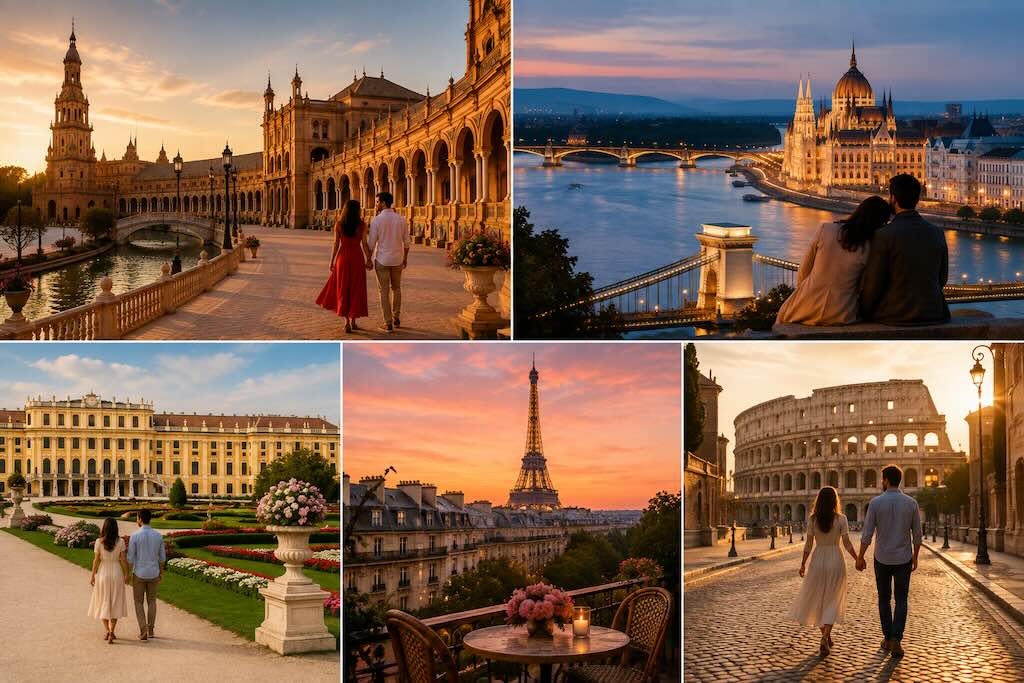
Europe does romance without needing to announce it. It appears in the amber light across an old plaza, the quiet of a palace garden, a late dinner on a narrow street, or the reflection of a bridge across dark water. For couples planning a European escape in 2026, the most memorable cities are often those that make slowing down feel natural.
Seville, Budapest, Vienna, Paris, and Rome each offer a different version of that experience. Some are theatrical and sunlit. Others feel grand, intimate, or wonderfully unhurried. Together, they make a strong starting point for a romantic Eurotrip built around culture rather than a checklist.
Seville, Spain: warm nights and Andalusian rhythm
Seville feels particularly seductive after the afternoon heat begins to soften. Orange trees line the streets, tiled courtyards hide behind heavy doors, and dinner has little reason to begin early.
The city’s architectural centerpiece is the Royal Alcázar of Seville, where Islamic, Mudéjar, Gothic, Renaissance, and Baroque influences meet across ornate rooms and green courtyards. The palace remains a royal residence, while its gardens offer one of the city’s loveliest places for a slow walk together.
From there, wander through Santa Cruz without treating the neighborhood as a route to complete. Stop for tapas. Find a shaded table. Later, seek out a flamenco performance where the room is small enough to hear the shoes strike the floor. The official Seville tourism site is useful for checking exhibitions, performances, festivals, and current visitor information before you arrive.
Budapest, Hungary: romance after dark
Budapest’s scale is part of its appeal. Monumental architecture rises on both sides of the Danube, yet the city still creates small, atmospheric moments: steam above thermal water, café tables tucked into old interiors, and the Parliament Building illuminated across the river.
A walk along the Danube at dusk is difficult to improve upon. Cross between Buda and Pest, climb toward Castle Hill for the wider view, then watch the riverfront gradually light up as evening settles over the city.
Budapest’s thermal bathing culture offers another kind of date entirely. Historic bath complexes turn a few hours away from sightseeing into part of the trip rather than downtime between attractions. Check individual bath operators and Budapest’s official visitor information for current opening details and booking requirements.
Vienna, Austria: old-world elegance without the rush
Vienna carries romance differently. The mood is more polished: stone façades, coffeehouses, formal gardens, concert halls, and streets where imperial scale meets everyday city life.
Spend part of a day at Schönbrunn Palace, but leave enough time for the grounds rather than moving directly from room to room. Back in the center, walk instead of immediately taking transport. Vienna rewards the spaces between its major sights.
Music remains one of the city’s defining pleasures, so an evening performance can give a romantic trip a natural centerpiece. The Vienna Tourist Board maintains current information on concerts, museums, seasonal events, neighborhoods, restaurants, and practical planning.
Budapest and Vienna also make an intuitive pairing for couples who prefer rail travel. Europe’s cross-border rail system continues to develop, with the European Commission pursuing measures designed to make multi-operator journeys and ticketing easier. Travelers should still compare individual operators and ticket conditions when building a multi-city itinerary.
Paris, France: find the quieter version
Paris does not need another declaration that it is romantic. The better question is how to experience that side of the city without spending an entire trip moving between famous photo locations.
See the Eiffel Tower, certainly. The view from above remains extraordinary, particularly as daylight fades. The official Paris tourism office provides current visitor information and ideas beyond the obvious landmarks.
Then give Paris room to become less structured. Walk along the Seine. Cross a bridge simply because the light looks good on the other side. Buy bread, cheese, fruit, and something sweet for an informal picnic where permitted, or settle into a neighborhood restaurant and allow dinner to take most of the evening.
That contrast is where Paris works best for couples: the Louvre and a tiny café, monumental boulevards and quiet side streets, carefully planned reservations followed by hours with nowhere particular to be.
Rome, Italy: history in golden light
Rome rarely behaves like a museum, even when ancient ruins are everywhere. Scooters move past Renaissance façades. Espresso is taken standing at a counter. A street opens unexpectedly onto a fountain or a fragment of the ancient city. That friction between centuries gives Rome its energy.
First-time visitors will naturally gravitate toward the Colosseum, Roman Forum, Pantheon, and Trevi Fountain. The official Rome tourism portal’s guide to the Colosseum Archaeological Park is a useful starting point for understanding the ancient center.
There is also an important 2026 change at the Trevi Fountain. From February 2, tourists and non-residents entering the basin area closest to the monument generally pay a €2 admission fee between 9 a.m. and 10 p.m., with exemptions and possible schedule changes. Check the official Trevi Fountain visitor information shortly before going.
For the romantic part, leave some empty space in the itinerary. Walk through Trastevere in the evening, linger over dinner, and see the city around sunset when pale stone shifts toward honey and terracotta. Rome is better when you occasionally stop trying to see Rome.
How to build a romantic multi-city Eurotrip
The temptation with a European itinerary is to add one more city. Resist it. Romance tends to disappear when every morning begins with packing and every afternoon ends at another station.
Three or four nights per major city gives couples more freedom to change plans, return to a favorite neighborhood, or spend an afternoon doing almost nothing. Regional combinations also make more sense than zigzagging across the continent. Budapest and Vienna pair naturally, while Rome can anchor a longer Italian journey and Seville can become part of a wider Spanish itinerary.
Rail can be particularly useful for city-center-to-city-center journeys. The European Commission’s rail information outlines current developments in European rail, including work on high-speed connections and cross-border travel. For actual departure times and fares, confirm details with the relevant rail operators before booking.
Conclusion
The best romantic city is not necessarily the one with the most famous view. It is the place that gives two people enough time and atmosphere to pay attention to each other.
Seville brings heat and rhythm. Budapest glows across the Danube. Vienna feels composed and graceful. Paris turns ordinary walks into part of the experience, while Rome layers dinner, history, noise, and golden evening light into the same frame. Choose fewer places, stay longer, and leave part of the journey unscheduled.
FAQ: Romantic European destinations in 2026
Which European cities are best for a romantic trip in 2026?
Paris and Rome remain classics, while Seville, Budapest, and Vienna offer distinct alternatives. Seville suits couples drawn to food and late-night atmosphere, Budapest combines architecture with thermal bathing, and Vienna is especially strong for music, museums, cafés, and imperial surroundings.
When is the best time for a romantic trip to Europe?
Late spring and early autumn are attractive for many European cities because temperatures can be comfortable for walking. The ideal period still depends on the destination. Seville can become intensely hot in summer, while Vienna and Budapest offer a completely different atmosphere during the colder months.
Is train travel a good option for couples visiting several European cities?
Yes, particularly when cities have convenient center-to-center rail connections. In May 2026, the European Commission proposed measures intended to simplify booking journeys involving multiple operators and strengthen passenger protection across combined rail journeys. Travelers should still verify schedules, ticket rules, reservations, and disruption policies for each route before departure.
How many nights should couples spend in each city?
Three to four nights is a comfortable starting point for cities such as Vienna, Budapest, and Seville. Paris and Rome can easily justify four or five nights. Staying longer also creates space for slower mornings, spontaneous dinners, and neighborhoods beyond the principal attractions.
Which destination is best for a romantic weekend?
For a short break, choose the city with the simplest journey from your departure point. Vienna works beautifully for culture, Budapest for spas and evening river views, Paris for food and art, Seville for warm-weather atmosphere, and Rome for couples who want history woven into everyday city life.
How can couples make a European trip feel more romantic?
Plan one or two anchor experiences rather than filling every hour. Reserve a special dinner, concert, palace visit, or evening cruise, then leave time around it for walking and spontaneous stops. A less crowded itinerary often creates better memories than trying to cover every landmark.