


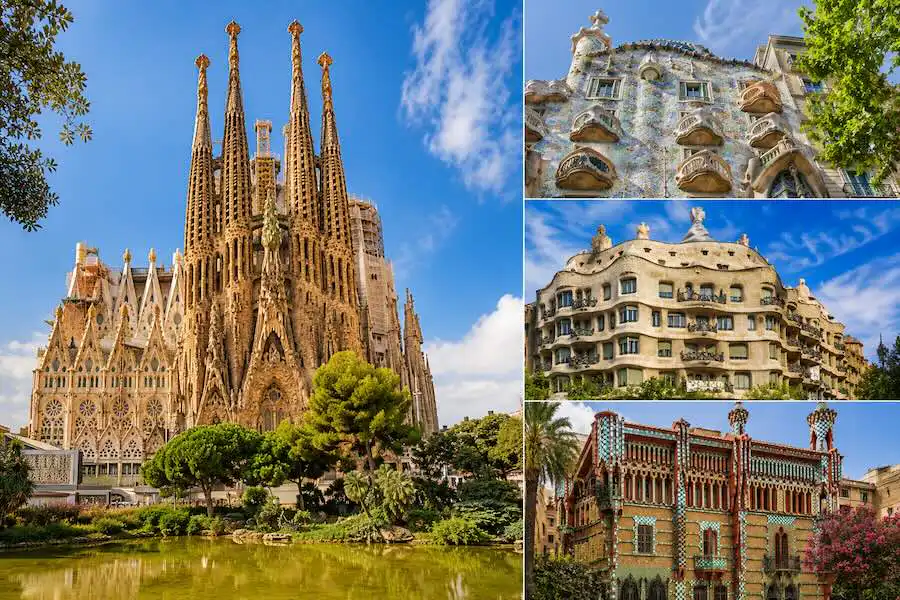
Barcelona changes when you begin looking for Antoni Gaudí. Stone starts to ripple. Chimneys become sculpture. Ceramic fragments catch the Mediterranean light, and a basilica that has occupied the city’s skyline for generations rises above the grid in towers of sand-colored stone. Gaudí did not simply leave buildings behind; he gave Barcelona a visual language that still feels unmistakably its own.
For travelers, his architecture creates an unusually coherent route through the city. The monumental Sagrada Família may be the natural centerpiece, but Casa Batlló, Casa Milà and Casa Vicens reveal different stages of the architect’s imagination. Together, they show how structure, craft, religion and the natural world became intertwined in his work.
If Barcelona forms part of a wider family vacation, these buildings can also turn architecture into something surprisingly accessible. Dragons, twisting columns, colored glass and sculptural rooftops require very little architectural vocabulary to appreciate.
Who Was Antoni Gaudí?
Antoni Gaudí was born in Catalonia in 1852 and became the architect most closely associated with Catalan Modernisme. His work absorbed influences from Gothic architecture, traditional Catalan craft, geometry, religion and forms observed in nature.
That relationship with nature is visible everywhere. Columns branch like trees. Rooflines curve rather than sit obediently straight. Light filters through colored glass and changes the atmosphere as the sun moves across the city.
Gaudí also worked extensively with physical models, allowing him to investigate geometry and structural forces in three dimensions. The result was architecture that could appear fantastical while remaining deeply concerned with engineering.
Seven properties associated with Gaudí form the UNESCO-listed Works of Antoni Gaudí, recognition of the extraordinary influence his architecture had on building design during the late 19th and early 20th centuries.
Sagrada Família: Gaudí’s Unfinished Masterpiece
Nothing prepares you completely for the scale of the Sagrada Família. From several streets away, towers emerge between apartment blocks. Closer in, the façades dissolve into biblical figures, plants, stone surfaces and geometric detail.
Construction began in 1882 under architect Francisco de Paula del Villar. Gaudí assumed responsibility for the project the following year and transformed its architectural direction dramatically. He would eventually devote the final phase of his life almost entirely to the basilica.
Gaudí died in 1926, leaving the building incomplete. Work continued across generations, interrupted by events including the Spanish Civil War and, much later, the COVID-19 pandemic.
The long-discussed 2026 milestone carries particular symbolism because the year marks the centenary of Gaudí’s death, not his 200th birthday. Visitors planning a trip should check the official Sagrada Família website for the latest construction status, opening information and ticket availability rather than relying on older completion forecasts.
Why the Interior Feels Like a Forest
The exterior may attract the cameras first, but the interior changes the emotional register completely. Columns rise from the floor before branching overhead, creating the impression of walking beneath an immense stone canopy.
Then there is the light. Stained-glass windows wash the interior with changing color, moving from cooler blues and greens to warmer oranges and reds. On a bright day, the stone seems to absorb those colors rather than simply reflect them.
This combination of geometry and daylight is central to the experience. The basilica feels monumental without becoming visually heavy. Look upward and the complexity increases; stand still for a few minutes and patterns begin to reveal themselves.
Understanding the Three Façades
The Sagrada Família is organized around three monumental façades representing different parts of the Christian narrative.
The Nativity Façade faces east and celebrates the birth and early life of Jesus. Dense with plants, animals and human figures, it has an almost organic abundance. It is also the façade most directly associated with Gaudí’s lifetime.
On the western side, the Passion Façade presents a striking contrast. Its forms are sharper and more austere, reflecting the suffering and crucifixion of Christ. Sculptor Josep Maria Subirachs created much of its distinctive sculptural program.
The Glory Façade forms another major chapter in the continuing construction project. Intended as the principal entrance, its theological program addresses themes including death, judgment and eternal glory.
The Meaning Behind the Sagrada Família Towers
Gaudí’s complete design calls for 18 towers, each carrying symbolic meaning. Twelve represent the apostles, four represent the evangelists, one represents the Virgin Mary and the central, tallest tower represents Jesus Christ.
The hierarchy is deliberate. Gaudí intended the central tower to remain lower than Barcelona’s Montjuïc, reflecting his belief that human construction should not surpass the work of the Creator.
For visitors, tower access can provide an entirely different perspective on the architecture and the surrounding city. Availability and access conditions can change with construction and maintenance, so tower entry should be checked when reserving tickets.
Casa Batlló: Gaudí at His Most Theatrical
On Passeig de Gràcia, Casa Batlló appears almost liquid beside its more conventional neighbors. The façade shimmers with colored fragments, balconies resemble masks or bones, and the roof has often been compared to the scaled back of a dragon.
Gaudí remodeled the existing building for textile industrialist Josep Batlló in the early 20th century. Inside, conventional straight lines repeatedly give way to curves. Doors, windows, staircases and ventilation were considered as parts of one integrated composition rather than separate functional components.
The central light well is particularly revealing. Its blue tiles change in intensity as they rise, helping distribute the perception of light through the interior. Visit the official Casa Batlló website for current admission information.
Casa Milà: Stone, Air and a Surreal Rooftop
A short walk along Passeig de Gràcia leads to Casa Milà, better known as La Pedrera. Constructed between 1906 and 1912, its undulating stone exterior gave rise to the nickname meaning “the stone quarry.”
The façade appears heavy from street level, yet the building’s internal organization was innovative. Courtyards draw light and air into the structure, while Gaudí’s approach to structure allowed greater flexibility in arranging interior spaces.
The rooftop is the memorable finale. Chimneys, ventilation towers and stair enclosures become sculptural forms standing against the Barcelona sky. Some look helmeted, others almost extraterrestrial. Practical infrastructure has been transformed into architecture.
Current visits and exhibitions can be found through La Pedrera’s official website.
Casa Vicens: Where the Gaudí Story Begins
Casa Vicens offers a different Gaudí. Located in the Gràcia neighborhood, the house was his first major residential commission and reveals an architect still developing the vocabulary that would later become instantly recognizable.
Its exterior combines brick, stone, ironwork and intensely colored ceramic tiles. Geometric patterns sit beside botanical references, creating a surface that feels decorative without losing architectural discipline.
Compared with the enormous Sagrada Família, Casa Vicens is intimate. That smaller scale makes it easier to notice materials, joinery and ornamental details at close range. The official Casa Vicens website provides current visitor information.
How to Plan a Gaudí Architecture Day in Barcelona
Trying to see every Gaudí site in a single day can turn extraordinary architecture into a checklist. A calmer itinerary gives each building enough space.
- Book Sagrada Família in advance and allow time to experience the interior without rushing.
- Pair Casa Batlló and Casa Milà because both sit along Passeig de Gràcia.
- Visit Casa Vicens while exploring the streets of Gràcia.
- Consider Park Güell on a separate morning if your itinerary allows.
- Use official attraction websites for current opening hours, accessibility information and ticket conditions.
Early visits can offer softer light and a quieter atmosphere, although Barcelona’s most famous Gaudí landmarks remain popular throughout much of the year. Advance reservations are particularly useful when travel dates are fixed.
Look Beyond the Famous Façades
The temptation is to photograph Gaudí’s buildings from the pavement and move on. Resist it when possible. His architecture rewards proximity.
Notice how a handrail fits the hand. Look at ventilation grilles, door handles, tiles and furniture. Watch how daylight changes from one floor to another. Gaudí’s work becomes more interesting when the monumental and domestic scales are viewed together.
That’s why Barcelona offers more than a collection of famous landmarks. The city allows visitors to move through several decades of one architect’s thinking, from the patterned surfaces of Casa Vicens to the extraordinary structural ambition of the Sagrada Família.
Conclusion
Antoni Gaudí’s Barcelona is made of contradictions: stone that appears soft, buildings inspired by plants but calculated through geometry, sacred symbolism expressed through radically unconventional forms. More than a century later, that tension still gives the work its energy.
Begin with the Sagrada Família, but do not end there. Walk Passeig de Gràcia, climb to sculptural rooftops and step inside the tiled rooms of Casa Vicens. Seen together, these buildings reveal something a single photograph cannot: Gaudí was not designing isolated monuments. He was constructing an architectural world.
FAQ
Who was Antoni Gaudí?
Antoni Gaudí was a Catalan architect born in 1852. He became a leading figure associated with Catalan Modernisme and designed landmarks including the Sagrada Família, Casa Batlló, Casa Milà, Casa Vicens and Park Güell.
Did Gaudí design the Sagrada Família from the beginning?
No. Construction began in 1882 under Francisco de Paula del Villar. Gaudí took over as architect in 1883 and substantially transformed the project’s design and ambition.
Is the Sagrada Família finished in 2026?
The Sagrada Família has reached major construction milestones, but travelers should consult its official website for the current status of individual towers, façades and surrounding works. Earlier predictions that every aspect of the project would simply be complete in 2026 should not be treated as current visitor information.
Which Gaudí buildings should first-time visitors see?
Sagrada Família is the essential starting point. Casa Batlló, Casa Milà and Casa Vicens then provide an excellent introduction to his residential architecture. Park Güell is another major Gaudí site worth adding when time allows.
Should I book Gaudí attractions in advance?
Advance booking is sensible for major attractions, particularly the Sagrada Família and other popular Gaudí sites during busy travel periods. Check official websites for current tickets, opening hours and access conditions before visiting.