



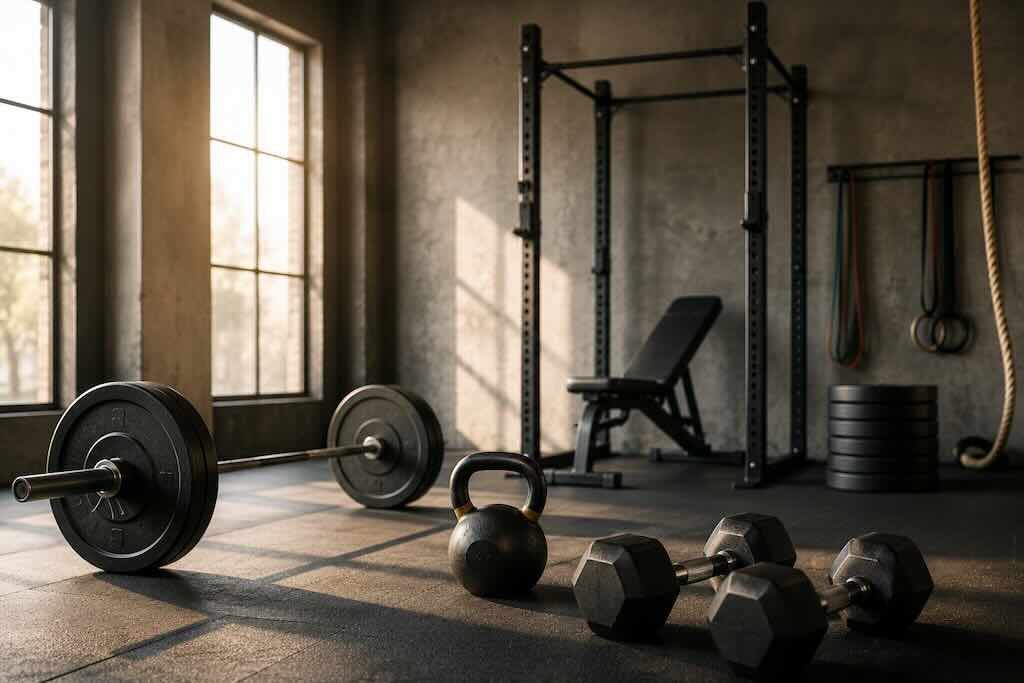
A useful strength workout doesn’t need dozens of exercises or two hours in the gym. For most people, a small collection of well-chosen movements can train a large amount of muscle, build practical strength and provide plenty of room to progress over time.
The key is not finding one magical exercise. It’s choosing movements that suit your body and experience, learning them well, and gradually making the work more challenging.
Why Compound Exercises Are So Useful
Compound exercises involve multiple joints and muscle groups working together. Squats, deadlift variations, presses, rows and pull-ups are familiar examples.
That makes them efficient when you want to train several areas of the body without building a workout around a long list of isolated movements. They aren’t inherently superior to every isolation exercise, however. The two can comfortably coexist in a well-designed routine.
The World Health Organization recommends that adults perform muscle-strengthening activities involving the major muscle groups on two or more days each week, alongside aerobic physical activity. You don’t need to strength train seven days a week to make exercise worthwhile.
1. Squats
Squats train the lower body through a movement pattern that appears constantly outside the gym: bending at the hips and knees to lower and raise the body.
There is also no single squat variation everyone has to perform. Bodyweight squats can be an accessible starting point. Goblet squats introduce external resistance while keeping the weight in front of the body. More experienced lifters may progress to barbell variations when appropriate.
One old gym rule deserves retiring: your knees do not automatically become unsafe simply because they travel beyond your toes. Squat mechanics vary with anatomy, stance, mobility, load and the type of squat being performed. Rather than forcing every body into an arbitrary position, concentrate on a controlled movement you can perform comfortably and consistently.
2. Deadlift Variations
A deadlift is fundamentally a loaded hip-hinge movement. The hips, legs and trunk all contribute, while the upper body helps maintain position and control the load.
Conventional barbell deadlifts are only one option. Depending on your experience, mobility, equipment and goals, Romanian deadlifts, kettlebell deadlifts or trap-bar deadlifts may also fit into a strength program.
There is no universal rule that a deadlift should be performed for only one short set. Appropriate sets, repetitions and resistance depend on your program and training goals. Beginners are generally better served by learning the movement with manageable resistance than chasing a heavy number immediately.
3. Pull-Ups and Pulldowns
Pull-ups are a demanding vertical pulling exercise that trains the back and arms while requiring considerable control of your own bodyweight.
They’re also difficult for many beginners, and that’s not a reason to exclude vertical pulling from a workout. Assisted pull-ups and lat pulldowns can provide more manageable ways to train a similar movement pattern while strength develops.
If a full pull-up is your goal, treat it as a skill to build rather than a test you repeatedly fail. Consistent pulling work and sensible progression are more useful than forcing repetitions with poor control.
4. Rows
Pull-ups get plenty of attention, but horizontal pulling deserves a place in the conversation too. Dumbbell rows, cable rows, machine rows and other variations train the upper back and arms from a different angle.
Rows are also easy to adapt. A supported machine or chest-supported row may suit someone who wants more stability, while free-weight variations introduce different demands. Choose the version you can perform through a comfortable range of motion without turning every repetition into a battle with momentum.
5. Presses
A balanced basic routine usually includes pushing as well as pulling. Push-ups, dumbbell presses, machine chest presses and overhead presses are all possibilities.
Again, the exercise name matters less than finding a variation appropriate for you. A push-up can be adjusted by changing hand elevation, while dumbbells and machines offer other ways to control resistance. Pain is not a prerequisite for progress; if a particular pressing movement consistently hurts, don’t assume you need to force your way through it.
6. Farmer’s Carries
The farmer’s carry is wonderfully uncomplicated: hold resistance at your sides and walk under control.
Simple doesn’t mean effortless. Carries challenge grip and require the trunk and lower body to manage a load while you’re moving. Dumbbells and kettlebells make the exercise relatively straightforward to add to a gym session.
Start with a weight you can carry while maintaining a steady walk and controlled posture. The objective isn’t to stagger across the room with the heaviest objects you can pick up.
The Exercises Matter Less Than the Progression
A list of good exercises is only the beginning. Strength develops when training provides an appropriate challenge and that challenge progresses as your ability improves.
That doesn’t mean adding weight every time you enter the gym. Progress can also mean performing another controlled repetition, improving technique, using a greater comfortable range of motion or gradually moving to a more demanding variation.
Recovery matters too. Muscles don’t need to be punished every day for training to count. The CDC’s physical activity guidance likewise recommends muscle-strengthening activity on at least two days per week for adults, rather than suggesting daily strength workouts are necessary.
A Simple Way to Build a Strength Workout
Instead of trying to fit every exercise into every session, think in movement patterns. A straightforward full-body workout might include one squat or knee-dominant movement, one hip hinge, one push, one pull and, if useful, a loaded carry.
The exact exercises can change. What matters is choosing versions that match your current ability and equipment, then giving yourself enough consistency to improve at them.
If you’re new to resistance training, returning after a long break, managing an injury or unsure how to perform a loaded movement safely, guidance from a suitably qualified exercise professional can be more useful than trying to imitate someone else’s program.
Strength Training Doesn’t Need to Be Extreme
The most effective workout isn’t necessarily the one that leaves you flattened on the floor. It’s the one that provides enough challenge to create progress while remaining realistic enough to repeat.
Build around a handful of useful movements. Learn them patiently. Increase the challenge gradually. Then give your body time to recover before doing it again.
Frequently Asked Questions
How many days a week should you strength train?
There isn’t one schedule that suits everyone. Public-health guidance recommends muscle-strengthening activities involving the major muscle groups on at least two days per week for adults. Your appropriate frequency will also depend on your goals, training volume, experience and recovery.
Are compound exercises enough for a workout?
Compound movements can form an efficient foundation because they train several muscle groups at once. Isolation exercises can still be useful for targeting particular muscles, adding training volume or accommodating individual goals and limitations.
Do your knees have to stay behind your toes when squatting?
No universal rule requires this. Some forward knee movement is normal during many squat variations. Individual anatomy, mobility, stance and the exercise being performed all influence squat mechanics.
Do you need to lift very heavy weights to get stronger?
No. Resistance needs to provide an appropriate challenge, but strength training does not require beginners to immediately handle very heavy loads. Technique, consistency and gradual progression provide a more sensible foundation.