



The best gifts for creative people often have a life beyond the moment they are unwrapped. A beautifully made sketchbook fills with ideas. A repairable tool stays on a studio desk for years. A ceramics class becomes a new skill. An afternoon workshop leaves a memory rather than another object waiting for shelf space.
That perspective also makes holiday shopping more considered. Instead of treating sustainability as another label printed on a package, look at materials, durability, usefulness, repairability and whether the recipient will genuinely use what you choose.
Editor’s note: This guide has been updated for 2026 with clearer advice on environmental claims, refurbished technology, low-waste wrapping and choosing creative gifts for usefulness rather than novelty.
What Makes a Creative Gift More Sustainable?
There is rarely a perfectly sustainable product. Materials need to be extracted or grown, products manufactured and transported, and packaging eventually handled. Even apparently simple choices can involve environmental trade-offs.
A more useful approach is comparative. Look for recycled or responsibly sourced materials where appropriate, minimal packaging, refillable designs, replaceable components and construction sturdy enough to remain useful.
Be cautious with broad language too. The U.S. Federal Trade Commission’s guidance on environmental marketing claims encourages consumers to look beyond general terms such as “green” and examine what a specific claim actually refers to. If something claims recycled content, for example, check whether that describes the product, its packaging or both, and whether a percentage is provided.
Buying fewer, better-chosen gifts has another advantage: it reduces the likelihood that a well-intentioned present becomes clutter by January.
1. Recycled-Paper Art and Writing Supplies
Artists tend to know their materials intimately. Paper weight, surface texture, pigment behavior and even the way a particular pen moves across a page can become deeply personal preferences.
Unless you know exactly what someone uses, avoid choosing expensive specialist paints, brushes or drawing materials simply because they look impressive in a gift box.
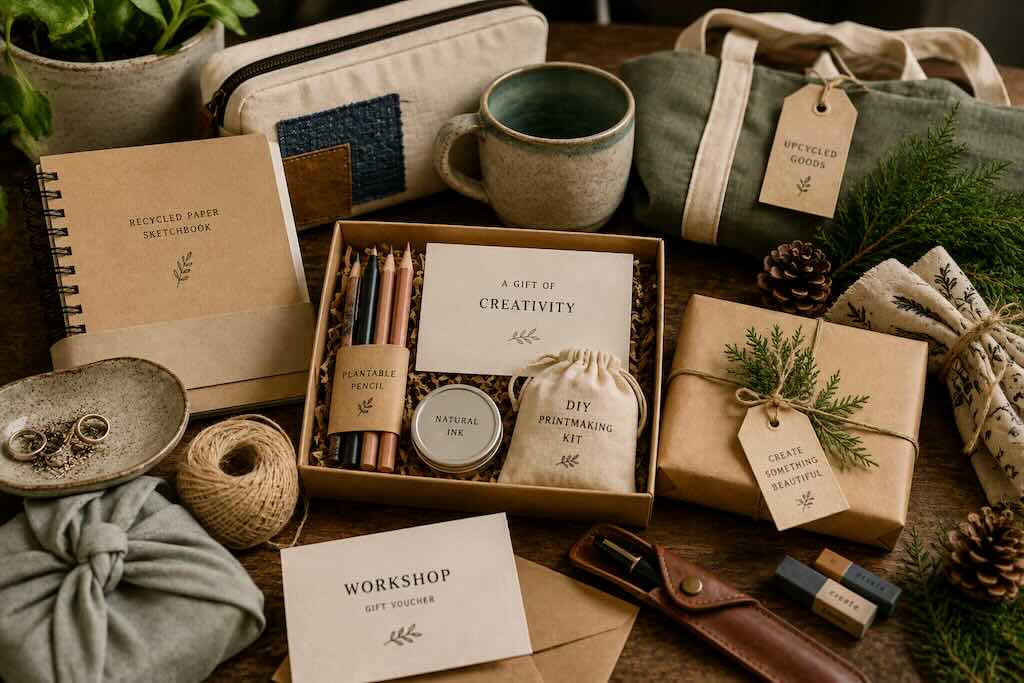
A good recycled-paper sketchbook or notebook is less risky, particularly for someone who is constantly drawing, planning, writing lyrics or collecting visual ideas. Ecojot is one source for paper goods made with recycled materials.
Check the specifications of the individual product rather than assuming every item within a company’s range uses the same paper or manufacturing process.
2. Refillable Tools They Will Actually Keep
A pen that becomes someone’s everyday pen is a better gift than a desk set that looks beautiful for a week and is never touched again.
Refillable pens, mechanical pencils and other reusable creative tools can make particularly good gifts because consumable parts can be replaced while the main object remains in use.
Look carefully at refill availability before buying. A theoretically refillable product is not especially useful if its cartridges or replacement parts are difficult to obtain where the recipient lives.
Plantable stationery offers a more playful alternative. SproutWorld, for example, makes pencils designed so the remaining stub can be planted after use. It is a charming idea for gardeners, writers and younger creatives, though usefulness should still come before novelty.
3. Upcycled Studio Accessories
A studio tote, pencil case, camera strap, laptop sleeve or small piece of jewelry can work well when it reflects the recipient’s actual routine.
Pieces made from reclaimed textiles or recycled materials can add another layer of interest, particularly when the maker explains where those materials came from and how the object was produced.
Durability still matters. A tote that survives years of rehearsals, workshops, train journeys and coffee-shop sessions is more compelling than something purchased primarily because an environmental phrase appeared on its product page.
For more ideas centered on personal rather than generic gifting, explore Divine’s thoughtful gift ideas.
4. A DIY Kit That Becomes an Evening
A well-chosen making kit gives two things at once: materials and an excuse to spend a few quiet hours learning something.
Natural dyeing, visible mending, linocut printing, embroidery, pottery painting, bookbinding and candle-making are possibilities. Match the activity to the person rather than buying whatever craft happens to have the prettiest packaging.
Look inside the box before deciding. Does it contain enough material to complete the project? Can the tools be used again? Is half the volume unnecessary plastic packaging? Will the recipient need to buy several additional supplies before they can begin?
A good kit removes friction from trying something new. A poor one simply relocates the shopping list.
If holiday shopping itself is becoming stressful, Divine’s holiday gift-giving tips offer a simpler way to organize it.
5. Give a Creative Class Instead of Another Object
For the person whose shelves are already full, an experience can make far more sense than another physical possession.
Consider a ceramics workshop, photography walk, life-drawing session, songwriting class, printmaking afternoon, museum membership or another experience connected to something the recipient already wants to explore.
Local classes have the added pleasure of giving someone a place to go. There is clay under the fingernails, the smell of ink or paint, unfamiliar tools on a workbench and another person showing you how to use them.
Digital learning can work too. MasterClass offers online courses across creative disciplines. Before gifting any subscription, check current pricing, availability, renewal terms and whether the person is realistically likely to use it.
6. Stationery Worth Keeping
Writers, illustrators and habitual note-takers can be surprisingly particular about paper. That makes stationery a better present when you know something about how the person works.
Someone who sketches in cafés may appreciate a compact hard-wearing notebook. A writer who fills pages at a desk may prefer something larger that opens flat. Fountain-pen users care about paper differently from someone working in pencil.
A refillable notebook, recycled-paper journal or well-made pen can become an everyday object rather than decorative desk clutter. Neutral covers and durable construction are usually safer than novelty designs unless you know the recipient’s taste well.
7. Buy Something Made Close to Home
Independent studios, print shops, galleries, craft fairs and makers’ markets can be excellent places to find objects with a visible connection to the person who made them.
A ceramic cup from a local potter, a small-edition print, hand-bound notebook or piece of textile work carries details that mass production tends to smooth away: slight variations in glaze, paper edges, fibers and marks left by the process.
Ask about materials and production rather than assuming handmade automatically means environmentally preferable. Small-scale production and sustainability are related in some cases, but they are not synonyms.
8. Consider Refurbished Creative Technology
Digital creatives may appreciate technology more than another decorative object, but cameras, headphones, tablets and audio equipment are intensely personal tools.
For expensive equipment, ask first.
If you know the exact model someone wants, manufacturer-refurbished or reputable refurbished equipment can be worth considering. Check what has been tested or replaced, battery-health information where relevant, warranty coverage, return conditions and whether replacement parts remain available.
An accessory for equipment the recipient already owns can be another sensible route: a compatible stylus, protective case, storage drive, camera support or other item they have specifically requested.
The environmental case for electronics is also a reminder to think beyond purchase day. The U.S. Environmental Protection Agency’s recycling guidance recommends checking manufacturer, retailer and local options for donating or recycling electronics when they eventually reach the end of their useful life.
9. Give Something That Can Be Repaired
Repairability is an underrated quality in a gift.
A tool with replaceable parts, a bag whose zip can be repaired, a mechanical pencil with readily available components or a piece of equipment backed by long-term parts availability has a better chance of staying in someone’s creative life.
This does not require turning Christmas shopping into an engineering assessment. For a costly gift, simply ask a few questions: Can the worn component be replaced? Does the manufacturer sell spare parts? Is there a repair service? Does the product come with a meaningful warranty?
Those details are rarely as photogenic as packaging, but they become much more important several years later.
10. Wrap the Gift With What You Already Have
The final layer does not need to create another bag of waste.
Reuse boxes, gift bags, tissue paper and ribbon from previous occasions. Fabric can become wrapping and part of the present itself. Plain recyclable paper can look beautiful with a simple length of string and a sprig cut from greenery already available at home.
Be careful with shiny or laminated wrapping paper. The EPA notes that a great deal of gift wrap is not recyclable because of its coating and recommends checking with the local recycling provider. The agency also encourages reusing gift bags and tissue paper rather than discarding them after one use.
How to Check an “Eco-Friendly” Gift Claim
When a product is covered in environmental language, ignore the mood of the marketing for a moment and look for specifics.
- Recycled: What percentage is recycled, and does the claim describe the product or only its packaging?
- Refillable: Can you easily buy the refill where the recipient lives?
- Recyclable: Can the material actually be accepted by local recycling services?
- Natural: What material is being described, and what does the claim actually tell you about its production?
- Certified: Who issued the certification, what does it cover and can its criteria be checked independently?
- Durable: Are replacement parts, refills or repair options available?
The FTC’s Green Guides caution against broad, unqualified environmental-benefit claims because such language can imply benefits far beyond what a company can substantiate. Specific information is more useful than a green-colored box.
Conclusion
Sustainable gifting is less about finding a flawless product than making a more deliberate choice.
Buy something useful. Choose materials thoughtfully. Look for objects that can be refilled, repaired or used for years. Support skilled makers when you can, and consider experiences when another possession is unnecessary.
For a creative person, the most memorable gift may simply be the one that gives them another reason to make something.
FAQ
What are good sustainable gifts for artists?
Consider recycled-paper sketchbooks, refillable tools, carefully sourced art materials, locally made studio accessories, repairable equipment or a workshop connected to the artist’s interests. For specialist supplies, ask what they actually use before buying.
Are experience gifts more sustainable?
Not automatically. Travel, venues and materials can all contribute to an experience’s environmental footprint. The practical advantage is that a class, membership or workshop can provide something meaningful without necessarily adding another unwanted possession to the recipient’s home.
How can I tell whether an eco-friendly gift claim is credible?
Look beyond broad language and find specific information about materials, percentages, sourcing, packaging, repairability and certifications. If a claim sounds impressive but never explains what makes the product environmentally preferable, treat it cautiously.
Is recycled paper always a better choice?
Recycled content is a useful factor to consider, but no single material attribute describes a product’s complete environmental impact. Look at the percentage and type of recycled content alongside durability, manufacturing, packaging and whether the product will actually be used.
How can I make holiday gift wrapping less wasteful?
Reuse wrapping materials already at home, save boxes and ribbons, reuse gift bags and choose locally recyclable paper when new wrapping is necessary. Avoid assuming shiny or laminated paper can go into household recycling; local rules differ.