


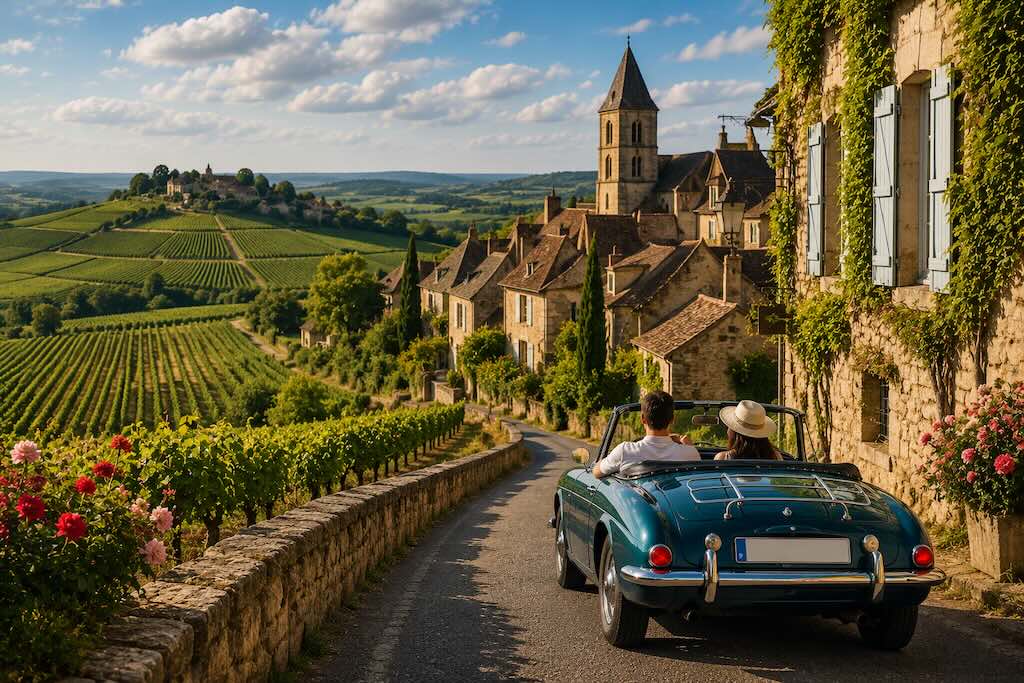
France rewards travelers who resist the urge to collect destinations. Beyond Paris, vineyard walls follow narrow roads through Burgundy, Renaissance façades rise above the Loire, and Mediterranean light changes the character of the journey again along the Côte d’Azur. The distances are manageable. The temptation to cover too much is not.
Editor’s note: This article has been updated for 2026 to verify Burgundy and Loire Valley route information, strengthen wine-tasting and driving advice, remove unnecessary shopping references, and focus the itinerary on slower regional travel rather than trying to cover France in a single trip.
A better approach is to choose one or two regions and let the days expand around them. Burgundy works beautifully for vineyards and small wine towns. The Loire Valley combines châteaux, gardens and wine. Champagne can be added without committing to a long drive, while the Riviera deserves its own southern chapter.
Here are four routes that reveal very different versions of France.
1. Drive Burgundy’s Route des Grands Crus
Burgundy is one of the easiest places to understand why a wine region is about more than tasting wine.
The Route des Grands Crus passes through vineyards divided by old stone walls and villages whose names appear on some of the world’s most recognizable wine labels. France’s official tourism portal describes the route as running from Dijon toward Santenay, passing through the Côte de Nuits and Côte de Beaune.
The official Burgundy destination guide is a useful place to begin planning.
Dijon makes a natural northern gateway. From there, the landscape begins to tighten around vineyards as the route moves through places such as Gevrey-Chambertin, Nuits-Saint-Georges and Vougeot before reaching Beaune.
Why Burgundy’s Climats Matter
The word climat has a particular meaning in Burgundy. It refers to a precisely defined vineyard parcel associated with its own historical and environmental characteristics rather than simply the weather.
France’s tourism authority identifies 1,247 such vineyard parcels within the UNESCO-recognized landscape. The Climats of the Burgundy vineyards were added to UNESCO’s World Heritage List in 2015.
That history becomes visible from the road: vines arranged in narrow bands, dry-stone boundaries, compact villages and slopes that have been divided and cultivated for centuries.
Give Beaune More Than a Lunch Stop
Beaune deserves at least one unhurried afternoon and preferably a night.
The historic center is compact enough to explore on foot, with the colorful glazed roof of the Hospices de Beaune providing its most recognizable architectural detail. Wine bars and cellars make it possible to park the car and shift the evening onto foot.
South of Beaune, names such as Pommard, Meursault and Chassagne-Montrachet continue the route through the Côte de Beaune.
Do not try to taste everywhere. A small number of prearranged visits leaves enough time to understand what you are tasting and still see the countryside between appointments.
2. Build a Château Route Through the Loire Valley
The Loire Valley changes the visual language completely. Vineyard walls give way to river landscapes, pale limestone, formal gardens and château towers appearing beyond long avenues of trees.
The UNESCO-listed cultural landscape extends for approximately 280 kilometers. France’s official Loire Valley guide highlights the region’s combination of Renaissance architecture, gardens, vineyards and historic towns.
The problem is abundance. There are enough significant châteaux to turn a holiday into an architectural endurance test.
Choose fewer.
Chambord for Scale
Chambord is the monumental choice: towers, chimneys and an immense estate creating a silhouette that looks almost theatrical from a distance.
Its size justifies several hours rather than a hurried circuit before driving somewhere else. Leave time for the exterior and surrounding estate instead of treating the château purely as an indoor attraction.
Chenonceau for the River
Chenonceau creates a very different impression. The château extends across the River Cher, with architecture, water and gardens forming a more intimate composition.
It pairs naturally with Amboise, where the historic town provides restaurants, accommodation and another concentration of Renaissance history.
Amboise for Leonardo da Vinci
Amboise offers both its royal château and nearby Clos Lucé, where Leonardo da Vinci spent the final years of his life.
That makes the town a particularly good base for travelers interested in the cultural history surrounding the Loire’s architecture rather than simply photographing façades.
Two château visits in one day are usually enough. Leave the remaining hours for gardens, villages, wine and the river itself.
3. Take Champagne Slowly Between Reims and Épernay
Champagne works particularly well when a longer driving holiday is not practical.
Reims combines wine culture with substantial history, including its Gothic cathedral. Épernay shifts the focus toward the wine houses clustered around Avenue de Champagne and vineyards beyond the town.
The official Champagne tourism portal provides regional wine routes and information for planning visits around Reims, Épernay and the surrounding vineyard areas.
Cellar visits should be researched before arrival. Opening arrangements differ between major houses and independent growers, and some experiences require advance reservations.
If you intend to taste wine, remove driving from the equation. Stay within walking distance, use available local transport or arrange an appropriate tour or driver.
The slower approach suits Champagne. Underground cellars, chalk, cool air and glasses poured at the end of a visit lose something when squeezed between parking deadlines.
4. Change the Palette on the French Riviera
The Côte d’Azur feels almost like another country after Burgundy.
Vineyard greens and limestone villages give way to palms, ochre façades and intensely blue Mediterranean water. Nice makes an easy base, particularly because several coastal destinations can also be reached by public transport.
That matters. A car provides freedom in rural France, but along a busy Mediterranean coastline it can become an unnecessary responsibility. Parking, traffic and narrow streets can remove much of the pleasure the vehicle was supposed to provide.
Use rail connections where they make sense and reserve the car for routes that genuinely benefit from it.
Antibes makes an appealing coastal stop, combining an old town with a harbor and Mediterranean waterfront. Inland villages can provide another contrast if the itinerary has enough time.
Driving in France: What to Check Before You Go
A French road trip should begin with current rules rather than an old travel checklist.
Requirements can depend on your vehicle, licence, route and the cities you intend to enter. France also uses low-emission zones in a growing number of urban areas, where vehicle restrictions and Crit’Air emissions stickers may apply.
Before departure, check current information through the French government’s official road and driving information and verify any environmental restrictions affecting your planned route.
If renting a car, ask the rental company about equipment, documentation, toll arrangements and environmental requirements rather than assuming everything is automatically covered.
Never Combine a Tasting Route With Casual Driving
Wine tourism creates an obvious planning conflict: many of the most interesting producers are scattered across rural areas where a car is useful.
Solve that problem before the first tasting.
Use a designated driver who is not drinking, book suitable transportation, join a tour or arrange accommodation that allows you to explore part of the area without driving afterward.
Spitting during professional-style tastings can reduce alcohol consumption, but it should not be treated as a calculation that makes driving automatically safe. If driving is part of the day, the simplest plan is not to drink.
Plan Around Markets, Meals and Empty Space
Not every hour needs an attraction attached to it.
A market can be as revealing as a museum when the stalls are filled with local cheese, bread, vegetables and preserves. A village café can become the most memorable stop simply because rain arrived at the right moment.
When shopping for something to bring home, choose objects connected to the region rather than generic souvenirs: ceramics, stationery, prints or foods that can legally and practically travel with you.
Wine needs more planning. Check airline baggage rules and customs allowances for your destination before buying several bottles at a vineyard.
A Practical France Road Trip Framework
- Choose fewer regions: Two well-paced regions will usually provide a richer trip than five rushed ones.
- Stay two nights when possible: Constant packing quickly erodes the pleasure of a road trip.
- Reserve important tastings: Do not assume every winery operates as a walk-in attraction.
- Separate wine and driving: Decide who is driving before the tasting day begins.
- Research parking: Historic centers are often easier to approach using designated parking outside their narrowest streets.
- Check environmental zones: Verify current Crit’Air and low-emission-zone requirements for cities on your route.
- Leave unscheduled time: Markets, viewpoints and small villages rarely appear at exactly the hour an itinerary expects them.
- Use trains strategically: A car is not automatically the best transport for every section of France.
Conclusion
The most rewarding way to travel through France is rarely the fastest.
Burgundy asks you to notice stone walls dividing one vineyard from another. The Loire changes the scale with long riverside landscapes and château roofs above the trees. Champagne leads underground into cool chalk cellars. Farther south, the Riviera opens toward salt air and Mediterranean light.
Connect everything if you have weeks. If you have days, choose less.
France becomes more interesting when there is enough room in the itinerary to stop without knowing exactly why.
Frequently Asked Questions
Which region of France is best for a wine road trip?
Burgundy is particularly convenient for a focused wine road trip because the Route des Grands Crus connects Dijon, Beaune and internationally known vineyard villages across a relatively compact area. Bordeaux and Champagne offer very different but equally significant wine experiences.
Do you need a car to explore France?
No. France’s major cities and many regional destinations are accessible by rail. A car becomes particularly useful for rural vineyards, smaller villages and itineraries where public transport is limited.
How many days should you spend in the Loire Valley?
Three or four days can support a well-paced introduction with several major châteaux, towns and meals between visits. Staying longer creates room for vineyards, gardens, cycling and smaller historic sites.
Can Champagne be visited without renting a car?
Yes. Reims and Épernay can be reached by rail, and avoiding a car can be particularly convenient when wine tasting is central to the trip. Research local transportation and individual cellar locations before booking visits.
Should wine tastings in France be booked ahead?
Often, yes. Visiting arrangements vary considerably between producers. Well-known houses and smaller estates may operate scheduled tours or require reservations, so confirm directly before arriving.
What is a Crit’Air sticker in France?
Crit’Air is France’s vehicle emissions classification system. Restrictions can apply within designated low-emission zones, so drivers should check current official requirements for their vehicle and planned destinations before travelling.