



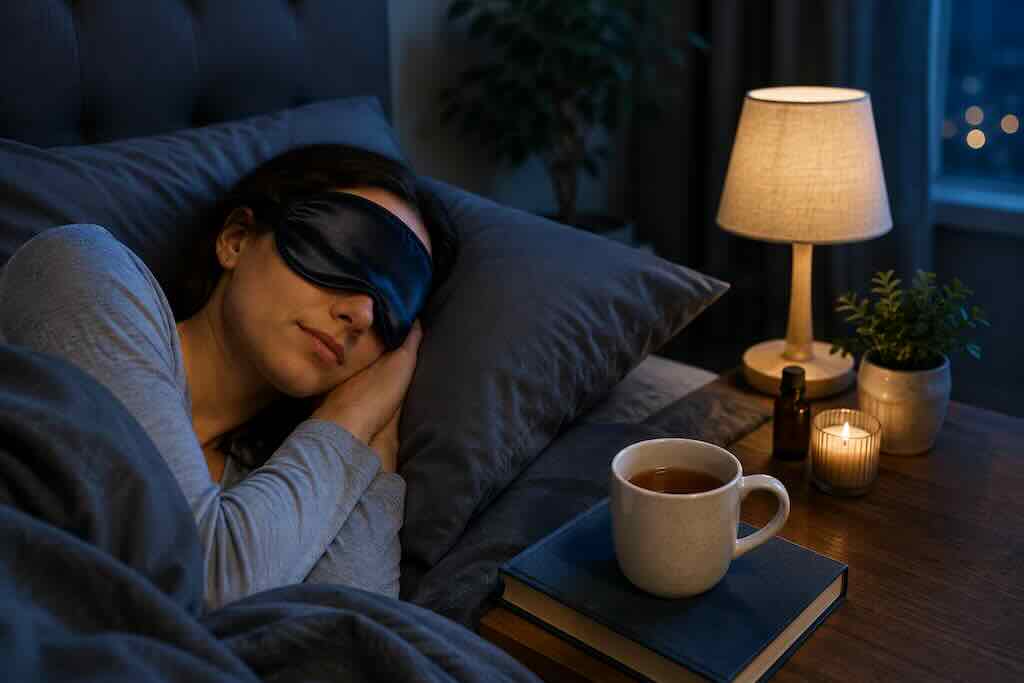
A sleep mask looks almost too simple to matter: a strip of fabric, a soft elastic band, darkness. Yet light is one of the strongest environmental signals governing when the body feels awake and when it prepares for sleep. For anyone dealing with streetlights, glowing electronics, early summer sun or daytime sleep, controlling that light can make the bedroom noticeably calmer.
Sleep masks are not treatments for insomnia or other sleep disorders, and many of the dramatic wellness claims attached to them run ahead of the evidence. What they can do well is much more practical: create darkness when your surroundings cannot. Research also suggests that blocking ambient light overnight may have benefits for sleep quality, next-day alertness and memory.
Why darkness matters for sleep
The body’s internal clock responds closely to the light-dark cycle. The National Heart, Lung, and Blood Institute explains that light entering the eyes sends signals to the brain that help coordinate the body’s sleep-wake rhythm. This is one reason nighttime light can work against the biological signals preparing us for rest.
A dark bedroom is therefore not simply an aesthetic preference. The NHLBI’s healthy sleep guidance recommends keeping the bedroom quiet, cool and dark while limiting bright artificial light before bed.
Blackout curtains and switching off unnecessary LEDs can accomplish much of this. A sleep mask becomes particularly useful when those options are impractical: in hotels, shared bedrooms, airplanes or apartments where outside light slips around the curtains.
What research actually says about sleep masks
There is evidence that an eye mask can do more than make a room feel darker. A study published in the journal Sleep investigated healthy adults sleeping with an eye mask that blocked ambient light. Researchers reported improvements in next-day alertness and episodic learning, with the memory benefit associated with time spent in slow-wave sleep.
Clinical research points in a similar direction, although much of it comes from hospital environments rather than ordinary bedrooms. A systematic review and meta-analysis indexed by PubMed found that eye masks improved self-reported sleep quality among adult intensive-care patients. Because hospital conditions differ substantially from sleeping at home, those findings should not be treated as proof that every sleeper will experience the same effect.
The practical conclusion is refreshingly modest: if unwanted light is disturbing your sleep, blocking it is worth trying.
Sleep masks may support alertness and memory
Sleep and daytime performance are closely connected. The Centers for Disease Control and Prevention notes that sufficient quality sleep supports attention, memory, mood and wider health.
This makes the findings around sleep masks and next-day alertness particularly interesting. The mask itself is not sharpening memory. A more plausible interpretation is that reducing disruptive nighttime light can protect the conditions in which healthy sleep occurs.
That distinction matters. A sleep mask should be viewed as one environmental tool within a broader sleep routine rather than a shortcut around irregular bedtimes, excessive caffeine or insufficient time in bed.
Choosing the right type of sleep mask
The best sleep mask is usually the one you forget you are wearing. Fit, pressure, temperature and fabric matter more than an elaborate list of features.
Traditional fabric masks
Simple cotton, satin and silk-style masks are lightweight and easy to pack. Look for an adjustable strap and enough coverage around the nose to prevent light leaking underneath.
Contoured or 3D masks
Molded eye cups create space between the mask and eyelids. They can feel more comfortable for people who dislike fabric resting directly against their eyes and may also work well for those wearing eye makeup or eyelash extensions.
Weighted masks
Some people find gentle pressure relaxing, but heavier does not automatically mean better sleep. A mask should never feel uncomfortable or place excessive pressure around the eyes.
Aromatherapy masks
Scented inserts can become part of a relaxing bedtime ritual if you enjoy fragrance. Their primary function remains blocking light, however, and anyone sensitive to fragrances may prefer an unscented mask.
Smart sleep masks
Technology-heavy designs can include speakers, heating or cooling functions and programmable lighting. These features may suit particular sleepers, but a basic mask capable of comfortably blocking light can accomplish the central task without electronics.
A useful tool for travel and shift work
A sleep mask makes particular sense when your schedule and the natural light-dark cycle do not align. Shift workers may need to sleep while daylight pours through the windows, while travelers routinely encounter unfamiliar hotel lighting and changing time zones.
The NHLBI specifically recommends removing light and sound distractions from the bedroom when shift workers need to sleep during the day. Blackout curtains remain useful at home, but a mask creates a portable version of the same principle.
It will not prevent jet lag on its own. Circadian adjustment also depends on the timing of light exposure, sleep and other behavioral cues. Still, having darkness available when it is time to rest makes a sleep mask an unusually practical item to keep in hand luggage.
How to use a sleep mask comfortably
Start with fit. The mask should remain in place without digging into the temples, pressing heavily against the eyelids or leaving the strap painfully tight. Side sleepers may prefer a low-profile design without bulky fasteners near the ear.
Keep it clean as well. A mask spends hours against skin, collecting facial oils, skincare products and perspiration. Follow its washing instructions and rotate between two masks if you use one every night.
Then consider the rest of the room. Switch off unnecessary lights, cover bright charging indicators and keep the space comfortably cool and quiet. Divine’s guide to building healthier sleep habits offers additional ways to create a more consistent routine.
What a sleep mask cannot fix
A mask can solve a light problem. It cannot solve every sleep problem.
Persistent difficulty falling asleep, repeated nighttime waking, excessive daytime sleepiness or symptoms such as loud snoring and gasping deserve more attention than another bedroom accessory. Sleep problems can have many causes, and ongoing symptoms are worth discussing with a healthcare professional.
For everyday sleep hygiene, the fundamentals remain familiar: maintain a reasonably consistent schedule, allow enough time for sleep, reduce disruptive light and noise, and create a bedroom associated with rest. For more low-effort wellness ideas, see Divine’s guide to staying healthy with minimal effort.
Conclusion
The appeal of a sleep mask lies in its simplicity. There is no complicated routine and no need for another glowing device beside the bed. Soft fabric, darkness, quiet.
Research does not support every claim made about sleep masks, but it does give us good reason to take nighttime light seriously. For people whose bedrooms never become completely dark—or whose work and travel schedules demand sleep at unusual hours—a comfortable mask is a small experiment with a remarkably low barrier to entry.
Frequently Asked Questions
Do sleep masks really improve sleep?
They can help when light is interfering with sleep. Research has found benefits for sleep quality in certain settings, while a study of healthy adults found improvements in next-day alertness and episodic learning when ambient light was blocked overnight.
Can I wear a sleep mask every night?
For most people, a clean, comfortable and properly fitted fabric mask can be used regularly. Stop using one if it causes eye pressure, irritation, headaches or skin problems.
Is silk better than cotton?
Neither material is automatically better for sleep. Silk-style masks can feel smooth against the skin, while cotton is typically soft and breathable. Effective light blocking and comfortable fit are more important.
Can a sleep mask prevent jet lag?
Not by itself. Jet lag involves a mismatch between your internal circadian clock and the local time. A mask can help create darkness when you need to sleep, but appropriately timed light exposure and sleep scheduling also matter.
Are weighted sleep masks better?
Not necessarily. Some people enjoy gentle pressure, but there is no need to choose a weighted design to obtain the basic light-blocking benefit of a sleep mask.
Author Bio
Sandhya Jadhav is a research analyst specializing in health, wellness and lifestyle trends. Her work focuses on translating research into practical information readers can use in everyday life.