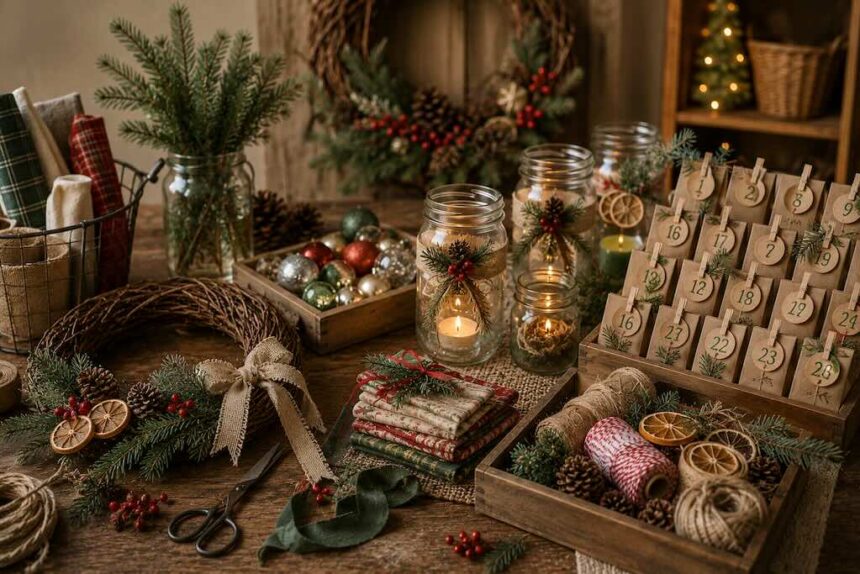
Holiday decorating has a habit of accumulating. A wreath loses a ribbon. A box collects mismatched ornaments. Candle jars gather in cupboards, while fabric left from previous celebrations waits quietly at the back of a drawer.
- Start With What You Already Own
- 1. Rebuild an Old Wreath
- 2. Give Mismatched Ornaments a New Role
- 3. Turn Empty Glassware Into Candlelight
- 4. Turn Forgotten Textiles Into Holiday Details
- 5. Make a Reusable Advent Calendar
- 6. Combine Old Decorations With Natural Texture
- 7. Reuse Last Year’s Wrapping Materials
- A Simple Upcycling Rule: Edit Before You Add
- Conclusion
- FAQ
Before buying another set of decorations, look at what is already there. Upcycling can turn worn, incomplete or forgotten pieces into a holiday scheme with more texture and personality, while reducing the number of new objects brought into the home.
Start With What You Already Own
Upcycling is different from simply buying decorations marketed as sustainable. The starting point is an existing object: something that can be repaired, altered or given another purpose rather than discarded.
Begin by opening the holiday boxes before going shopping. Separate decorations into pieces that still work, pieces that need minor repairs and materials that could be dismantled for another project. Ribbon, bells, wire, beads, glassware, fabric and wreath frames can all become useful components.
This approach can also keep seasonal spending under control. For broader ideas on reducing household expenses, Divine Magazine’s guide to saving money around the home offers additional practical considerations.
1. Rebuild an Old Wreath
A tired wreath rarely needs to be discarded completely. Remove brittle greenery, damaged ribbon and faded decorations while keeping a sturdy wire, grapevine or reusable frame.
Then rebuild it with materials you already have. Leftover ribbon can become a loose bow. Undamaged ornaments from incomplete sets can add color. Pinecones and dried citrus introduce rough, natural texture against glossy baubles.
If you use fresh greenery, choose material that is safe and appropriate to collect where you live. A restrained combination of evergreen branches, ribbon and a few existing ornaments can feel more contemporary than covering every centimeter of the frame.
2. Give Mismatched Ornaments a New Role
An ornament does not need a matching set to remain useful. Gather individual baubles within a loose color palette and display them together in a bowl, shallow tray or clear vessel.
Lightweight ornaments can also become garlands when securely attached to ribbon or cord. Mix finishes rather than trying to disguise the differences: aged metal beside matte glass, faded velvet beside polished surfaces. The irregularity becomes part of the design.
Handle damaged glass ornaments carefully. Pieces with sharp cracks or unstable hanging hardware are better removed than repurposed in places where they could cause injury.
3. Turn Empty Glassware Into Candlelight
Empty jars can become understated seasonal containers once labels and old residue are removed. Use them for greenery, small arrangements or decorative collections of pinecones and ornaments.
If a container is suitable for candle use, keep combustible decorations such as twine, dried foliage, paper and fabric safely away from the flame. When there is any uncertainty about whether a vessel is heat-safe, use a battery-operated light instead.
A group of different glass vessels can look particularly effective when unified by one material or color: clear glass, amber tones or simple greenery rather than multiple decorative themes competing for attention.
4. Turn Forgotten Textiles Into Holiday Details
Old table linens, damaged shirts and fabric remnants can provide some of the most tactile materials in an upcycled holiday scheme.
Cut usable sections into ribbon-like strips for gift wrapping or garlands. Larger pieces can become reusable wrapping cloths, simple stockings or table accents. Even small remnants can be tied around napkins or used to hang lightweight ornaments.
Natural wear can add character. Washed linen, faded cotton and soft velvet introduce depth without requiring every element to look new.
5. Make a Reusable Advent Calendar
Small boxes, fabric pockets, envelopes and jars can be assembled into an advent calendar that returns every December.
Rather than buying twenty-four new objects to fill it, mix occasional treats with handwritten activities: choose tonight’s film, bake something together, take an evening walk or play a favorite record.
Store the calendar carefully after the holidays and the project becomes less about making something disposable and more about creating a seasonal object that develops its own history.
6. Combine Old Decorations With Natural Texture
Existing holiday decorations can feel different when placed beside quieter natural materials. Pinecones, evergreen cuttings, fallen branches and dried citrus can soften a collection of older ornaments without requiring an entirely new decorating scheme.
Try arranging a few pieces along a dining table or mantel rather than filling every surface. Repetition creates cohesion: the same ribbon appearing on a wreath and gift wrapping, or the same dried citrus appearing in a garland and table arrangement.
7. Reuse Last Year’s Wrapping Materials
Gift wrapping is another easy place to work with existing materials. Save sturdy boxes, ribbons, gift bags and undamaged paper rather than treating them as single-use objects.
Plain paper can be paired with fabric ribbon, evergreen cuttings or a reusable ornament. Fabric itself can become wrapping and return to the cupboard when the celebrations are finished.
A Simple Upcycling Rule: Edit Before You Add
The strongest upcycled spaces do not necessarily contain more decoration. Often they contain less.
Choose a restrained palette, repeat a few materials and leave breathing room between arrangements. If an old decoration does not fit the room anymore, it does not have to be transformed immediately. Store it, donate it if appropriate or salvage useful components for another year.
Upcycling works best when it solves a genuine need. The goal is not to turn every discarded object into another object that must eventually be stored.
Conclusion
A more considered holiday home can begin with a box you already own. An old wreath frame, faded ribbon, mismatched ornaments and forgotten fabric each offer raw material for something new.
The result does not need to look handmade in an obvious way. Keep the palette quiet, work with texture and allow older pieces to show a little history. Holiday decorating becomes less about replacing last year’s look and more about seeing familiar objects differently.
FAQ
What is the difference between upcycling and recycling?
Upcycling keeps an existing object or material in use by repairing, adapting or repurposing it. Recycling typically involves processing discarded material so it can be used as raw material for another product.
What holiday decorations are easiest to upcycle?
Wreath frames, ribbon, fabric, sturdy boxes, jars, baskets and undamaged ornaments are good starting points because they can be reused in different arrangements without extensive tools or materials.
Can broken Christmas ornaments be reused?
It depends on the material and damage. Loose ribbons, caps and decorative components may be reusable, but cracked glass and sharp fragments should be handled carefully and disposed of according to local guidance rather than incorporated into decorations.
How can upcycled holiday decor look more cohesive?
Limit the color palette and repeat a small number of materials throughout the room. Natural wood, greenery, glass, linen and one metallic finish can connect objects from different periods without requiring them to match exactly.
Where can I find more upcycling inspiration?
Upcycle That collects projects and ideas centered on finding new uses for existing objects and materials.