



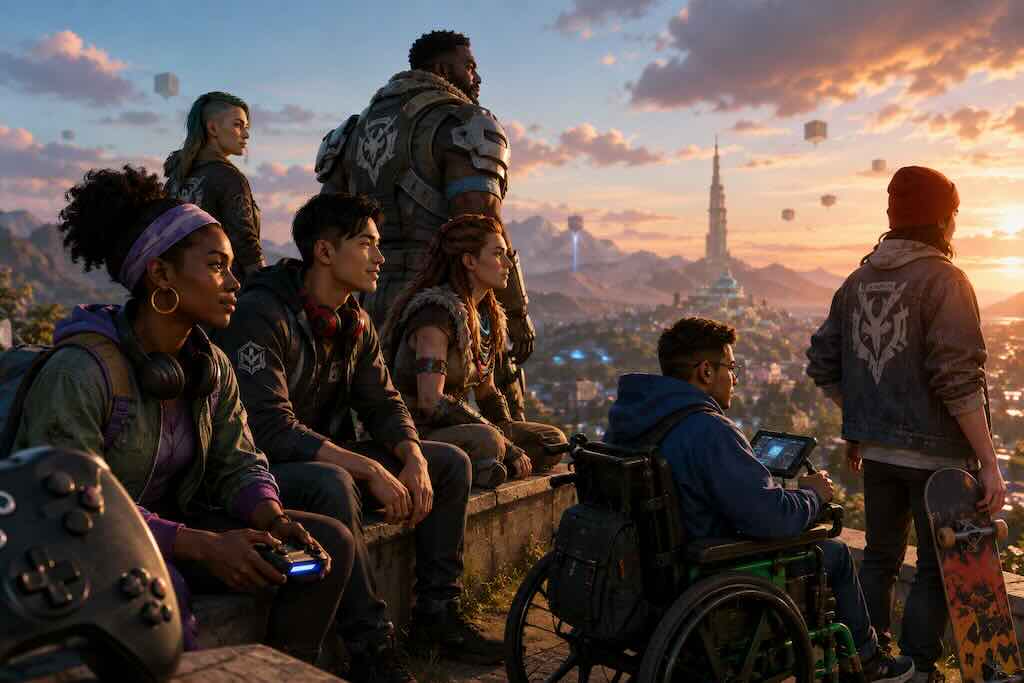
The old stereotype of the gamer was always too narrow. Today, video games are played across generations, genders, abilities and backgrounds, while the worlds inside those games increasingly carry the expectation that they should reflect at least some of that breadth.
Representation in gaming has changed considerably. Women lead major franchises. Character creators offer more freedom. Developers are paying closer attention to cultural representation, and accessibility is increasingly treated as part of game design rather than an optional extra.
Still, progress is uneven. The more interesting question now isn’t simply whether games are becoming more diverse. It’s whether players are being given characters, stories and experiences that feel thoughtful rather than tokenistic.
The Gaming Audience Is Broader Than the Old Stereotype
Any conversation about representation should begin with the people actually playing.
The Entertainment Software Association’s 2026 U.S. industry data reports that 212.3 million Americans play video games for at least an hour a week. The average player is 37 years old, while the gender split reported by the ESA is 53 percent male and 46 percent female.
That makes the familiar image of gaming as a pastime belonging primarily to young men increasingly disconnected from its actual audience.
Games are also unusually personal as an entertainment medium. A film asks us to watch a character. A game can ask us to inhabit one, shape their appearance, make decisions for them and spend dozens of hours seeing a world through their perspective. That gives representation a particular kind of weight.
Representation Is About More Than Who Appears on Screen
Counting characters can reveal patterns, but numbers alone don’t tell us whether representation is good.
A character from an underrepresented background who exists primarily as a stereotype isn’t necessarily meaningful progress. Representation becomes more convincing when characters receive the same complexity, agency and narrative attention as everyone else.
Strong characterization allows people to be funny, difficult, ambitious, vulnerable, heroic, ordinary or contradictory without asking one person to stand in for an entire community.
Women Have Become More Visible at the Center of Games
One of the clearest changes in modern gaming is the visibility of women as protagonists rather than supporting characters or decoration.
Earlier eras of gaming frequently marketed titles around male protagonists even as the audience itself became increasingly balanced. Female characters also faced a long history of exaggerated sexualization and narrow character types.
Modern games offer a much wider spectrum. Women can lead action games, role-playing adventures, horror stories and intimate narrative titles without their gender needing to function as the central premise.
That normality matters. Representation often feels most natural when a character is allowed to exist as a complete person rather than being introduced as an example of representation.
Cultural Representation Needs Depth
Race and cultural background present a similar challenge. Simply placing a wider range of faces on screen doesn’t automatically create meaningful representation.
Details matter: names, families, environments, language, history, relationships and the assumptions built into a fictional world. When those elements feel considered, cultural identity can add texture without reducing a character to a collection of recognizable traits.
The people creating games matter here too. Writers, artists, performers, designers, consultants and developers bring different experiences into the production process, potentially catching clichés or assumptions that might otherwise pass unnoticed.
Player Choice Has Changed the Conversation
Games can approach identity differently from film and television because many allow players to participate in creating the protagonist.
Character creators can provide choices around appearance and body type, while role-playing systems allow players to determine aspects of a character’s personality and story. At their best, these systems give people more freedom to create someone they identify with — or someone completely different from themselves.
Customization isn’t a substitute for authored characters, however. A world in which the player can create almost anyone can still feel strangely narrow if everyone they encounter follows the same familiar template.
That’s why some of gaming’s most interesting progress comes from combining player agency with richer casts: protagonists and supporting characters whose backgrounds are specific, intentional and embedded naturally within the world.
Disability Representation and Accessibility Are Different — and Both Matter
Disability presents another important distinction. Representing disabled characters on screen is not the same thing as making a game accessible to disabled players.
A game can tell a nuanced story involving disability while remaining difficult or impossible for some disabled people to play. Conversely, a highly accessible game may contain little explicit disability representation in its narrative.
Modern accessibility design can include remappable controls, subtitle customization, visual and audio cues, difficulty options, screen-reader support, alternatives to rapid button inputs and settings designed for different motor, visual, auditory and cognitive needs.
The industry has begun making these features easier to identify. In 2025, the Entertainment Software Association launched the Accessible Games Initiative, designed to provide clearer information about accessibility features before players buy a game.
That’s a practical shift. Inclusion isn’t only about seeing yourself inside a fictional world. Sometimes it begins with being able to enter that world at all.
What Better Representation Looks Like
There isn’t a checklist that automatically produces an inclusive game. Better representation tends to come from something less mechanical: giving a wider range of people room to be fully realized.
- Write characters rather than symbols. Background and identity can shape a person’s experience without becoming their only defining characteristics.
- Build variety throughout the world. One character shouldn’t carry the burden of representing an entire group of people.
- Include different voices behind the scenes. Writers, designers, performers, consultants and developers can bring perspectives that affect everything from dialogue to character design.
- Think about accessibility early. Accessibility tends to work best when considered as part of the design process rather than added as an afterthought.
- Give characters room to be complicated. Memorable people are rarely defined by a single characteristic.
Gaming Has Changed. The Expectations Have Too
The argument for broader representation in games isn’t that every title must portray every possible kind of person. No individual story could, and trying to do so would flatten the very differences worth portraying.
The larger point is that gaming now reaches an enormous and varied audience. Across thousands of games, genres, studios and fictional worlds, there is room for far more kinds of people to lead adventures, make mistakes, solve mysteries, save galaxies or simply exist.
Gaming has already moved a long way from the narrow idea of who a player is supposed to be. Its most interesting future may come from letting the worlds on screen become just as expansive.
FAQ
Why does representation matter in video games?
Games are interactive, so players can spend many hours inhabiting characters and participating in fictional worlds. Thoughtful representation can help a wider audience recognize aspects of their own experiences while encountering perspectives different from theirs.
Has representation of women in gaming improved?
Women are considerably more visible as protagonists across major contemporary games and genres. The quality of characterization still varies, but female characters are no longer confined to the limited roles that were common in earlier eras of gaming.
Is accessibility the same as disability representation?
No. Disability representation concerns how disabled people and experiences appear within games. Accessibility concerns whether players with different disabilities can actually play and navigate a game. A title can succeed at one and fall short at the other.
Does every video game need a diverse cast?
No single game can represent everyone. The broader issue is whether the industry as a whole creates enough space for varied characters, backgrounds, perspectives and player needs rather than repeatedly defaulting to the same narrow range of experiences.