


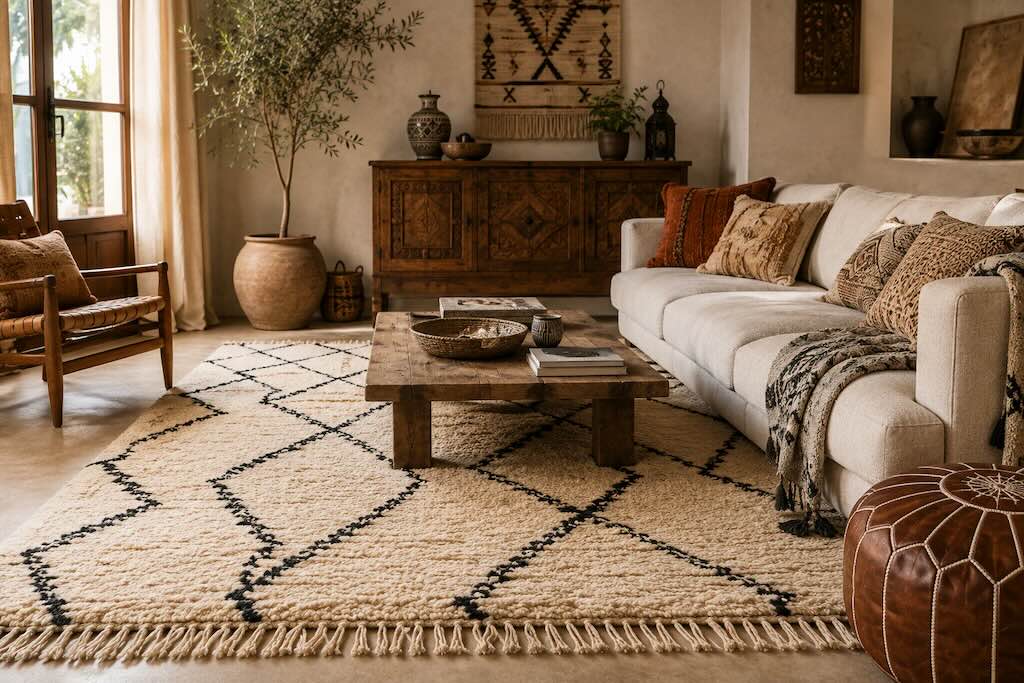
A Moroccan wool rug changes a room quietly. Underfoot, the surface is dense and tactile; across the floor, irregular lines, softened geometry and hand-worked texture introduce warmth that mass-produced textiles often struggle to reproduce.
That beauty is only part of the appeal. Wool is naturally elastic, moisture-responsive and relatively resistant to staining, while traditional Moroccan rug-making carries generations of material knowledge into contemporary interiors. The result is a textile that can be decorative, practical and deeply connected to craft.
Why Wool Works So Well Underfoot
Wool has an unusually complex fibre structure. Its natural crimp gives the fibre a spring-like quality, helping it recover after compression rather than remaining permanently flattened. The Woolmark Company also notes wool’s natural elasticity, breathability and ability to manage moisture.
That combination matters in a rug. Furniture, footsteps and daily movement repeatedly compress the pile, so resilience can help a well-constructed wool rug retain its character over time.
Wool is hygroscopic, meaning it interacts with moisture in the surrounding environment. According to Woolmark’s research on wool and moisture, the fibre can absorb considerable moisture vapour before feeling wet. That property should not be confused with making a rug waterproof, but it helps explain why wool behaves differently from many synthetic fibres.
The Craft Behind Moroccan Wool Rugs

Moroccan rugs should not be treated as one uniform design category. Weaving traditions vary by region, community, technique and period, producing everything from thick-pile carpets to lighter flatweaves.
The cultural context matters. The Metropolitan Museum of Art documents the extraordinary breadth of North African artistic traditions, where textiles sit within a much larger history of pattern, material and decorative craft.
Rather than thinking of a Moroccan rug simply as a trending interior accessory, look closely at its construction. The density of the weave, character of the wool, finishing, coloration and irregularities created by hand can tell you considerably more than a retailer’s style label.
Understanding Beni Ourain, Azilal and Kilim Styles
Several names appear repeatedly when shopping for Moroccan rugs, although terminology can become loose once traditional textiles enter the international interiors market.
Beni Ourain rugs are widely associated with thick wool pile, pale natural tones and dark geometric motifs. Their visual restraint makes them particularly comfortable in rooms built around timber, plaster, linen and other quiet materials.
Azilal rugs tend to bring more visual energy. Graphic forms, asymmetry and stronger color can turn the floor into a focal point rather than a neutral foundation.
Flatwoven rugs, frequently marketed internationally under the broad term kilim, offer a thinner profile and sharper geometry. Their reduced pile makes them useful where a heavy, plush rug would feel visually or physically cumbersome.
Names alone are not proof of origin. If provenance matters to you, ask the seller where the rug was made, whether it is handmade, what fibres and dyes were used and what information exists about its maker or weaving community.
Wool Is Resilient, but It Is Not Indestructible
One reason wool remains compelling for interiors is its balance between softness and performance. Its outer structure offers some natural resistance to staining, while the fibre’s elasticity helps it recover from pressure.
Wool also behaves differently around flame than many common synthetic textiles. Woolmark describes wool as naturally flame resistant, with a relatively high ignition temperature and self-extinguishing characteristics.
Those qualities do not make a wool rug fireproof, stain-proof or immune to damage. A beautiful handmade textile still needs sensible placement and care.
Do Wool Rugs Improve Indoor Air Quality?
Claims around rugs and indoor air deserve careful language. Wool’s structure can interact with airborne substances, and carpet fibres can temporarily hold particles that might otherwise remain suspended in the air. Woolmark has also published research discussing wool carpets and indoor air.
Still, a rug should never be treated as an air purifier. Indoor air quality depends on ventilation, moisture management, pollutant sources and cleaning practices. Regular vacuuming matters because dust captured by any carpet eventually needs to be removed.
How to Care for a Moroccan Wool Rug
The safest maintenance routine is usually gentle and consistent. Handmade rugs can vary substantially in construction and dye stability, so care instructions from a knowledgeable seller or textile specialist should take precedence over generic cleaning advice.
- Vacuum carefully. Use lower suction where appropriate and avoid aggressive rotating brushes on delicate pile, fringe or loose fibres.
- Rotate periodically. Changing the rug’s orientation can distribute foot traffic and sunlight more evenly.
- Respond quickly to spills. Blot rather than scrub so liquid is lifted instead of driven farther through the fibres.
- Test cleaning products first. Dyes and fibres can react differently, particularly on handmade and vintage rugs.
- Use specialist cleaning when necessary. Valuable, antique or heavily soiled pieces deserve a cleaner experienced with handmade wool rugs rather than a generic carpet treatment.
Sunlight deserves attention too. Strong, prolonged exposure can alter textile color over time. That gradual fading can be beautiful on an older rug, but rotating the piece helps prevent one section from changing dramatically faster than another.
The Sustainability Question Is More Complicated
Wool has several clear material advantages. Sheep grow new fleece, making wool renewable, and untreated wool fibres are biodegradable under suitable conditions. Durability can also extend the useful life of a well-made textile.
But calling every wool rug inherently sustainable goes too far. Farming, land use, animal welfare, processing, dyes, transportation and cleaning all contribute to environmental impact. The International Wool Textile Organisation’s work on life-cycle assessment illustrates why environmental performance needs to be considered across production, use and end-of-life rather than reduced to a single material claim.
For a buyer, longevity is one of the more tangible considerations. A rug that is well made, repairable and kept for decades presents a different consumption pattern from inexpensive flooring replaced whenever the decorating cycle changes.
How to Style a Moroccan Rug Without Losing Its Character
A strong rug rarely needs an equally loud room around it. Give its pattern and texture enough visual space to register.
A pale, deep-pile rug can soften concrete, timber and sharply lined furniture. A colorful Azilal-style piece works beautifully against restrained walls and uncomplicated upholstery. Flatwoven geometric designs can bring structure beneath a dining table, desk or low-profile seating arrangement.
Natural materials are particularly easy companions. Linen curtains, timber furniture, ceramic vessels, leather and woven baskets repeat the tactile quality of wool without copying the rug’s pattern. For more ideas on building a room through material rather than clutter, Divine’s guide to redesigning a living room to maximize space offers a useful starting point.
What to Check Before Buying
A photograph can show color and pattern. It cannot tell you everything about a rug.
- Confirm the fibre composition rather than assuming “Moroccan style” means wool.
- Ask whether the rug is handmade, machine-made or a combination of processes.
- Request exact dimensions, including fringe where relevant.
- Ask about origin and maker information if provenance is important.
- Check whether dyes are natural, synthetic or unknown.
- Review cleaning instructions before purchase.
- For vintage pieces, request close photographs showing edges, backing, repairs, pile wear and staining.
Handmade irregularities are not automatically defects. Slight changes in line, pile and color can be part of what gives an artisan-made textile its presence. Damage is different. Learn to distinguish character from deterioration before paying a premium.
Conclusion
The enduring appeal of a Moroccan wool rug comes from the meeting of material and hand. Wool provides resilience, warmth and texture. Weaving turns those qualities into something cultural and individual: a surface carrying rhythm, pattern and evidence of its construction.
Choose slowly. Ask where the rug came from and how it was made. Look beyond fashionable labels and consider whether its scale, texture and character belong in the room for years rather than one season.
A good rug does not simply complete an interior. With time, footsteps and changing light, it becomes part of the home itself.
FAQ: Moroccan Wool Rugs
Are Moroccan wool rugs durable?
Quality wool is naturally resilient and elastic, making it well suited to rugs. Actual durability also depends on fibre quality, weave, pile construction, traffic and maintenance.
Do wool rugs stain easily?
Wool has a natural outer structure that provides some resistance to staining, but it is not stain-proof. Liquids should still be blotted promptly.
Can I vacuum a handmade Moroccan rug?
Usually, but gently. Avoid aggressive brushes around fringe or delicate pile and follow specialist care instructions for antique, vintage or unusually constructed rugs.
Are Moroccan rugs always handmade?
No. The popularity of the aesthetic has produced many machine-made and Moroccan-inspired products. Ask about construction and provenance rather than relying on the product name.
Is wool sustainable?
Wool is renewable and biodegradable, but those properties do not describe its entire environmental footprint. Farming practices, processing, dyes, transport, longevity and end-of-life all matter.
Why do handmade rugs have small irregularities?
Variation in lines, pile, color and dimensions can result from hand-weaving and does not necessarily indicate poor quality. On many pieces, those variations are part of the textile’s individual character.