




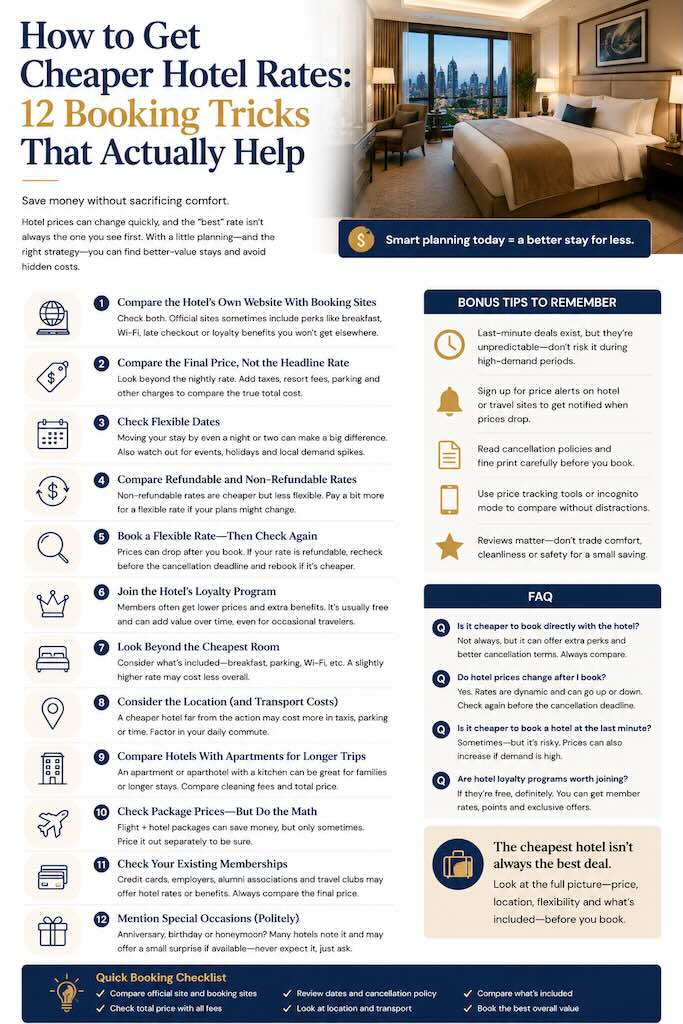
Hotel prices can feel strangely unpredictable. Check a room on Monday and it costs one amount. Look again a few days later and the price has jumped — or suddenly dropped.
There isn’t a secret day of the week when every hotel becomes cheaper, and endlessly clearing your browser cookies isn’t the travel hack people sometimes claim it is. But there are smart ways to compare hotel prices, uncover better-value rates and avoid paying more than necessary.
Before you confirm your next stay, try these 12 hotel-booking strategies.
Editor’s note: This article from Divine Magazine’s earlier archive has been substantially rewritten and updated to remove outdated booking advice.
1. Compare the Hotel’s Own Website With Booking Sites
Hotel comparison and booking platforms are useful for seeing what’s available, but don’t assume the first price you find is automatically the best one.
Once you’ve found a hotel you like, check its official website too.
The headline room price may be identical, but booking directly can sometimes come with a different cancellation policy, breakfast, hotel credit, Wi-Fi, loyalty benefits or other inclusions.
Compare the complete offer rather than saving $10 on a room only to spend considerably more on something that was included elsewhere.
2. Compare the Final Price, Not the Headline Rate
A room advertised at $179 isn’t necessarily a $179 hotel stay.
Taxes and mandatory property or destination fees can significantly change the total. Parking can be another major expense, particularly in large cities and resorts.
Before deciding which hotel is cheapest, get as close as possible to the final checkout screen and compare what you’ll actually pay for the entire stay.
A $200 room with breakfast and parking included could ultimately be better value than a $170 room charging separately for both.
3. Check Flexible Dates
If your travel dates aren’t fixed, moving your stay by even one or two nights can make a surprising difference.
Hotel demand changes according to destination. A business-heavy city may become less expensive over a weekend, while a leisure destination might do exactly the opposite.
Major concerts, conventions, sporting events, school holidays and festivals can also send room prices dramatically higher.
Rather than relying on a universal “book midweek” rule, compare several combinations around your preferred dates.
4. Compare Refundable and Non-Refundable Rates Carefully
Non-refundable hotel rates are often tempting because they’re cheaper. But you’re effectively exchanging flexibility for that discount.
If your plans are absolutely firm, the saving may make sense. If there’s a reasonable possibility that your trip could change, paying slightly more for a flexible rate could save you considerably more later.
Read the cancellation deadline carefully too. “Free cancellation” doesn’t necessarily mean you can cancel without charge until the day you arrive.
5. Book a Flexible Rate — Then Check Again
This is one of the simplest hotel-booking strategies because hotel prices can change after you’ve made a reservation.
If you’ve booked a genuinely refundable rate, make a note to check the same hotel occasionally before the cancellation deadline.
If an equivalent room with comparable conditions becomes substantially cheaper, you may be able to make a new reservation and cancel the original one according to its terms.
Just make sure the replacement reservation is confirmed before cancelling anything.
6. Join the Hotel’s Loyalty Program Before Booking
You don’t necessarily need to be a frequent traveler to benefit from hotel loyalty programs.
Some hotel groups offer member-only rates or additional benefits simply for joining their free program. Depending on the hotel and program, benefits can also become more valuable as you accumulate stays or status.
If membership is free and you’re already planning to book the property, it’s worth checking the member price before paying the public rate.
7. Look Beyond the Cheapest Room
The lowest room rate isn’t always the smartest booking.
Imagine Hotel A costs $160 per night but charges $40 for parking and doesn’t include breakfast. Hotel B costs $190 but includes both.
Depending on what you actually need, the supposedly more expensive hotel may cost less overall.
Think in terms of cost per stay, not simply cost per night.
8. Consider the Location Before Celebrating a Bargain
That beautiful hotel 40 minutes outside the city center may look like an incredible deal — until you calculate what you’ll spend getting back and forth every day.
Before booking a cheaper property, check its location against the places you actually intend to visit.
Public transportation, taxis, rideshares, rental cars, parking and simply the value of your vacation time can turn a cheap room into an expensive compromise.
9. Compare Hotels With Apartments for Longer Trips
Traditional hotels aren’t automatically the best value for every trip.
For longer stays, families and groups, an apartment or aparthotel with a kitchen and additional living space may make financial sense.
But make the same total-price comparison you would with a hotel. Cleaning fees and other charges can change what initially appears to be an inexpensive nightly rate.
10. Check Package Prices — But Do the Math
Booking your flight and hotel together can sometimes produce a lower combined price, particularly for certain leisure destinations.
Sometimes it doesn’t.
Before purchasing a package, separately price the flights and the exact hotel room for the same dates. Then compare cancellation conditions and what’s included.
A package is only a bargain if the numbers actually make it one.
11. Check Whether Your Existing Memberships Offer Hotel Rates
Before searching for another discount code, check benefits you already have.
Depending on your country and memberships, certain employers, automobile associations, professional organizations, travel clubs and eligible credit cards may provide access to hotel rates or travel benefits.
Don’t assume they’re cheaper, though. Compare the final price and cancellation terms against the hotel’s normal rate.
12. Ask About Special Occasions — Without Expecting an Upgrade
Celebrating an anniversary, honeymoon or birthday?
There’s nothing wrong with mentioning it politely when you make your reservation. A hotel may note the occasion and occasionally provide a small gesture if availability and policy allow.
Just don’t build your trip around receiving a complimentary suite upgrade. Treat anything extra as exactly that: an extra.
The Hotel Booking Trick We’d Skip: Waiting Until the Last Minute
You’ll often hear that hotels slash their prices shortly before check-in because an empty room earns nothing.
That can happen. It can also go spectacularly wrong.
If demand is strong, the opposite happens: inexpensive rooms disappear and you’re left choosing between an expensive room and somewhere you never wanted to stay.
Last-minute booking makes more sense when you’re extremely flexible about where you stay. For an important trip, event weekend or destination with limited accommodation, gambling on a dramatic price drop can be a false economy.
A 5-Minute Hotel Price Check Before You Book
- Find several suitable hotels using a comparison site.
- Check the same hotels’ official websites.
- Compare the total price including mandatory fees.
- Check member rates and what’s included.
- Compare flexible and non-refundable options.
- Try shifting your dates if your schedule allows.
- Check the hotel’s location and transportation costs.
- Book the combination of price, location and flexibility that offers the best overall value.
The Cheapest Hotel Isn’t Always the Best Deal
The smartest hotel booking isn’t necessarily the one with the smallest number beside “price per night.”
It’s the stay that gives you the right combination of location, cancellation flexibility, room quality and included extras for the lowest sensible total cost.
Spend five extra minutes comparing those details before booking and you may save considerably more than you would chasing questionable hotel-booking hacks around the internet.
FAQ
Is it cheaper to book a hotel directly?
Not always. Direct rates and third-party rates can differ, which is why it’s worth comparing both. Also compare cancellation terms and included benefits rather than looking only at the nightly price.
Do hotel prices change after you book?
They can. Hotel rates are dynamic and may rise or fall according to demand and availability. If you’ve booked a refundable rate, checking the price again before your cancellation deadline can sometimes be worthwhile.
Is it cheaper to book a hotel at the last minute?
Sometimes, but there’s no guarantee. Prices can fall when a hotel has excess availability or increase sharply when demand is strong. Waiting is therefore much riskier when your destination or hotel choice isn’t flexible.
Are hotel loyalty programs worth joining?
If membership is free and you’re already considering that hotel group, checking the member rate makes sense. Benefits vary considerably between programs and properties.