




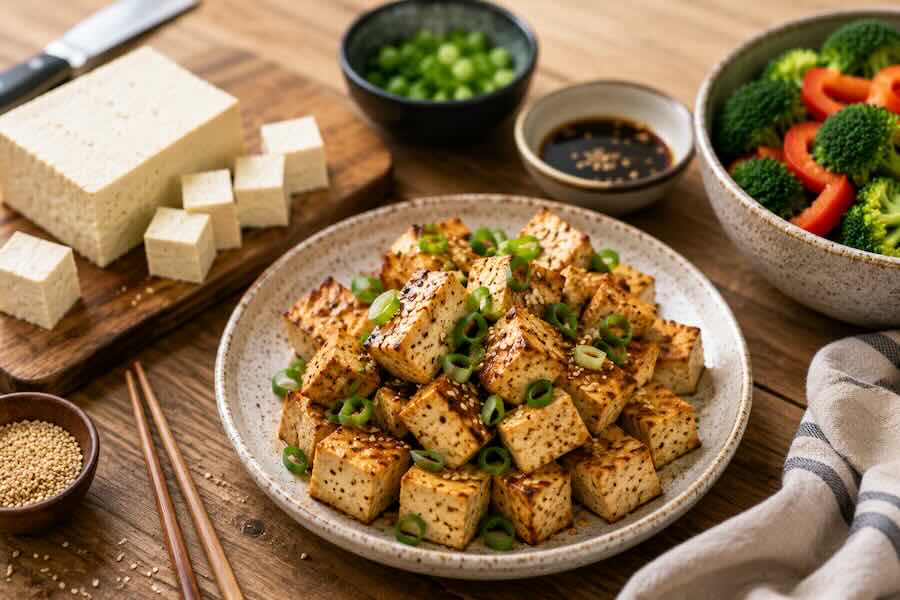
Tofu has carried an oddly complicated reputation for such a simple food. Some people worry about hormones, others assume soy is unhealthy, and plenty have encountered a pale block of badly prepared tofu and decided it simply has no flavor.
Much of that reputation comes from misconceptions about soy nutrition, combined with confusion between research on whole soy foods, concentrated supplements and animal studies. Current evidence paints a considerably more nuanced picture. Here are five common tofu myths worth clearing up.
1. Myth: Tofu Raises Estrogen Levels
The hormone conversation around tofu usually begins with isoflavones. Soy contains these naturally occurring plant compounds, which belong to a group known as phytoestrogens.
Phytoestrogens are not the same thing as human estrogen. According to the Harvard T.H. Chan School of Public Health, soy isoflavones can bind to estrogen receptors but have much weaker effects than human estrogen. Depending on the tissue and other biological factors, they may produce weak estrogenic or anti-estrogenic activity.
That distinction matters. Saying that eating tofu simply “raises estrogen” misrepresents how these compounds interact with the human body. Research on soy is complex, but ordinary consumption of tofu and other whole soy foods should not be treated as equivalent to taking estrogen.
2. Myth: Tofu Is Unhealthy
Tofu can be a nutritious source of plant protein and provides a range of nutrients, with its precise nutritional profile depending partly on how it is produced.
Harvard describes tofu as a nutrient-dense protein source that can comfortably form part of a healthy diet. The American Cancer Society similarly states that soy foods such as tofu, tempeh, edamame and soy milk are considered healthy and safe as part of a balanced diet.
The cancer question deserves particular care. Human studies have generally found soy consumption to be associated with either a lower risk or no change in the risk of several cancers. Earlier concerns were influenced partly by animal experiments involving high doses of isoflavones, but humans process these compounds differently.
Whole soy foods should also be distinguished from concentrated isoflavone supplements. The American Cancer Society recommends obtaining soy through foods rather than using high-dose soy supplements for cancer prevention.
3. Myth: Tofu Has No Flavor
Plain tofu has a subtle flavor, and that is precisely what makes it useful. Its relatively neutral character gives cooks a flexible surface for marinades, sauces, spices and aromatic ingredients.
The difference between forgettable and excellent tofu often comes down to preparation. Soy sauce, ginger, garlic, sesame oil, chili, citrus and spice blends can move it in completely different directions. Browning it properly adds another layer, creating crisp edges and deeper roasted notes around a softer center.
Think of tofu less as a finished dish and more as an ingredient. Potatoes, rice and pasta are similarly understated before seasoning and cooking transform them.
4. Myth: Tofu Is Difficult to Cook
Tofu is not particularly difficult to cook, but choosing the right texture makes an enormous difference.
Silken tofu has a delicate, custard-like consistency and works beautifully in blended sauces, desserts and soups. Soft and medium varieties suit dishes where tenderness matters. Firm and extra-firm tofu hold their shape better, making them useful for pan-frying, baking, grilling and stir-fries.
For crisp tofu, removing excess surface moisture before cooking can help. Cut it into evenly sized pieces, season it well and give each piece enough contact with a hot pan or baking surface to develop color. Avoid constantly moving it while it browns.
Once you understand the different textures, tofu becomes remarkably adaptable. It can move from a silky breakfast smoothie to a spicy evening stir-fry without asking much from the cook.
5. Myth: Eating Tofu Is Driving Global Soy Production
Soy production does have genuine environmental consequences, particularly when agricultural expansion contributes to habitat loss and deforestation. The missing piece in many conversations is where most of that soy actually goes.
Data summarized by Our World in Data shows that more than three-quarters of global soy production is used as livestock feed. Products people commonly associate directly with soy—including tofu, tempeh, soy milk and edamame—represent a much smaller share of global demand.
So the environmental story cannot accurately be reduced to tofu consumption alone. Where soy is grown, how land is managed and what the crop is ultimately used for all matter when assessing its environmental footprint.
How to Make Tofu Taste Better
If your previous tofu experience involved something soft, wet and almost entirely unseasoned, give it another chance with a different technique. Start with extra-firm tofu, remove excess moisture, cut it into cubes and season generously. A hot skillet can turn those quiet white cubes golden at the edges, while a strong sauce supplies salt, acidity, sweetness and heat.
For softer preparations, take the opposite approach. Let silken or medium tofu remain delicate and pair it with broth, scallions, mushrooms, chili oil or other ingredients that provide contrast.
Conclusion
Tofu is neither a miracle food nor the dietary villain it is sometimes made out to be. It is a versatile soy food with protein and useful nutrients, backed by a substantial body of research supporting its place in a balanced diet for most people.
Its quiet flavor is part of its appeal. Treat the texture correctly, season it confidently and tofu becomes less mysterious: crisp at the edges, soft within and capable of carrying almost any flavor you put around it.
Frequently Asked Questions About Tofu
Does tofu contain estrogen?
Tofu contains soy isoflavones, which are phytoestrogens. These plant compounds are structurally similar to estrogen but have much weaker and more complex effects in the human body.
Is tofu a good source of protein?
Yes. Tofu is a plant-based source of protein and can contribute additional nutrients to the diet. Exact amounts vary by product and serving size.
Which tofu is best for beginners?
Extra-firm tofu is particularly approachable for frying, baking and stir-frying because it holds its shape well. Silken tofu is better suited to creamy sauces, soups, smoothies and desserts.
Is soy linked to breast cancer?
Current human evidence does not show that eating soy foods increases breast cancer risk. Research has generally found either neutral associations or potential benefits. Concentrated soy supplements are a separate category and should not automatically be treated as equivalent to eating tofu or other whole soy foods.