A beautiful bathroom rarely comes down to having the biggest bath, the most expensive marble or enough space to recreate a five-star hotel suite. More often, it is the quieter details that change how the room feels: warmer lighting, better storage, a mirror that actually suits the wall and materials that make an ordinary morning feel a little less ordinary.
That is good news if a complete renovation isn’t happening anytime soon. Some of the most effective bathroom upgrades involve changing what you already have rather than tearing everything out.
Start with the things you touch every day
Taps, handles and shower fittings occupy surprisingly little visual space, yet they can reveal the age of a bathroom almost immediately.
Replacing tired hardware with a more cohesive finish can therefore have an outsized effect. Brushed metal can soften an otherwise stark room, while chrome remains particularly useful when you want something clean and understated.
The important part isn’t chasing whichever finish happens to be fashionable. Look at what is already in the room. A bathroom tends to feel calmer when its fittings appear to belong to the same visual family rather than competing for attention.
Anything involving plumbing, waterproofing or electrical work is different territory. That’s where a qualified professional is worth bringing in rather than turning a weekend refresh into an accidental renovation.
Give the walls some personality
White isn’t the only colour capable of making a bathroom feel fresh.
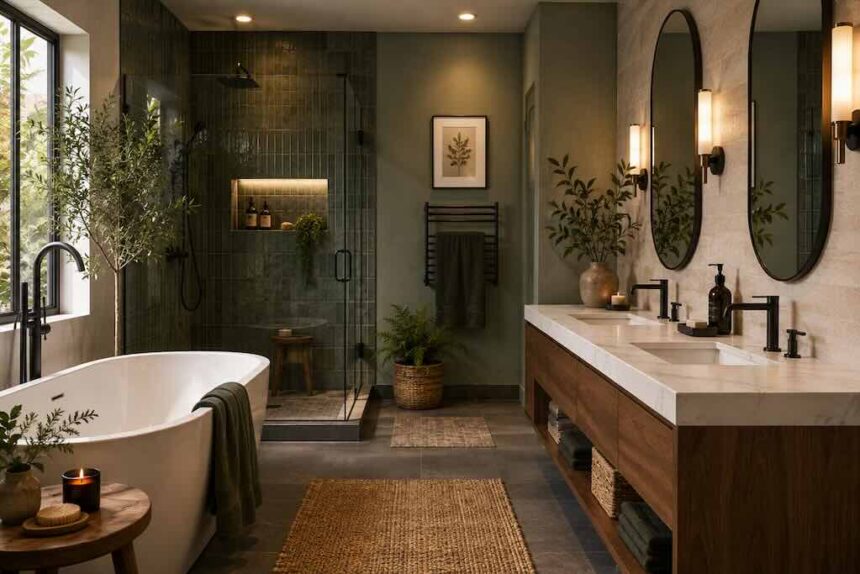
Muted olive, warm clay, deep blue, mushroom and other earthy shades can give the room considerably more depth, particularly when they’re paired with natural wood, stone or warm metallic details.
If committing to colour across the entire bathroom feels like too much, use it above tiled areas or on a single wall. Wallpaper can work beautifully too, particularly in a powder room, although bathrooms with regular steam and splashing need finishes specifically suited to humid environments.
Bring in wood — carefully
Bathrooms contain plenty of hard surfaces: tile, glass, porcelain, metal. A little wood interrupts all of that coolness.
You don’t need a timber-clad spa to achieve the effect. A wooden stool beside the bath, framed mirror, vanity or simple shelf can be enough to make the room feel warmer and more lived in.
Moisture matters, however. Choose materials and finishes appropriate for bathrooms, maintain ventilation and avoid placing vulnerable timber where it will be repeatedly soaked.
Make the vanity work harder
A beautiful vanity covered in toothbrushes, bottles, cables and half-used skincare products quickly stops looking beautiful.
This is one place where good design is really about what you don’t see.
Drawers are particularly useful because they allow everyday products to remain accessible without occupying the countertop. Drawer dividers, concealed sockets where appropriate, trays and small organisers can make an existing vanity considerably easier to live with.
If replacement is necessary, think about storage before choosing the prettiest countertop. The vanity you can comfortably use at 7 a.m. will ultimately feel more luxurious than one designed mainly for photographs.
Use greenery as a finishing layer
One or two plants can soften a bathroom almost instantly, particularly against stone, white tile or darker painted walls.
But don’t assume every plant loves a bathroom simply because the room gets humid. Light is just as important. A bathroom with a bright window offers very different growing conditions from an internal room with almost no natural daylight.
Choose plants according to the actual conditions in the room rather than the photograph you’re trying to recreate. Sometimes one healthy plant on a windowsill looks considerably better than an attempted indoor jungle struggling to survive.
Let one mirror do the decorating
If there is one change capable of altering a bathroom without occupying any additional floor space, it may be the mirror.
An oversized mirror can bounce light around the room and make a compact bathroom feel more open. An unusual shape or beautiful frame can also become the decorative focal point, reducing the need to fill every wall with accessories.
Scale is the trick. Rather than automatically choosing a small mirror because the bathroom is small, look at the width of the vanity and the amount of empty wall above it. A more generous mirror can often make the entire arrangement feel intentional.
And don’t forget the lighting
This may be the upgrade that changes the atmosphere most.
A single harsh ceiling light can make even an expensive bathroom feel clinical. Layered lighting gives you options: brighter, practical illumination around the mirror when you’re getting ready and softer light when the room needs to wind down with you.
Then stop decorating.
A bathroom doesn’t need fifteen accessories to feel finished. Fresh towels, a good mirror, somewhere sensible to put things and a few materials that feel pleasant under your hands can do far more.
The most convincing bathrooms aren’t necessarily the ones that look like spas. They’re the ones that make an ordinary Tuesday morning feel unexpectedly good.